North Island Brown Kiwi – New Zealand’s Iconic Flightless Bird

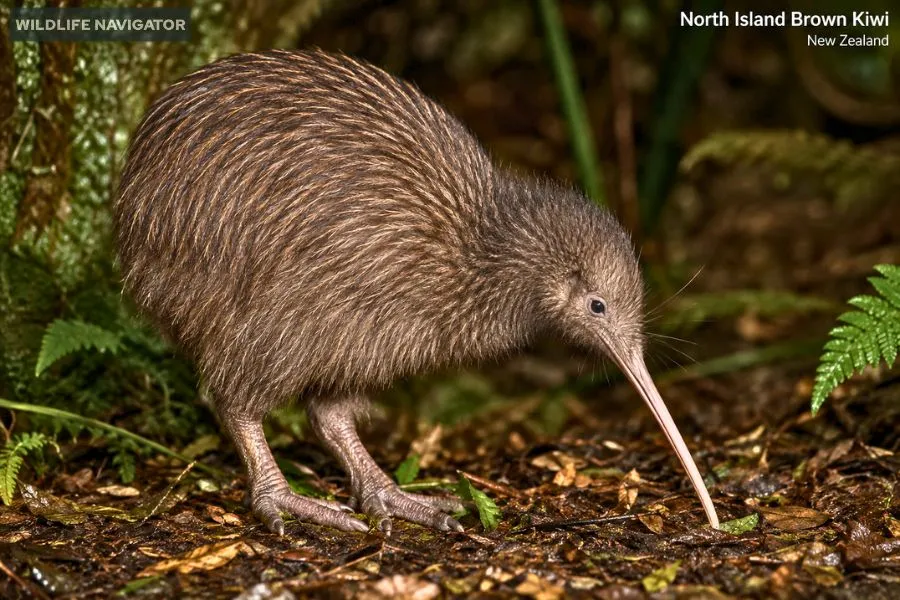
The North Island Brown Kiwi (Apteryx mantelli) is a flightless bird endemic to New Zealand’s North Island and one of the country’s most recognizable native species. With its shaggy brown feathers, long slender bill, powerful legs, and compact body, it is uniquely adapted to life on the forest floor.
Unlike most birds, the Brown Kiwi is primarily nocturnal and relies heavily on its exceptional sense of smell to find earthworms, insects, and other food hidden beneath soil and leaf litter. Its nostrils are positioned at the tip of its bill, an unusual adaptation that helps it locate prey while foraging in darkness.
Although Brown Kiwis have survived for centuries in New Zealand’s forests, introduced predators and habitat loss have placed many populations under pressure. Conservation programs, predator control, and habitat protection are helping safeguard the species. In this guide, we explore the Brown Kiwi’s appearance, habitat, behavior, diet, reproduction, unique adaptations, threats, conservation, and where it can be found in New Zealand.
Quick Facts About Brown Kiwi
| Feature | Information |
|---|---|
| Common Name | Brown Kiwi |
| Other Name | North Island Brown Kiwi |
| Scientific Name | Apteryx mantelli |
| Family | Apterygidae |
| Order | Apterygiformes |
| Class | Aves |
| Diet | Omnivorous |
| Habitat | Native forests, shrublands, and farmland |
| Distribution | North Island, New Zealand |
| Length | About 40 cm (16 in) |
| Weight | About 2 kg (4.4 lb) male; 2.7 kg (6 lb) female |
| Lifespan | 25–50 years in the wild |
| Activity | Nocturnal |
| Conservation Status (DOC New Zealand) | DOC currently lists the species as Not Threatened (conservation dependent) under New Zealand’s conservation classification. |
Scientific Classification
The North Island Brown Kiwi belongs to the kiwi family Apterygidae and the order Apterygiformes. Its scientific name is Apteryx mantelli. Brown Kiwi are one of the five recognized living kiwi species found in New Zealand.
| Rank | Classification |
|---|---|
| Kingdom | Animalia |
| Phylum | Chordata |
| Class | Aves |
| Order | Apterygiformes |
| Family | Apterygidae |
| Genus | Apteryx |
| Species | Apteryx mantelli |
The genus Apteryx contains all living kiwi species. The North Island Brown Kiwi is the species most commonly associated with the name Brown Kiwi and is native to New Zealand’s North Island.
Physical Characteristics
The North Island Brown Kiwi has a distinctive appearance unlike that of most other birds. Its compact body, shaggy feathers, long bill, powerful legs, and reduced wings reflect its highly specialized adaptation to life on the forest floor.
Size and Weight
The Brown Kiwi is a medium-sized flightless bird measuring about 40 cm (16 inches) in length. Females are noticeably larger and heavier than males, with males weighing around 2 kg (4.4 lb) and females around 2.7 kg (6 lb).
Shaggy, Hair-Like Feathers
Instead of the smooth, stiff feathers associated with many birds, the Brown Kiwi has loose, hair-like feathers that give its body a shaggy appearance. Their brown coloration provides camouflage among leaf litter, vegetation, and forest-floor debris.
Long Bill with Nostrils at the Tip
One of the Brown Kiwi’s most unusual features is its long, slender bill. Unlike most birds, its nostrils are positioned near the tip of the bill, helping it detect food while probing soil and leaf litter.
Tiny Wings
Although the Brown Kiwi is a bird, its wings are extremely reduced and have no practical function in flight. They remain hidden beneath its feathers and are one of the features associated with the species’ flightless lifestyle.
Powerful Legs and Feet
The Brown Kiwi has strong, muscular legs and large feet adapted for walking, running, digging, and moving through dense vegetation. Its feet also have strong claws that can be used for digging and defense.
No External Tail
The Brown Kiwi has no visible external tail, giving its body a rounded, compact appearance. This is another distinctive feature that separates it from most other birds.
Sensitive Facial Bristles
Fine, whisker-like feathers around the bill and face help the Brown Kiwi detect objects at close range as it moves through dense vegetation and forages in darkness.
Why Can’t Brown Kiwis Fly?
The North Island Brown Kiwi is naturally flightless, with several anatomical features that distinguish it from flying birds. Its wings are extremely small and vestigial, while its breastbone lacks the prominent keel that flying birds use to anchor powerful flight muscles. Its wing and chest muscles are also greatly reduced, making powered flight impossible.
Instead of being adapted for life in the air, the Brown Kiwi is highly specialized for moving and foraging on the forest floor. Its strong legs and feet allow it to walk, run, dig, and navigate dense vegetation, while its long bill and highly developed sense of smell help it locate food beneath leaf litter and soil.
Kiwi evolved in New Zealand in relative isolation from many of the mammalian predators found on other continents. Over time, this unusual island environment favored a ground-dwelling lifestyle, allowing kiwi to develop a distinctive combination of flightlessness, powerful legs, reduced wings, and nocturnal behavior. Today, these adaptations make the Brown Kiwi one of the world’s most unusual birds.
Habitat and Distribution
The North Island Brown Kiwi is endemic to New Zealand’s North Island, meaning it occurs naturally nowhere else in the world. It is the most widespread of New Zealand’s kiwi species and occupies a variety of habitats, including native forests, scrubland, plantation forests, wetlands, rough farmland, and some subalpine areas.
Brown Kiwis spend much of their time on or close to the forest floor. During the day, they shelter in burrows, hollow logs, dense vegetation, fallen vegetation, or other protected locations. At night, they emerge to forage for invertebrates and other food using their long bills and highly developed sense of smell.
Brown Kiwi populations are distributed across several parts of the North Island, although their range is no longer continuous. Many populations now survive in protected areas, predator-controlled forests, sanctuaries, offshore islands, and landscapes where local communities actively manage kiwi habitat.
Where Are Brown Kiwis Found?
Brown Kiwi occur in parts of:
- Northland
- Auckland region
- Coromandel Peninsula
- Waikato
- Bay of Plenty
- Taranaki
- East Coast
- Hawke’s Bay
- Central North Island
- Lower North Island
Important populations also occur in areas such as Tongariro Forest, Pureora Forest, and other protected or predator-managed forests and sanctuaries.
Several offshore islands and protected sanctuaries also support Brown Kiwi populations, including areas where birds have been translocated as part of conservation programs.
Four Geographical Forms Recognized for Management
The North Island Brown Kiwi (Apteryx mantelli) is a single species with four geographically distinct forms recognized for management purposes: Northland, Coromandel, Western, and Eastern brown kiwi. These forms are genetically differentiated but are not formally recognized as separate species or subspecies.
| Brown Kiwi form | Main distribution |
|---|---|
| Northland Brown Kiwi | Northland and the far north of the North Island |
| Coromandel Brown Kiwi | Coromandel Peninsula and surrounding areas |
| Western Brown Kiwi | Western and central parts of the North Island |
| Eastern Brown Kiwi | Eastern North Island, including parts of the East Coast and Hawke’s Bay |
Northland Brown Kiwi
The Northland Brown Kiwi occurs in northern New Zealand, including areas around Northland. Conservation efforts in this region include predator control, habitat restoration, and community-led kiwi protection.
Coromandel Brown Kiwi
The Coromandel Brown Kiwi is found in the Coromandel region. Conservation programs have also established populations on predator-free islands, including Motutapu, as part of efforts to strengthen the wider Coromandel population.
Western Brown Kiwi
The Western Brown Kiwi occurs across parts of the western and central North Island. Important conservation areas include managed forests such as Tongariro Forest and other predator-controlled habitats.
Eastern Brown Kiwi
The Eastern Brown Kiwi occurs in parts of the eastern North Island, particularly around the East Coast and Hawke’s Bay regions. Like the other forms, its survival depends heavily on predator control and protection of suitable habitat.
National parks where Brown Kiwi are found
North Island Brown Kiwi occur in several protected areas across New Zealand’s North Island. Among the national parks with documented Brown Kiwi populations are Tongariro National Park and Whanganui National Park.
- Tongariro National Park: North Island Brown Kiwi live in the forested areas of Tongariro National Park, as well as the adjacent Tongariro Forest Conservation Area. DOC notes that the Tongariro Forest area supports a monitored kiwi sanctuary population.
- Whanganui National Park: The park supports a major population of North Island Brown Kiwi. DOC states that the park is home to the largest population of North Island Brown Kiwi in New Zealand, with several thousand birds present. Kiwi occur throughout the park’s forest habitats, and visitors may sometimes hear them calling at night.
Important distinction – Brown Kiwi also occur in many forests, conservation areas, sanctuaries, private lands, and offshore islands that are not national parks. For example, Tongariro Forest Conservation Area is an important kiwi sanctuary but is separate from Tongariro National Park.
Behavior
The Brown Kiwi is a shy and secretive bird that is rarely seen in the wild. Its nocturnal lifestyle and preference for dense vegetation help it avoid predators while reducing competition with other birds.
Nocturnal Lifestyle
Brown Kiwis are most active from dusk until dawn. They spend the night searching for food, patrolling their territory, and communicating with mates through distinctive calls. During daylight hours, they remain hidden in sheltered burrows or dense vegetation.
Territorial Nature
Adult Brown Kiwis are highly territorial and defend their home range throughout the year. Male Brown Kiwi produce higher-pitched calls, while females produce deeper, guttural calls. Pairs use these calls to maintain contact and defend their territories.
Burrow Construction
Brown Kiwis create or occupy underground burrows that provide protection from weather and predators. A single bird may use dozens of different burrows within its territory, rotating between them regularly to reduce the risk of detection.
Communication
Although rarely seen, Brown Kiwis are often heard. Males and females produce loud, high-pitched calls that help partners maintain contact and warn neighboring birds that a territory is occupied. Male and female calls differ in pitch, making them recognizable to experienced observers.
Diet
The Brown Kiwi is primarily an invertebrate feeder, using its long bill to probe soil, leaf litter, and decaying wood for food. Earthworms, insect larvae, and other soil-dwelling invertebrates make up an important part of its diet, while fruits and other plant material are also consumed.
Its diet commonly includes:
- Earthworms
- Beetles
- Beetle larvae
- Spiders
- Centipedes
- Snails and slugs
- Insects
- Fruits
- Seeds
- Berries
- Fungi
The bird probes the ground with its long bill, detecting prey using sensitive nostrils located at the tip. Once food is located, it quickly extracts worms and insects from the soil with remarkable precision.
Because Brown Kiwis consume a diverse range of organisms throughout the year, they play an important role in maintaining healthy forest ecosystems by helping regulate invertebrate populations and dispersing the seeds of some native plants.
Reproduction and Life Cycle
North Island Brown Kiwis have a distinctive reproductive system. They form territorial pairs, and unlike many birds, the male does most of the work of incubating the eggs. Brown Kiwi can produce more than one egg and, under suitable conditions, may breed more frequently than other kiwi species.
Pair Bonding and Breeding
Brown Kiwis are generally monogamous and territorial, with breeding pairs sharing overlapping territories. Breeding can occur throughout much of the year, although timing varies between populations and regions.
The female typically lays one or two large eggs, and Brown Kiwi can produce one or two clutches in a year. This gives the species a relatively high reproductive potential compared with several other kiwi species.
The Remarkably Large Kiwi Egg
The Brown Kiwi produces an exceptionally large egg relative to the female’s body size. The egg contains a large yolk that provides the developing chick with substantial energy before and immediately after hatching.
Male Incubation
One of the most unusual features of Brown Kiwi reproduction is that the male incubates the egg. In North Island Brown Kiwi, the male generally performs the incubation alone. Incubation lasts approximately 70–80 days, which is exceptionally long for a bird.
During this period, the male remains close to the nest and periodically leaves to feed. The female may remain nearby within the pair’s territory.
Hatching and Chicks
Brown Kiwi chicks hatch fully feathered and relatively well developed. They are precocial, meaning they are capable of moving around soon after hatching rather than remaining helpless in a nest. A newly hatched Brown Kiwi weighs roughly 300 g.
Young kiwi remain vulnerable to introduced predators, particularly stoats, until they become large enough to defend themselves. Predator control and conservation programs therefore play an important role in improving chick survival.
Unique Adaptations
The North Island Brown Kiwi has evolved a remarkable set of adaptations for life on the forest floor. Rather than relying on flight or keen eyesight, it uses its sense of smell, touch, powerful legs, specialized bill, and unusual feathers to navigate and forage in dark, dense habitats.
Exceptional Sense of Smell
Unlike most birds, the Brown Kiwi has a highly developed sense of smell and uses it while searching for prey beneath soil and leaf litter. Its nostrils are positioned near the tip of its long bill, allowing it to detect food as it probes the ground.
Nostrils at the Tip of the Bill
The position of the nostrils is one of the Brown Kiwi’s most unusual adaptations. As the bird pushes its bill into soil, leaf litter, and decaying vegetation, the nostrils are close to the area being investigated. This helps the kiwi detect potential prey while foraging.
Hair-Like Feathers
Brown Kiwi feathers are loose and hair-like rather than smooth and streamlined like those of many flying birds. Their soft, shaggy structure provides insulation and suits a bird that spends its life moving through dense vegetation rather than flying.
Powerful Legs and Feet
Strong legs are essential to the Brown Kiwi’s ground-based lifestyle. Its muscular legs and sturdy feet help it walk and run through dense vegetation, dig into the forest floor, and defend itself when threatened.
Sensitive Facial Bristles
Whisker-like bristles around the bill and face provide an additional sense of touch. They help the kiwi detect objects around its head as it moves through dark vegetation and searches for food.
Poor Eyesight and Nocturnal Senses
Brown Kiwi have relatively small eyes and are active mainly at night. Instead of depending primarily on vision, they rely heavily on smell and touch while navigating and feeding in darkness. This combination of senses is particularly suited to their nocturnal lifestyle.
Reduced Wings and Flightlessness
The Brown Kiwi’s wings are extremely small and serve no role in powered flight. Its body is instead specialized for terrestrial movement, with strong legs and feet replacing flight as its primary means of locomotion.
Predators and Threats
FThe North Island Brown Kiwi faces its greatest threats from introduced predators, habitat loss, and human-related impacts. Although the species is currently classified as Not Threatened (conservation dependent) in New Zealand, its populations can decline rapidly where effective predator control is absent. DOC estimates that the Brown Kiwi population is about 26,000 and warns that ongoing conservation support is essential.
Introduced Predators
New Zealand’s native wildlife evolved without the range of terrestrial mammalian predators introduced by humans. Brown Kiwi are particularly vulnerable because they spend much of their lives on the ground and have limited defenses against these predators.
Dogs
Dogs are one of the most serious threats to adult Brown Kiwi. Even a single encounter can kill a kiwi, and uncontrolled dogs can cause severe declines in local populations. DOC notes that dogs can kill kiwi regardless of their size, breed, training, or temperament.
Stoats
Stoats are especially dangerous to young kiwi. Kiwi chicks remain vulnerable to stoats until they reach roughly 1 kg, after which they can generally defend themselves against them.
Ferrets
Ferrets can prey on both young and adult kiwi and are therefore an important target of predator-control programs. DOC specifically identifies adult kiwi as vulnerable to ferrets and recommends controlling them at kiwi translocation sites.
Cats
Cats can prey on young kiwi and are among the predators that need to be controlled around kiwi populations.
Habitat Loss
The loss and fragmentation of suitable habitat has contributed to the disappearance of Brown Kiwi from many areas where they once occurred. New Zealand Birds Online notes that North Island Brown Kiwi have disappeared from many lowland sites and parts of their former range because of a combination of habitat loss and predation by introduced mammals.
Habitat protection is therefore an important part of long-term kiwi conservation, alongside predator control.
Roads and Human Activity
Brown Kiwi increasingly live close to people in some parts of the North Island. This creates additional risks from roads, vehicles, domestic dogs, and other human activities. DOC specifically notes increased contact with dogs and cars as a risk associated with the species’ proximity to human habitation.
Small and Isolated Populations
Small populations face additional risks, including reduced genetic diversity, inbreeding, difficulty finding mates, and vulnerability to localized events such as fire, disease, or sudden increases in predators.
Why Predator Control Matters
Predator control can dramatically improve kiwi survival. DOC monitoring has shown that predator-control operations can substantially increase kiwi chick survival; long-term research in Tongariro Forest found much higher chick survival following aerial 1080 operations.
Conservation programs therefore combine predator control, habitat protection, monitoring, translocation, and community involvement to protect Brown Kiwi populations.
Conservation Status
The North Island Brown Kiwi (Apteryx mantelli) is currently classified as Not Threatened (conservation dependent) under New Zealand’s conservation status system. However, this does not mean the species is free from risk. The population is continuing to decline in areas without effective predator control, and its long-term survival depends heavily on ongoing conservation management. DOC currently estimates the Brown Kiwi population at around 26,000 birds.
Brown Kiwi have disappeared from many parts of their former range because of introduced predators, habitat loss, and other human impacts. Their close proximity to people can create additional risks from dogs, cats, vehicles, and habitat development, but it also allows communities to play an important role in their protection.
Major Conservation Efforts
Conservation programs for Brown Kiwi focus on several key approaches:
- Predator control to reduce deaths from stoats, ferrets, cats, and other introduced predators
- Dog control and kiwi-avoidance programs to protect adult birds
- Habitat restoration to improve and reconnect suitable forest and shrubland
- Population monitoring through call counts, radio tracking, and other methods
- Translocation to establish or strengthen populations in suitable predator-managed areas
- Community conservation projects involving landowners, iwi, volunteers, and conservation organizations
Predator control can have a substantial effect on kiwi survival. Long-term DOC research in Tongariro Forest found that kiwi chicks had a much greater chance of surviving following aerial 1080 predator-control operations.
Why Conservation Is Still Necessary
Although Brown Kiwi are not currently classified as threatened under the New Zealand status system, “Not Threatened” should not be interpreted as “secure without intervention.” DOC describes the species as conservation dependent and warns that, without ongoing support, experts estimate Brown Kiwi could become extinct in the wild within two generations.
The species’ recovery therefore depends on maintaining predator control, protecting habitat, monitoring populations, and continuing community-led conservation.
Ecological Importance
The North Island Brown Kiwi plays an important role in New Zealand’s forest-floor ecosystem. As a nocturnal soil-feeding bird, it searches through leaf litter, soil, and decaying wood for invertebrates, making it an active predator within the forest-floor food web.
Forest-Floor Foraging
Brown Kiwi spend much of their active period probing the ground and rotting wood for food. Their diet includes earthworms, insect larvae, wētā, crickets, centipedes, moths, spiders, and other invertebrates. This makes their foraging activity an important part of the ecological interactions taking place in forest soils and leaf litter.
Moving Through and Disturbing Soil
While searching for prey, Brown Kiwi use their long bills to probe soil and decaying material, leaving distinctive holes in the ground. Their feeding behavior therefore interacts directly with the forest-floor environment as they search for buried and surface-dwelling invertebrates.
Part of the Forest Food Web
Brown Kiwi are also part of a wider network of native species that depends on healthy forest ecosystems. Their reliance on soil invertebrates links them closely to the condition of the forest floor, while their own survival depends on suitable habitat and functioning ecosystems.
The importance of protecting Brown Kiwi therefore extends beyond the species itself. Conserving kiwi habitat also helps protect the native forests and wider communities of plants and animals with which they are associated.
Brown Kiwi vs Other Kiwi Species
The North Island Brown Kiwi (Apteryx mantelli) is one of five living kiwi species found in New Zealand. The other four are the Great Spotted Kiwi, Little Spotted Kiwi, Rowi, and Tokoeka.
Although all kiwi share distinctive traits such as flightlessness, nocturnal behavior, strong legs, and hair-like feathers, they differ in distribution, size, appearance, habitat, and conservation status.
| Kiwi species | Main distribution | Key distinction |
|---|---|---|
| North Island Brown Kiwi (Apteryx mantelli) | North Island | Most widespread kiwi species; four recognized forms |
| Great Spotted Kiwi (Apteryx haastii) | South Island | Largest kiwi species |
| Little Spotted Kiwi (Apteryx owenii) | Mainly predator-free islands | Smallest kiwi species |
| Okarito Kiwi / Rowi (Apteryx rowi) | Okarito, South Island | One of the rarest kiwi species |
| Tokoeka (Apteryx australis) | South Island and Stewart Island | Several geographically distinct forms |
The Brown Kiwi is particularly notable because it occurs close to human communities across parts of the North Island and has benefited from extensive community-led predator control and habitat restoration.
Interesting Facts About the Brown Kiwi
The Brown Kiwi is one of the world’s most unusual birds. Here are some fascinating facts that make this species truly unique:
- Brown Kiwi are one of five living kiwi species found in New Zealand.
- Their nostrils are located near the tip of the bill, an unusual feature among birds that helps them detect food while probing the ground.
- Brown Kiwi have loose, hair-like feathers rather than the smooth feathering typically associated with flying birds.
- They cannot fly, with tiny vestigial wings and a body specialized for life on the forest floor.
- Brown Kiwi can produce up to two eggs per clutch and one to two clutches per year, giving them a higher reproductive rate than most other kiwi species.
- Male Brown Kiwi incubate the eggs, an unusual reproductive trait among birds.
- Kiwi chicks hatch fully feathered and begin leaving the nest to feed at around five days old.
- Young kiwi are not fed by their parents. After leaving the nest, chicks forage for themselves.
- Brown Kiwi can live for decades. DOC states that kiwi can live between about 25 and 50 years, although longevity varies among species and populations.
- Brown Kiwi can live surprisingly close to people. DOC describes them as the kiwi species living closest to human habitation, with populations occurring around communities in several parts of the North Island.
- They are powerful runners despite being flightless, using their strong legs and feet to move through dense vegetation.
- A Northland Brown Kiwi named Noodle travelled nearly 4 km from where she hatched before establishing a territory.
Where to See Brown Kiwi in New Zealand
North Island Brown Kiwi can be found in forests, scrubland, farmland, and protected areas across parts of New Zealand’s North Island. However, seeing one in the wild can be challenging because Brown Kiwi are nocturnal, secretive, and often active in dense vegetation.
Places to See Brown Kiwi in the Wild
Some important areas supporting Brown Kiwi populations include:
- Whangārei and Northland — home to Northland Brown Kiwi and the Whangārei Kiwi Sanctuary.
- Coromandel Peninsula — supports Coromandel Brown Kiwi, including populations protected through intensive predator management.
- Tongariro Forest — an important area for Western Brown Kiwi and the location of the Tongariro Forest Kiwi Sanctuary.
- Sanctuary Mountain Maungatautari — one of the major predator-controlled areas supporting thousands of North Island Brown Kiwi.
Brown Kiwi also occur in other protected forests, sanctuaries, and community-managed areas across the North Island. DOC notes that the species lives particularly close to human habitation compared with other kiwi species, including communities in Northland, Coromandel, Bay of Plenty, East Coast/Hawke’s Bay, and parts of Taranaki.
Where to See Brown Kiwi More Easily
Because wild kiwi sightings are unpredictable, nocturnal houses and captive conservation facilities can provide a much more reliable opportunity to see Brown Kiwi. DOC notes that captive facilities are an important part of kiwi conservation and that Brown Kiwi are the main kiwi species represented in captivity.
For example, Otorohanga Kiwi House and the National Kiwi Hatchery are among the places promoted by Tourism New Zealand for experiencing kiwi and learning about conservation.
Best Time to Look for Brown Kiwi
Brown Kiwi are primarily nocturnal, so after sunset and during the night is when they are most active. If visiting a protected area where kiwi occur, follow local rules and use designated guided experiences rather than entering the forest at night independently.
A very important wildlife-watching note
I would add a short warning here:
Do not approach, chase, call, or attempt to photograph a wild kiwi at close range. Kiwi can be easily disturbed, and visitors should follow the instructions of local conservation organizations and guides.
Conclusion
The North Island Brown Kiwi (Apteryx mantelli) is one of New Zealand’s most distinctive birds. Its flightlessness, hair-like feathers, powerful legs, unusual bill, and exceptional sense of smell have made it highly specialized for life on the forest floor.
Yet the Brown Kiwi’s survival depends heavily on conservation. Introduced predators, dogs, habitat loss, and other human pressures continue to threaten unmanaged populations. At the same time, predator control, habitat protection, monitoring, translocation, and community-led conservation are helping protect and restore populations across the North Island.
The Brown Kiwi is therefore more than an unusual flightless bird. It is a symbol of New Zealand’s unique natural heritage—and a reminder that protecting native wildlife requires continued effort. With effective conservation and community support, the distinctive call of the Brown Kiwi can continue to be heard in New Zealand’s forests for generations to come.
Frequently Asked Questions (FAQs)
Sources:
- New Zealand Department of Conservation (DOC)
- New Zealand Birds Online
- DOC — Tongariro National Park Flora & Fauna
- DOC — Whanganui National Park: Nature and Conservation
- Department of Conservation/Te Papa Atawhai
- Wikipedia -North Island brown kiwi
- Kiwi (Apteryx spp.) recovery plan 2008–2018
- Peer-reviewed research where necessary

Curating and documenting wildlife and protected areas through detailed guides and the continuously updated WN Index.
- Rosan Prasad

- Rosan Prasad

- Rosan Prasad

- Rosan Prasad