Red-tailed Hawk: Identification, Habitat, Diet, Behaviour and Facts

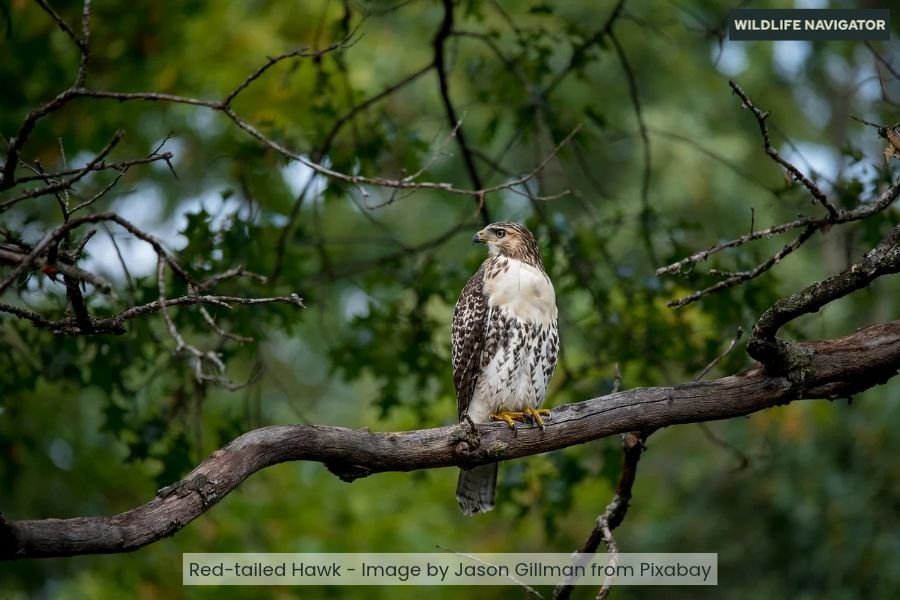
The Red-tailed Hawk (Buteo jamaicensis) is a large bird of prey native to North America and one of the continent’s most widely distributed hawk species. It belongs to the family Accipitridae, which also includes eagles, kites and other hawks. The species is recognised by its broad wings, sturdy body, hooked bill and, in most adult individuals, a distinctive reddish-brown tail.
Red-tailed Hawks inhabit a variety of landscapes, including grasslands, deserts, forests, agricultural areas and urban environments. They are particularly associated with open habitats where they can watch for prey from elevated perches or soar above the ground. Their diet consists mainly of small mammals, although they also hunt birds, reptiles, amphibians and other available animals.
As adaptable predators, Red-tailed Hawks play an important role in their ecosystems by helping regulate populations of small mammals and other prey. Their ability to use different habitats, exploit varied food sources and adjust their hunting techniques has contributed to their widespread distribution across North America.
Scientific Classification of the Red-tailed Hawk
| Taxonomic Rank | Classification |
|---|---|
| Kingdom | Animalia |
| Phylum | Chordata |
| Class | Aves |
| Order | Accipitriformes |
| Family | Accipitridae |
| Subfamily | Buteoninae |
| Genus | Buteo |
| Species | Buteo jamaicensis |
| Common Name | Red-tailed Hawk |
Scientific name: Buteo jamaicensis
First described by: Johann Friedrich Gmelin, 1788.
Taxonomic note: The Red-tailed Hawk belongs to the genus Buteo, a group of broad-winged raptors commonly known as buzzards in much of the Old World and hawks in North America.
Physical Characteristics and Identification
The Red-tailed Hawk is a medium-to-large raptor with a robust body, broad wings and a relatively short, wide tail. Its appearance varies considerably between individuals and geographic populations, but adult birds are generally identifiable by their reddish upper tail, pale underside and dark band of markings across the belly.
Body size and weight
Adult Red-tailed Hawks typically measure approximately 45–65 cm (18–26 inches) in body length, with a wingspan of around 110–145 cm (43–57 inches). Their weight generally ranges from approximately 690 to 1,460 grams (1.5–3.2 pounds), although females are usually heavier and larger than males.
Females are noticeably larger than males, a characteristic form of sexual size dimorphism commonly found among birds of prey. This difference can be useful when comparing members of an established breeding pair, although size alone is not always sufficient to determine an individual bird’s sex in the field.
Plumage and distinctive features
The most recognisable feature of an adult Red-tailed Hawk is its reddish-brown tail, which is particularly noticeable when the bird is perched or flying overhead. The upperparts are generally brown, while the underside is usually pale, ranging from whitish to cream.
Many individuals have a dark band of streaked feathers across the lower breast or belly, often referred to as a belly band. The head is typically brown, and the throat and chest may appear lighter.
Its wings are broad and rounded, allowing it to soar efficiently on rising air currents. The flight feathers are generally darker than the underwing coverts, producing a characteristic pattern visible when viewed from below.
Like other raptors, the Red-tailed Hawk has a strongly hooked bill for tearing prey and powerful feet equipped with sharp, curved talons for capturing and holding animals.
Male, female and juvenile differences
Adult males and females have broadly similar plumage, making them difficult to distinguish visually without comparing their sizes. Females are generally larger and heavier, while males are smaller but similarly marked.
Juvenile Red-tailed Hawks have brown, banded tails rather than the characteristic reddish tail of adults. Their plumage is often more heavily streaked underneath, and their overall appearance can vary depending on their age and geographic population.
Young birds gradually acquire adult plumage as they mature. The reddish tail becomes more prominent after their first year, although the precise timing of plumage development can vary.
Colour variations and morphs
Red-tailed Hawks display considerable variation in plumage. Individuals are commonly classified into three broad colour categories:
- Light morph: The most familiar appearance, with pale underparts, brown upperparts and a dark belly band.
- Dark morph: Much darker overall, with extensive dark brown or nearly black plumage.
- Intermediate morph: Shows characteristics between the light and dark forms, with varying amounts of brown and pale plumage.
These colour differences are natural variations within the species rather than separate species. Their frequency also varies geographically, with darker forms occurring more commonly in certain western and northern populations.
Distribution and Geographic Range
The Red-tailed Hawk has an extensive geographic range across North America, making it one of the most widely distributed raptors on the continent. Its native range extends from Alaska and Canada through the United States and Mexico, reaching parts of Central America and several Caribbean islands.
In Canada and the United States, the species occurs across a wide range of regions, including temperate forests, grasslands, agricultural landscapes, deserts and mountainous areas. It is also found throughout much of Mexico, where different populations occupy habitats ranging from lowland landscapes to higher elevations.
The species is represented by several recognised subspecies, which differ in geographic distribution and certain physical characteristics. These regional forms reflect adaptations to different climates and habitats across its extensive range.
Resident and migratory populations
Not all Red-tailed Hawks migrate. Many individuals living in warmer regions remain in the same general area throughout the year, while populations breeding in northern parts of North America commonly move south during the colder months.
Migration is influenced by seasonal temperatures, food availability and breeding conditions. Northern populations may travel considerable distances to reach wintering areas in the southern United States and Mexico.
During migration, Red-tailed Hawks often use rising warm air currents, known as thermals, to gain altitude and travel efficiently. They may also be observed gathering at migration routes and favourable locations where atmospheric conditions support soaring flight.
Some individuals remain close to their breeding territories throughout the year, particularly where prey remains available during winter.
Habitat and Preferred Environment
Red-tailed Hawks occupy a wide range of habitats, demonstrating considerable ecological flexibility. Although they are commonly associated with open landscapes, they can also live in wooded environments, mountainous regions and human-modified areas.
Their habitat preferences are closely connected to the availability of prey, suitable nesting locations and elevated perches from which they can observe their surroundings.
Natural habitats
The species is frequently found in grasslands, prairies, savannas and agricultural landscapes. These environments provide open ground where small mammals can be detected and captured.
Woodland edges and open forests are also important habitats. Tall trees provide nesting locations and elevated observation points, while nearby clearings offer suitable hunting grounds.
In western North America, Red-tailed Hawks inhabit deserts, shrublands and semi-arid landscapes. They may use rocky outcrops, isolated trees and elevated structures as hunting perches.
The species also occurs in mountainous regions, where it can occupy valleys, foothills and open slopes.
Adaptation to human-modified environments
Red-tailed Hawks are frequently observed in agricultural areas, where fields and grasslands support populations of mice, voles, rabbits and other small animals. Fence posts, utility poles and isolated trees provide convenient hunting perches.
They have also adapted to suburban and urban environments. Parks, roadside corridors, golf courses, cemeteries and other open green spaces can provide suitable feeding and nesting opportunities.
Tall buildings, communication structures and other elevated locations may occasionally be used for perching or nesting. However, the suitability of these environments depends on the availability of prey and the level of human disturbance.
Diet and Feeding Habits
The Red-tailed Hawk is a carnivorous predator with a varied diet consisting mainly of small mammals. Its feeding habits are opportunistic, meaning it takes advantage of prey that is locally available and relatively easy to capture.
Although small mammals make up a significant proportion of its diet, the species can hunt a wide range of animals depending on habitat, season and geographic location.
What does the Red-tailed Hawk eat?
Small mammals are among its most important food sources. Common prey includes:
- Mice and voles.
- Rabbits and hares.
- Squirrels and chipmunks.
- Ground squirrels and other rodents.
Birds are also taken, including smaller species that can be captured on the ground or in flight. Reptiles such as snakes and lizards may form part of the diet, particularly in warmer regions.
The hawk may also consume amphibians, large insects and other small animals when opportunities arise. Carrion is occasionally eaten, although the species primarily obtains food through hunting live prey.
The exact composition of its diet varies considerably across its range. In grassland environments, rodents and rabbits may be particularly important, while reptiles can contribute more substantially in warmer and drier habitats.
Hunting techniques
Red-tailed Hawks use several hunting techniques depending on the landscape and type of prey.
Perch hunting is one of their most familiar methods. The bird sits on a tree branch, fence post, utility pole or another elevated location and scans the surrounding ground for movement. Once it identifies suitable prey, it descends rapidly and attempts to capture the animal with its talons.
Soaring and aerial hunting involve flying above open habitats while searching for prey. The hawk uses its excellent vision to identify potential targets from a considerable distance before descending towards them.
It may also use low-level flight to approach prey while remaining relatively close to the ground. The final attack is generally carried out with a rapid downward movement, allowing the bird to seize its target with its powerful feet.
Feeding behaviour
After capturing prey, the Red-tailed Hawk usually kills it using its talons before tearing it apart with its hooked bill. Smaller animals may be consumed relatively quickly, while larger prey can require more time and may be eaten in several feeding sessions.
The hawk’s feeding habits are strongly influenced by seasonal prey availability. During periods when rodents and other small mammals are abundant, these animals may dominate its diet. In other conditions, it may rely more heavily on alternative prey.
Behaviour and Daily Activities
Red-tailed Hawks are primarily diurnal, meaning they are active during daylight hours. Much of their daily activity involves searching for food, defending territories, maintaining pair relationships and resting at suitable perches.
Although they are generally solitary hunters, they may spend considerable time interacting with their mates, particularly during the breeding season.
Flight and movement
The Red-tailed Hawk is an accomplished flier with broad, rounded wings and a relatively short tail. These physical characteristics allow it to remain airborne for extended periods while searching for prey.
It frequently uses thermals, which are columns of rising warm air, to gain altitude without continuously flapping its wings. By circling within these air currents, the hawk can travel across large areas while conserving energy.
During hunting, it may alternate between soaring, gliding and controlled descents. When it identifies prey, it can rapidly change direction and dive towards the target.
Its flight is generally steady and powerful, although wingbeats become more noticeable when it is travelling against strong winds or gaining altitude without assistance from rising air currents.
Territorial behaviour
Red-tailed Hawks are territorial, particularly during the breeding season. Established pairs defend areas around their nesting sites and may actively drive away other raptors that approach too closely.
They are known to chase competing hawks, eagles and even Great Horned Owls. Such interactions may involve aerial pursuit, aggressive flight displays and repeated vocalisations.
Territorial defence helps protect nesting locations and reduces competition for important resources, including food and suitable nesting sites.
Social behaviour
Outside the breeding season, Red-tailed Hawks are generally solitary. They often hunt independently and use separate perching locations within their respective territories.
However, established breeding pairs commonly remain together for multiple years and may stay together throughout their lives if both individuals survive.
They maintain their pair relationships through courtship displays, vocal communication and shared nesting activities.
Communication and vocalisations
The Red-tailed Hawk produces a distinctive, harsh, raspy scream that is one of its most recognisable characteristics. Its call is frequently associated with large birds of prey in films and television, sometimes being used as a sound effect for other species, including eagles.
The call is used in several situations, including territorial defence, communication between mates and interactions around nesting sites.
Both adults and young birds vocalise, although the context and frequency of calls vary with age and behaviour. During courtship and territorial encounters, vocalisations may accompany aerial displays and chasing behaviour.
Reproduction and Breeding Behaviour
Red-tailed Hawks generally form long-term breeding partnerships and reproduce once a year. Their breeding season varies geographically, beginning earlier in warmer southern regions and later in northern parts of their range.
Reproduction involves courtship displays, nest construction or renovation, egg incubation and extended parental care.
Breeding season and courtship
The breeding season usually takes place during spring, although nesting activity can begin as early as late winter in warmer parts of North America.
Before breeding, pairs perform aerial courtship displays in which they soar in circles, chase one another and make repeated dives. During some displays, the birds may approach each other with their legs extended or briefly lock talons while flying.
These displays help reinforce pair bonds and establish breeding partnerships.
Red-tailed Hawks are generally monogamous, and many pairs remain together for several breeding seasons. Established pairs may continue using the same nesting territory for years.
Nesting habits
Red-tailed Hawks typically build their nests in the crowns or upper branches of tall trees, particularly those that provide a clear view of the surrounding landscape.
They may also nest on cliff ledges, rocky outcrops, large cacti and artificial structures such as towers or buildings.
Both members of a pair participate in nest construction or renovation. The nest is usually a bulky platform made from sticks and branches, with an inner lining of bark, leaves and other softer vegetation.
Pairs may reuse the same nest over multiple breeding seasons, repairing it and adding new material when necessary.
Eggs and incubation
The female generally lays between one and five eggs, although two or three are common. The eggs are usually white or buff-coloured and may have brown, reddish or purplish markings.
Incubation lasts approximately 28–35 days. Both parents may participate, although the female usually spends more time incubating while the male supplies much of the food.
The eggs hatch over a period of time rather than necessarily hatching simultaneously. Consequently, chicks within the same nest may differ in size and development.
Chick development and parental care
Newly hatched Red-tailed Hawks are helpless and depend entirely on their parents for warmth, protection and food.
During the early stages, the female generally remains close to the nest and feeds the chicks by tearing prey into smaller pieces. The male frequently hunts and brings food to the nesting site.
As the young grow, both parents contribute to their feeding and protection.
The chicks usually begin leaving the nest at approximately 42–46 days of age. However, fledging does not mean they are immediately independent. Young birds continue receiving food and guidance from their parents while developing their flying and hunting abilities.
They gradually become better at catching prey and navigating their surroundings before eventually leaving the parental territory.
Adaptations and Survival Strategies
The Red-tailed Hawk possesses several physical and behavioural adaptations that help it survive in different environments. Its hunting success depends on a combination of excellent vision, powerful feet, specialised feathers and flexible feeding behaviour.
Exceptional eyesight
Vision is one of the most important adaptations of the Red-tailed Hawk. Its large eyes provide excellent visual capabilities, allowing it to detect potential prey while perched or flying above open landscapes.
This ability is particularly useful when hunting small animals that may be moving through grass, shrubs or agricultural fields.
By observing subtle movements from elevated positions, the hawk can identify prey without continuously searching at ground level.
Powerful talons and hooked bill
The Red-tailed Hawk has strong feet equipped with sharp, curved talons. These specialised structures allow it to grasp, restrain and kill prey.
Its hooked bill is adapted for tearing flesh, making it easier to consume animals with fur, feathers or tough outer coverings.
Together, the feet and bill form an effective feeding system suited to its carnivorous lifestyle.
Broad wings and efficient flight
Its broad wings allow the hawk to remain airborne using relatively little energy when suitable rising air currents are available.
This adaptation is particularly important for soaring over open landscapes while searching for food. The ability to glide for extended periods also helps the bird travel between hunting locations and nesting territories.
Camouflage and plumage variation
The brown upperparts of the Red-tailed Hawk help it blend into trees, branches and other natural surroundings when perched.
Its variable plumage also means individuals can have different appearances depending on their geographic population and colour morph.
This variation is particularly noticeable among populations in western North America, where darker and intermediate forms are more frequently encountered in some regions.
Flexible feeding behaviour
The ability to hunt different types of prey is another important survival advantage. Rather than depending on a single food source, Red-tailed Hawks can consume rodents, rabbits, birds, reptiles and other available animals.
This flexibility allows them to occupy environments where prey availability changes throughout the year.
Their use of different hunting methods, including perch hunting and soaring, further increases their ability to locate food under varying environmental conditions.
Ecological Importance and Role in the Ecosystem
The Red-tailed Hawk is an important predator in many North American ecosystems. As a carnivorous bird of prey, it helps regulate populations of small mammals and contributes to the balance of food webs.
Its ecological role extends beyond hunting, as its presence reflects the availability of suitable habitats and prey populations.
Regulation of small mammal populations
Small mammals, particularly rodents, make up a substantial part of the Red-tailed Hawk’s diet. By hunting mice, voles, ground squirrels and other small animals, it contributes to controlling their populations.
This predatory activity can be particularly relevant in agricultural landscapes, where rodents may damage crops or stored food.
However, the effect of Red-tailed Hawks on prey populations depends on several factors, including local predator numbers, prey reproduction and the availability of alternative food sources.
Position in the food chain
The Red-tailed Hawk occupies a relatively high position in terrestrial food webs. It feeds on herbivorous and omnivorous animals, including rodents, rabbits and some birds and reptiles.
Although adult Red-tailed Hawks have few natural predators, their eggs and young may be vulnerable to larger raptors, mammals and other nest predators.
Great Horned Owls, for example, can compete with Red-tailed Hawks for nesting locations and may prey on young hawks.
Contribution to ecosystem balance
By consuming different prey species, Red-tailed Hawks participate in the natural regulation of animal populations. Their feeding habits connect them to several parts of the ecosystem, from grassland rodents to woodland birds and desert reptiles.
They also provide opportunities for scavengers when prey remains are left behind or when hawks occasionally consume carrion.
Their ability to occupy agricultural, suburban and natural environments makes them an important component of many different North American landscapes.
Conservation Status, Threats and Interesting Facts
The Red-tailed Hawk is a widespread and adaptable species that currently maintains a relatively healthy global population. Its ability to occupy different habitats and consume a variety of prey has helped it remain common across much of North America.
Nevertheless, the species faces several threats associated with human activities, environmental changes and habitat disturbance.
Conservation status
IUCN: Least Concern
The Red-tailed Hawk is classified as Least Concern (LC) on the International Union for Conservation of Nature (IUCN) Red List. Its population is considered to be increasing globally, and it is not currently regarded as a species facing a high risk of extinction.
According to the 2024 IUCN assessment by BirdLife International, the estimated global population is approximately 2.6–3.1 million mature individuals.
Despite its favourable conservation status, continued monitoring remains important because local populations can be affected by habitat changes, poisoning, collisions and human disturbance. DOI+1
Major threats
Although Red-tailed Hawks are adaptable, several human-related activities can affect their survival.
- Habitat loss and fragmentation: Urban expansion, agricultural development and changes in land management can reduce suitable nesting and hunting areas.
- Vehicle collisions: Hawks hunting along roadsides may be struck by vehicles, particularly when pursuing prey near roadways.
- Electrocution: Contact with poorly designed electrical infrastructure can injure or kill birds that perch on power poles.
- Secondary poisoning: Rodenticides used to control rodents can enter the food chain when hawks consume poisoned animals.
- Human disturbance: Activities near active nests can disrupt breeding behaviour and potentially affect reproductive success.
- Illegal persecution: Shooting and other forms of direct persecution remain potential threats in some areas.
Conservation and protection
Protecting suitable nesting habitats, maintaining open hunting landscapes and reducing exposure to harmful chemicals are important conservation measures.
Responsible rodent control is particularly relevant because poisoned rodents can expose predators to toxic substances. Wildlife-friendly agricultural practices and safer electrical infrastructure can also help reduce unnecessary mortality.
In the United States, Red-tailed Hawks receive legal protection under the Migratory Bird Treaty Act. Protecting their nesting sites and avoiding unnecessary disturbance during breeding periods are also important.
Interesting facts about the Red-tailed Hawk
1. Its red tail is an adult identification feature: Juvenile Red-tailed Hawks have brown, banded tails, which gradually develop into the characteristic reddish appearance as they mature.
2. It is one of North America’s most familiar hawks: The species can be encountered across a remarkably wide range of landscapes, from deserts and grasslands to cities and agricultural areas.
3. Its scream is famous in films: The characteristic raspy call of the Red-tailed Hawk is frequently used as a sound effect to represent eagles and other large birds of prey.
4. Females are larger than males: This difference in body size is known as reverse sexual size dimorphism and is common among birds of prey.
5. It has several colour morphs: Red-tailed Hawks can have light, intermediate or dark plumage, depending partly on their geographic population.
6. It can hunt from a stationary perch: Rather than constantly flying in search of food, the hawk often waits on a tree branch, fence post or utility pole before attacking prey.
7. It uses thermals to conserve energy: Rising warm air allows the hawk to soar in circles and gain altitude without continuous wingbeats.
8. Breeding pairs may stay together for years: Established pairs often maintain long-term partnerships and may use the same nesting territory across multiple breeding seasons.
9. It can capture relatively large prey: Although rodents are important food sources, Red-tailed Hawks can sometimes capture rabbits and hares weighing several pounds.
10. It is highly adaptable to human environments: The species regularly uses roadsides, agricultural fields, parks and suburban green spaces for hunting and nesting.
Frequently Asked Questions (FAQs)
References and Sources
- Cornell Lab of Ornithology – Red-tailed Hawk – Identification, distribution and general species information.
- Cornell Lab of Ornithology – Life History – Habitat, diet, nesting, reproduction and behaviour.
- National Audubon Society – Red-tailed Hawk – Identification, migration, habitat and conservation.
- IUCN Red List – Buteo jamaicensis – Global conservation assessment and population information.
- USDA Forest Service – Red-tailed Hawk – Ecology, habitat and reproductive biology.
Curating and documenting wildlife and protected areas through detailed guides and the continuously updated WN Index.
- Rosan Prasad
- Rosan Prasad
- Rosan Prasad
- Rosan Prasad