Mourning Dove: Profile, Habitat, Diet, Behaviour & Interesting Facts

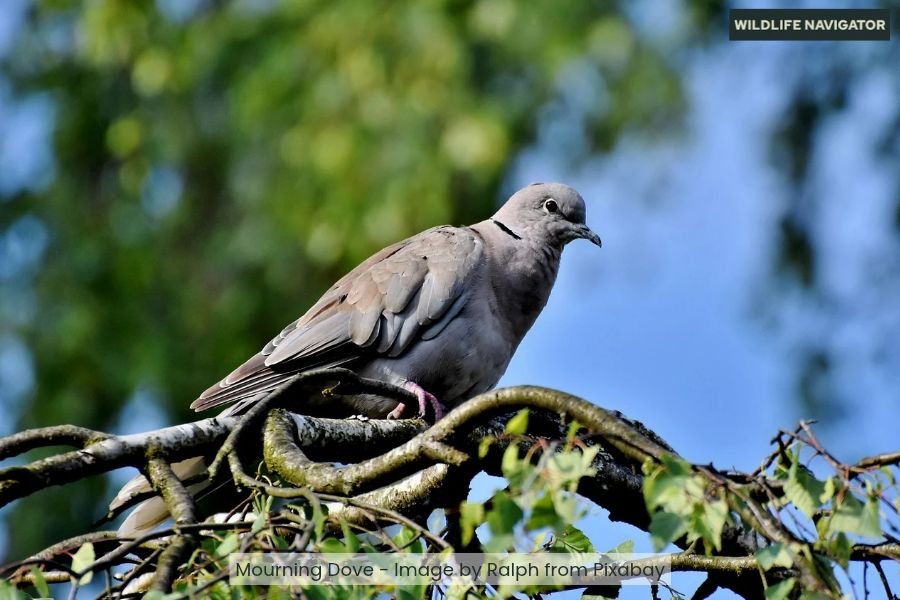
The Mourning Dove (Zenaida macroura) is a medium-sized bird belonging to the pigeon and dove family, Columbidae. Widely distributed across North America, it is recognised by its slender body, soft brownish-grey plumage, long pointed tail and distinctive mournful-sounding cooing call, which gives the species its common name.
The Mourning Dove primarily inhabits open and semi-open environments, including grasslands, woodland edges, agricultural fields and residential landscapes. It is predominantly a seed-eating bird, spending much of its time foraging on the ground. Its adaptability to different habitats and food sources has enabled it to thrive in both natural and human-modified environments.
Beyond its familiar appearance and call, the species has several distinctive biological characteristics. Its rapid flight, unusual wing sounds during take-off, elaborate courtship displays and ability to produce crop milk for its young make it an interesting subject of avian ecology. Both parents participate in raising their offspring, and favourable environmental conditions can allow breeding pairs to produce multiple broods in a season.
Although the Mourning Dove remains abundant across much of its range, it faces threats from predation, hunting, habitat changes and human-related hazards such as building collisions. It continues to play an important role in North American ecosystems as a seed-eating bird and a food source for numerous predators.
Scientific classification:
- Kingdom: Animalia
- Phylum: Chordata
- Class: Aves
- Order: Columbiformes
- Family: Columbidae
- Genus: Zenaida
- Species: Zenaida macroura
- Common name: Mourning Dove
Physical Characteristics and Identification
The Mourning Dove has a slender body, relatively small head, long pointed tail and narrow wings. Its overall appearance is understated, with soft brown, grey and buff colours that help it blend into open landscapes and vegetation.
Size and Body Structure
Adult Mourning Doves generally measure approximately 23–34 cm (9–13.4 inches) in length, including the tail. Their wingspan is approximately 37–45 cm (14.6–17.7 inches), while body weight commonly ranges from 96–170 g (3.4–6 ounces).
The bird has a streamlined body, a relatively small head and a long tail that gives it a graceful appearance. Its wings are pointed and well suited to fast, direct flight.
Its legs and feet are relatively short, allowing it to walk and move comfortably across the ground while searching for food. The bill is short and slender, adapted to picking up seeds and other small food items.
Plumage and Colouration
The adult Mourning Dove typically has a brownish-grey upper body with a pale pinkish or buff-coloured breast. Its back and wings are generally darker than its underside, while the head may appear slightly bluish-grey.
Small black spots are visible on the wing coverts, creating a distinctive pattern across the upper body. The neck may display subtle iridescent patches with pink, purple or greenish tones, although these colours are more noticeable under favourable lighting.
One of its most distinctive identification features is its long, pointed tail. The outer tail feathers have dark borders and pale or white tips, producing a noticeable pattern when the bird is viewed from behind or during flight.
Male and Female Differences
Male and female Mourning Doves look remarkably similar, making visual identification difficult in the field.
Males are generally slightly larger and may have more noticeable bluish-grey colouring on the head, along with stronger pinkish tones on the breast. Females tend to appear somewhat duller, with more brownish tones throughout their plumage.
However, these differences are subtle and can vary between individuals. Behaviour, particularly during courtship and nesting, may provide additional clues when distinguishing between the sexes.
Juvenile Appearance
Young Mourning Doves have a slightly different appearance from adults. Their plumage is generally browner and less uniform, with pale edges or buff-coloured markings on the feathers.
Juveniles may also have a more scaled appearance across the wings and upper body. As they mature and replace their juvenile feathers, they gradually develop the smoother plumage and characteristic markings of adult birds.
Distinctive Identification Features
The Mourning Dove can be identified through a combination of its body shape, plumage and behaviour.
Its small head, long pointed tail, black wing spots and pale underside are useful visual characteristics. Its soft cooing call is another important identification feature.
During flight, the bird displays rapid wingbeats and a relatively straight flight path. The sharp whistling or whinnying sound produced by its wings during take-off is particularly distinctive.
Habitat and Geographic Distribution
The Mourning Dove is widely distributed across North America and occupies a variety of open and semi-open environments. Its adaptability allows it to inhabit natural landscapes as well as agricultural and urban areas.
Geographic Range
The species occurs across much of North America, including the continental United States, southern Canada, Mexico and parts of Central America and the Caribbean.
Its breeding distribution extends from southern Canada through the United States and into Mexico. Some populations remain in the same general region throughout the year, while others move seasonally between breeding and wintering areas.
Mourning Doves are particularly common throughout the United States, where they are regularly observed in residential neighbourhoods, agricultural landscapes, open woodlands and grasslands.
Preferred Natural Habitats
Mourning Doves generally prefer open environments where they can find accessible food and suitable perching or nesting locations.
Common habitats include:
- Open woodlands: Areas with scattered trees and relatively open ground provide feeding and resting opportunities.
- Grasslands and prairies: These environments offer seeds from grasses and other vegetation.
- Savannas and scrublands: Open vegetation provides both food and protective cover.
- Semi-arid regions: The species can inhabit relatively dry environments where sufficient food and water are available.
- Woodland edges: These areas combine trees for nesting with open ground for feeding.
Unlike species that depend on dense forest interiors, Mourning Doves generally benefit from landscapes with a mixture of vegetation and open spaces.
Urban and Human-Modified Environments
The Mourning Dove has adapted particularly well to human-modified environments. It is frequently seen in residential gardens, parks, farms, roadsides and suburban neighbourhoods.
Trees, shrubs, fences, rooftops and utility wires provide suitable perching locations. Gardens and agricultural fields can also provide abundant seeds.
The species may nest near buildings, including on gutters, ledges and other sheltered structures. This flexibility allows it to use resources available in developed environments.
Seasonal Distribution and Migration
Not all Mourning Doves migrate. Many populations remain in their breeding areas throughout the year, particularly in warmer parts of the species’ range.
Birds breeding in northern regions are more likely to migrate south during autumn as temperatures decline and food availability changes. Their wintering areas include the southern United States, Mexico and parts of Central America.
Migration generally takes place between late summer and autumn, with northward movements occurring during spring. The timing and distance of these movements vary according to geographic location and local environmental conditions.
Diet and Feeding Behaviour
The Mourning Dove is primarily a seed-eating bird. Its diet consists mainly of seeds from grasses, weeds, herbs and cultivated plants. Its feeding behaviour is closely connected to open ground, where seeds can be collected efficiently.
Primary Diet
Seeds make up approximately 99% of the Mourning Dove’s diet according to the Cornell Lab of Ornithology.
Common food sources include:
- Grass seeds
- Weed and herb seeds
- Millet
- Wheat
- Corn
- Oats
- Other cultivated grains
The availability of these food sources varies according to season, habitat and agricultural activity.
Mourning Doves frequently feed in fields where harvested crops leave behind scattered grains. They also collect naturally occurring seeds from grasslands, roadsides and residential gardens.
Occasional Food Sources
Although seeds dominate their diet, Mourning Doves occasionally consume other foods.
These may include small fruits, berries and certain invertebrates. Snails have also been recorded in their diet, particularly in some seasonal feeding situations.
Such foods provide additional nutrients and may become more important when preferred seeds are less available.
Foraging Techniques
Mourning Doves are predominantly ground foragers. They walk across open areas while searching for seeds, using their bills to pick up individual food items.
They may also push aside loose vegetation and ground litter to uncover hidden seeds. Unlike many other ground-feeding birds, they generally do not scratch vigorously at the soil.
Their feeding locations include agricultural fields, lawns, gardens, woodland edges and roadsides.
Because they often feed in exposed areas, Mourning Doves remain alert to potential predators. They may suddenly take flight when disturbed, using their strong wings to escape.
Crop and Grit Consumption
The Mourning Dove has a specialised digestive system that allows it to consume large quantities of seeds.
Food is temporarily stored in the crop, an expandable part of the digestive tract. This allows the bird to collect food quickly and digest it later in a safer resting location.
Small stones and grit are also swallowed and retained in the muscular gizzard. These particles help grind hard food materials, making digestion more efficient.
Water Requirements and Drinking Behaviour
Mourning Doves regularly visit water sources such as ponds, streams, birdbaths and shallow pools.
One of their distinctive feeding adaptations is their ability to drink by immersing the bill in water and continuously drawing liquid without repeatedly lifting the head to swallow.
This behaviour differs from many other birds, which typically collect water in the bill and tilt their heads back to swallow.
Their regular access to water is important for maintaining hydration, particularly in hot and relatively dry environments.
Behaviour and Daily Activities
Mourning Doves are generally peaceful, alert and relatively cautious birds. Their daily activities revolve around feeding, resting, maintaining social relationships, communicating and avoiding predators.
General Behaviour and Temperament
The species is usually observed walking slowly across the ground while searching for food or resting on exposed perches.
Although individuals may appear relaxed around people, they remain alert to sudden movements and potential threats.
Mourning Doves commonly gather in areas with abundant food, particularly during colder months. They may feed individually, in pairs or in larger groups depending on local conditions.
Social Behaviour
Outside the breeding season, Mourning Doves may form feeding and roosting groups. These gatherings provide opportunities to exploit food-rich locations and suitable resting sites.
Breeding pairs often maintain close associations and participate in mutual preening. This behaviour involves gently nibbling around the head and neck and helps reinforce pair bonds.
Males may defend preferred calling perches against competing males, particularly during the breeding season.
Vocalisations and Communication
The Mourning Dove is especially famous for its soft, repetitive cooing call.
The male produces a characteristic sequence of notes that can sound like a mournful expression. These calls are commonly used during courtship and territorial communication.
The species also produces other vocal sounds, including shorter calls associated with interactions between individuals.
In addition to vocal communication, Mourning Doves use body movements and visual displays. Head movements, postures and courtship behaviour help communicate intentions to potential mates and rivals.
Another distinctive feature is the whistling or whinnying sound produced by the wings during take-off. This is a mechanical sound rather than a vocal call.
Flight Behaviour
Mourning Doves are capable of rapid and direct flight. Their pointed wings and streamlined body allow them to move quickly across open landscapes.
When disturbed, they often launch into the air with powerful wingbeats. Their flight may appear relatively straight, although they can change direction quickly when avoiding predators.
The distinctive wing sound is especially noticeable when a bird takes off suddenly from the ground or a low perch.
Roosting and Resting Habits
Mourning Doves commonly rest in trees, shrubs and other elevated locations that offer some protection from predators and environmental conditions.
During winter, they may gather in groups within woodlots and other sheltered areas.
Their choice of resting location depends on local habitat conditions, temperature, food availability and the presence of suitable cover.
Breeding, Courtship and Reproduction
Mourning Doves have a relatively long breeding season and can produce multiple broods in favourable conditions. Their reproductive strategy, combined with rapid development of young, contributes to their ability to maintain large populations.
Breeding Season
The breeding season varies according to geographic location and environmental conditions.
In warmer parts of their range, nesting may begin relatively early in the year and continue through much of the warmer season. In northern regions, breeding activity is generally more closely associated with spring and summer.
Food availability, temperature and suitable nesting locations influence the timing and success of reproduction.
Courtship and Mating Behaviour
Male Mourning Doves use a combination of vocalisations and physical displays to attract females.
A male may repeatedly call from a preferred perch before approaching a potential mate. During courtship, he may perform aerial displays involving gliding and changes in flight direction.
On the ground, the male may approach the female with an inflated breast, lowered head and repeated bowing movements.
Once a pair bond forms, the birds may engage in mutual preening. They can also grasp each other’s bills and move their heads in coordinated motions.
Mourning Doves are generally socially monogamous during breeding, although pair relationships and their duration may vary.
Nest Construction and Placement
Mourning Doves construct relatively simple and loosely arranged nests.
The male typically gathers and carries nesting materials, while the female arranges them into a suitable structure.
Common nesting materials include:
- Small twigs
- Grass stems
- Pine needles
- Fine plant materials
Nests are commonly placed on horizontal tree branches, particularly in areas with suitable foliage. They may also be constructed in shrubs, on the ground or on human-made structures such as gutters and building ledges.
The nest is generally shallow and poorly insulated compared with the more elaborate nests built by many other bird species.
Eggs and Incubation
A typical Mourning Dove clutch consists of two white, unmarked eggs.
Both parents participate in incubation, sharing responsibility for keeping the eggs warm until they hatch.
The incubation period generally lasts approximately 14 days, although it may vary slightly depending on environmental conditions.
Hatching and Development of Young
Newly hatched Mourning Doves, commonly called squabs, are altricial. This means they are born relatively undeveloped, with closed eyes and limited ability to move independently.
Both parents provide warmth, protection and food during the early stages of development.
One of the most remarkable aspects of their parental care is the production of crop milk. This nutrient-rich substance is produced in the lining of the crop by both male and female parents.
During the first few days after hatching, crop milk provides the primary nourishment for the young. As the chicks develop, the parents gradually introduce more seeds into the regurgitated food.
Young Mourning Doves generally leave the nest approximately 12–15 days after hatching. However, fledging does not mean complete independence, and the young may continue receiving food and protection from their parents.
Parental Care and Multiple Broods
Both parents contribute to raising their offspring.
They share incubation duties and provide food to the developing chicks. Their coordinated parental care is essential because the young require frequent feeding and protection during their early development.
Mourning Doves are capable of raising several broods within a single breeding season. Depending on the region and environmental conditions, pairs may attempt multiple nesting cycles.
This reproductive flexibility helps the species maintain its populations despite losses caused by predators, weather and other environmental pressures.
Lifespan, Predators and Natural Survival
The Mourning Dove faces threats from natural predators and human-related activities throughout its life. Eggs, nestlings and adults are vulnerable to different types of predators and environmental challenges.
Average Lifespan
The lifespan of a Mourning Dove varies considerably depending on environmental conditions, predation, disease, hunting pressure and access to food.
Many individuals do not survive beyond their first year, and average survival in the wild is relatively limited. However, some individuals can live much longer under favourable conditions.
Bird-banding records have documented exceptional wild individuals surviving for many years, with a recorded longevity of more than 19 years.
Such records represent exceptional cases rather than the typical lifespan of the species.
Natural Predators
Mourning Doves are preyed upon by several birds and mammals.
Common predators include:
- Hawks: Accipiter hawks and other birds of prey may capture adult doves during flight or while they are resting.
- Falcons: Fast-flying falcons can pursue and catch doves in open environments.
- Owls: Some owl species hunt Mourning Doves during their resting periods.
- Snakes: Certain snakes may raid nests and consume eggs or young birds.
- Domestic cats: Free-ranging cats can capture doves, particularly when they are feeding on the ground.
Eggs and nestlings are especially vulnerable because they cannot escape approaching predators.
Natural Defence Mechanisms
The Mourning Dove relies primarily on vigilance, camouflage and rapid flight to avoid predators.
Its muted plumage helps it blend into branches, soil and surrounding vegetation. When a potential threat approaches, the bird may remain still before suddenly flying away.
Its powerful wings and direct flight provide an effective means of escape.
Adults may also display distraction behaviour around nests, attempting to draw attention away from eggs or young birds.
Mortality and Survival Challenges
Apart from predation, Mourning Doves face several other survival challenges.
Severe weather, food shortages and habitat changes can affect survival, particularly during winter and migration.
Collisions with buildings, windows and vehicles also contribute to mortality in developed environments.
Hunting pressure is another important factor in parts of North America, where the species is managed as a game bird.
Ecological Role and Relationship with Humans
The Mourning Dove plays an important role in North American ecosystems through its feeding habits, interactions with predators and ability to occupy different habitats.
Role in the Ecosystem
As a predominantly seed-eating bird, the Mourning Dove participates in the movement and consumption of plant seeds.
By feeding on seeds from grasses, weeds and other vegetation, it contributes to the transfer of plant material through the food web.
Its ecological importance also comes from its role as prey for numerous predators, including hawks, falcons and owls.
The species therefore forms part of the relationship between plant resources, seed-eating birds and higher-level predators.
Relationship with Agriculture
Agricultural landscapes provide important feeding opportunities for Mourning Doves.
Harvested fields frequently contain scattered grains and seeds that become accessible to ground-feeding birds.
Corn, wheat, millet and other cultivated grains can form a substantial part of their diet.
Although their feeding habits may sometimes bring them into conflict with agricultural interests, they are also a familiar component of farmland ecosystems.
Adaptation to Urban Environments
Mourning Doves have successfully adapted to many residential and urban landscapes.
Gardens, parks and open spaces provide feeding opportunities, while trees, shrubs and building structures offer suitable perching and nesting locations.
They may also visit bird feeders where seeds are available.
Their tolerance of human presence makes them one of the more frequently observed birds in many North American neighbourhoods.
Cultural Significance
The Mourning Dove has a strong cultural association with peace, love and remembrance.
Its gentle appearance and mournful-sounding call have influenced its representation in literature, poetry, art and popular culture.
The bird is also widely recognised in North American wildlife traditions because of its abundance and long association with agricultural and residential landscapes.
Conservation Status and Threats
The Mourning Dove remains a widespread and abundant species across North America. However, its large population does not mean that it is free from conservation challenges.
Global Conservation Status
The Mourning Dove is classified as Least Concern (LC) on the IUCN Red List.
This classification indicates that the species does not currently meet the criteria for a threatened category at the global level.
Its broad geographic distribution and large population contribute to its relatively favourable conservation assessment.
Nevertheless, conservation assessments should be interpreted alongside regional monitoring data, because population trends can differ between geographic areas.
Population Distribution and Trends
Mourning Doves are among the most abundant birds in North America.
The Cornell Lab of Ornithology reports a breeding population estimate of approximately 150 million individuals globally, based on Partners in Flight data.
In the United States, the U.S. Fish and Wildlife Service estimated approximately 329 million Mourning Doves as of September 2025.
Despite their abundance, long-term monitoring has identified population declines over certain periods. This demonstrates why continued population surveys and responsible management remain important.
Major Threats
Habitat changes: Changes in agricultural practices, land development and vegetation management can influence the availability of suitable feeding and nesting areas.
Hunting pressure: Mourning Doves are among the most heavily hunted game birds in North America. Hunting is regulated through management systems designed to monitor and maintain populations.
Lead poisoning: Ground-feeding birds can accidentally consume spent lead ammunition pellets while searching for food in heavily hunted areas. Lead exposure can cause serious health problems and mortality.
Collisions: Buildings, glass windows, vehicles and other structures can cause injuries and deaths, particularly in urban environments.
Predation by domestic cats: Free-ranging cats can capture adult birds and juveniles, especially when they are feeding or resting close to the ground.
Conservation and Management Efforts
Conservation and management programmes focus on monitoring populations, regulating hunting and maintaining suitable habitats.
In the United States, the U.S. Fish and Wildlife Service coordinates population assessments and management activities across different regions.
Habitat management, responsible agricultural practices and reducing environmental hazards can also contribute to the long-term survival of the species.
For individual homeowners, maintaining native vegetation, providing safe feeding areas and keeping domestic cats indoors can help reduce risks to Mourning Doves and other birds.
Interesting Facts About the Mourning Dove
The Mourning Dove has several distinctive characteristics that make it an interesting species to observe and study.
- Its name comes from its call: The bird is called the Mourning Dove because its repeated cooing sounds similar to a mournful expression.
- It has a distinctive wing sound: Its wings produce a sharp whistling or whinnying sound during take-off, making the bird recognisable even when it is difficult to see.
- It produces crop milk: Both male and female Mourning Doves produce a nutrient-rich substance in their crops to feed their newly hatched chicks.
- It can drink without repeatedly lifting its head: Unlike many other birds, it can keep its bill immersed in water while continuously drawing liquid.
- It frequently feeds on the ground: Seeds make up approximately 99% of its diet, and it commonly searches for food in open areas.
- It has a long, pointed tail: Its distinctive tail, with dark borders and pale tips, is one of its most useful identification features.
- Both parents incubate the eggs: Male and female Mourning Doves share responsibility for keeping their eggs warm.
- Its nest is relatively simple: Unlike many birds that construct elaborate nests, the Mourning Dove often uses a loose arrangement of twigs and plant materials.
- It can raise multiple broods: Under favourable conditions, a pair may attempt several nesting cycles within one breeding season.
- It is an important game bird: The Mourning Dove is one of the most frequently hunted bird species in North America, making population monitoring and hunting management particularly important.
- It adapts well to human environments: The species frequently nests and feeds in residential gardens, parks, agricultural areas and suburban landscapes.
- It is capable of fast, direct flight: Its pointed wings and streamlined body help it move quickly when escaping predators or travelling between feeding and resting locations.
Frequently Asked Questions About the Mourning Dove
References and Sources
- Cornell Lab of Ornithology – Mourning Dove — Identification, distribution and general species information.
- Cornell Lab of Ornithology – Mourning Dove Life History — Diet, nesting, reproduction, behaviour and population information.
- IUCN Red List – Zenaida macroura — Global conservation assessment (2024).
- U.S. Fish and Wildlife Service – Mourning Dove Population Status, 2026 — Population estimates and management information.
- Animal Diversity Web – Mourning Dove — Reproduction, lifespan, feeding and natural behaviour.
- USDA Forest Service – Mourning Dove — Habitat, diet, breeding and predators.
Curating and documenting wildlife and protected areas through detailed guides and the continuously updated WN Index.
- Rosan Prasad
- Rosan Prasad
- Rosan Prasad
- Rosan Prasad