American Robin: Habitat, Diet, Behaviour, Migration & Interesting Facts

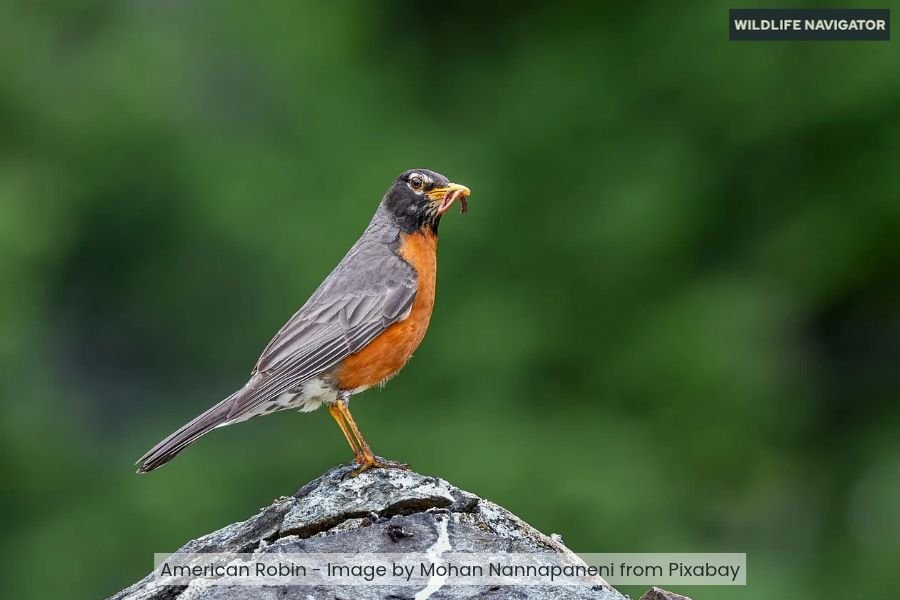
The American Robin (Turdus migratorius) is one of the most familiar and widely distributed birds in North America. Recognised by its distinctive reddish-orange breast, grey-brown upperparts, dark head and cheerful musical song, this medium-sized songbird is commonly seen searching for food across lawns, gardens, parks, woodlands and open landscapes. Its approachable appearance and frequent presence around human settlements have made it a familiar part of everyday life across much of the continent.
Belonging to the thrush family, Turdidae, the American Robin is an adaptable bird with a varied diet consisting of earthworms, insects, fruits and berries. It is particularly known for its ground-foraging behaviour, often running across grassy areas before stopping to search for earthworms and other small invertebrates. During colder months, it increasingly relies on fruits and berries and may gather in large flocks around food-rich habitats.
Although commonly associated with the arrival of spring, American Robins do not all migrate. Some populations remain in their breeding territories throughout the year, while others move south as temperatures fall and food availability changes. Their ability to occupy different habitats and adjust their feeding habits has contributed to their widespread presence across North America.
American Robin: Scientific Classification and Overview
The American Robin is a member of the order Passeriformes, which includes perching birds and songbirds. It belongs to the family Turdidae, a group commonly known as thrushes. Its scientific name, Turdus migratorius, reflects its classification within the genus Turdus and its seasonal movements across parts of North America.
Despite its familiar common name, the American Robin is not closely related to the European Robin (Erithacus rubecula). The two birds belong to different families and are distinguished by their appearance, geographical distribution and evolutionary relationships.
Scientific Classification
| Classification | Details |
|---|---|
| Kingdom | Animalia |
| Phylum | Chordata |
| Class | Aves |
| Order | Passeriformes |
| Family | Turdidae |
| Genus | Turdus |
| Species | Turdus migratorius |
| Common name | American Robin |
| Conservation status | Least Concern |
General Overview
The American Robin is a medium-sized songbird native to North America. It is recognised by its warm orange-red breast, long legs, yellow bill and relatively long tail. Males generally have darker heads and more prominent colouration, while females tend to appear slightly duller.
American Robins occupy a broad range of habitats, including forests, grasslands, agricultural landscapes and urban environments. They are active during daylight hours and spend considerable time searching for food on the ground.
The species is also known for its seasonal social behaviour. During the breeding season, individuals defend territories and establish nesting pairs. Outside the breeding period, particularly during autumn and winter, they may form large feeding and roosting flocks.
Physical Characteristics and Identification
The American Robin is easily recognised by its orange-red breast and contrasting grey-brown upperparts. Its upright posture, long legs and characteristic movements across open ground also make it relatively easy to identify.
Although males and females share similar overall patterns, differences in plumage colour and intensity can help distinguish them. Juveniles have a noticeably different appearance, particularly during their first months of life.
Size and Body Structure
Adult American Robins generally measure approximately 23–28 cm (9–11 inches) in length, with a wingspan of around 31–41 cm (12–16 inches). Their weight usually ranges from approximately 59–94 g (2.1–3.3 ounces), although individual measurements vary.
The species has a moderately slender body, strong legs and a relatively long tail. Its straight, pointed yellow bill is well suited to picking up earthworms, insects and fruits.
Plumage and Colouration
The most distinctive feature of the American Robin is its reddish-orange breast, which contrasts with its grey-brown back and wings.
Other identifying characteristics include:
- Head: Males generally have a dark grey to nearly black head, while females have a lighter brownish-grey head.
- Breast: Both sexes have a warm orange or reddish-orange breast.
- Back: The upperparts are generally grey-brown.
- Belly: The lower belly is pale, often appearing whitish.
- Bill: Yellow, sometimes darker near the tip.
- Eyes: Dark eyes surrounded by a relatively narrow pale eye ring.
- Tail: Long and dark, with white markings visible on the outer tail feathers.
Differences Between Male and Female American Robins
Male and female American Robins look similar, but males generally have stronger colour contrasts.
Adult males typically display a darker head, brighter orange-red breast and more noticeable contrast between their upperparts and underparts. Females usually have a lighter head, less intense breast colour and somewhat subdued overall plumage.
These differences can become more noticeable during the breeding season, although individual variation means that colour alone is not always sufficient for reliable identification.
Juvenile American Robin
Young American Robins look different from adults. Juveniles have spotted breasts, with dark markings scattered across a pale orange or buff-coloured background.
Their upperparts are generally brown, with pale streaks or spots that provide a more mottled appearance. As they mature and undergo their first plumage changes, these markings gradually become less prominent, and their appearance becomes increasingly similar to that of adult birds.
Distinctive Identification Features
The combination of an orange-red breast, grey-brown upperparts, yellow bill and long legs makes the American Robin distinctive.
Its ground-foraging behaviour is another useful identification clue. It often runs several steps across a lawn, pauses with its head tilted and then moves again while searching for food.
Habitat and Geographical Distribution
The American Robin is widely distributed across North America and occupies a variety of natural and human-modified environments. Its adaptability allows it to live in forests, woodland edges, grasslands, agricultural areas, gardens and urban parks.
The availability of food, suitable nesting locations and shelter plays an important role in determining where individual populations occur throughout the year.
Geographical Range
The American Robin is native to North America and occurs across much of Canada, the United States and parts of Mexico.
Its breeding distribution extends across large portions of Canada and the United States, reaching Alaska in the north. During the non-breeding season, many northern populations move towards southern Canada, the United States and Mexico.
Some populations remain in the same general region throughout the year, particularly in areas where food and suitable habitat remain available.
Natural Habitats
American Robins occupy several types of natural environments, including:
- Deciduous and mixed forests
- Woodland edges and forest clearings
- Open grasslands
- Mountain forests
- Shrublands
- Recently disturbed or burned landscapes
They often prefer habitats that combine open ground for feeding with trees or shrubs for nesting and shelter.
Urban and Suburban Habitats
One reason for the American Robin’s familiarity is its ability to live close to people.
It frequently occupies residential gardens, public parks, golf courses, school grounds, agricultural fields and suburban neighbourhoods. Lawns provide accessible feeding areas, while trees, shrubs and buildings can offer potential nesting locations.
However, the species is not dependent on urban environments. It also thrives in less-developed landscapes and natural woodland habitats.
Seasonal Habitat Preferences
Habitat use changes throughout the year.
During spring and summer, American Robins commonly forage in open areas where earthworms and insects are available. They also use trees and shrubs for nesting.
In autumn and winter, fruit-bearing trees and shrubs become especially important. Large groups may gather in wooded habitats where berries are abundant, providing access to food during colder conditions.
Diet and Feeding Behaviour
The American Robin is an omnivorous bird with a flexible diet. It consumes a combination of animal-based food and plant material, adjusting its feeding habits according to seasonal availability.
Earthworms and insects are particularly important during the breeding season, while fruits and berries become increasingly significant during autumn and winter.
What Do American Robins Eat?
Their diet includes a wide range of food items:
Animal-based food:
- Earthworms
- Beetles
- Caterpillars
- Grasshoppers
- Spiders
- Snails
- Other small insects and invertebrates
Plant-based food:
- Cherries
- Hawthorn berries
- Dogwood fruits
- Chokecherries
- Sumac fruits
- Juniper berries
- Other seasonal fruits and berries
This varied diet allows the American Robin to exploit different food sources across its geographical range.
Seasonal Diet Changes
Food preferences change according to the season.
During spring and summer, earthworms and insects are particularly important. These protein-rich foods provide nutrients for adult birds and growing chicks.
In autumn and winter, fruits and berries become a major part of the diet. As insects and earthworms become less accessible in colder conditions, robins increasingly search for fruit-bearing trees and shrubs.
This seasonal flexibility helps the species survive in environments where food availability changes considerably throughout the year.
How American Robins Find Food
American Robins are primarily ground foragers. They frequently search for food across lawns, fields, gardens and forest floors.
While feeding, a robin may run several steps before stopping suddenly. It often tilts its head and watches the ground carefully before moving towards a potential food item.
This behaviour is particularly noticeable when the bird searches for earthworms beneath the soil or within damp grass.
Robins also forage in trees and shrubs, where they pick berries and fruits directly from branches. They can occasionally catch insects in flight.
Feeding Adaptations
Their feeding behaviour is supported by several physical and behavioural adaptations:
- A pointed bill helps pick up insects, worms and small fruits.
- Strong legs allow efficient movement across open ground.
- Excellent visual attention helps locate potential food items.
- A flexible diet allows them to exploit both animal and plant resources.
- Seasonal changes in feeding behaviour help them respond to changing environmental conditions.
Behaviour and Social Characteristics
The American Robin is an active, primarily diurnal bird that spends much of the day feeding, communicating, defending territories and caring for its young.
Its social behaviour changes throughout the year. During the breeding season, individuals are generally more territorial, whereas outside the breeding period they often gather in groups.
Daily Activity
American Robins are frequently active during the early morning, when they search for earthworms and other invertebrates.
Their daily routines involve moving between feeding areas, resting locations and suitable perches. They may also spend time bathing, preening and communicating with other robins.
Their familiar movements across lawns include short runs, sudden stops and occasional hops.
Social Behaviour
During the breeding season, American Robins generally establish territories and form pairs.
Males often defend nesting areas through singing, displays and aggressive interactions with rival birds. Females also participate in territorial defence, particularly around the nest.
Outside the breeding season, robins become more social. They may feed together in groups and gather in large communal roosts during autumn and winter.
Communication and Vocalisation
American Robins are well known for their clear, melodious songs.
Their song consists of a series of musical whistles, often described as sounding like phrases of repeated notes. Males sing particularly frequently during the breeding season, when vocalisation helps establish and defend territories and attract females.
They also produce several calls, including short alarm and contact notes. These sounds help individuals communicate and respond to potential threats.
Territorial Behaviour
Territorial behaviour is particularly important during reproduction.
Males may sing from prominent perches, spread their tails, raise their wings and display their plumage when interacting with females or competing males.
They may also chase or physically confront other birds that enter their nesting territory.
Roosting and Bathing
American Robins regularly maintain their feathers through preening and bathing.
During the non-breeding season, they may gather in large communal roosts, often selecting wooded areas with suitable shelter.
These roosts can contain thousands of individuals, although their size varies according to location and seasonal conditions.
Breeding, Nesting and Reproduction
The American Robin generally breeds during spring and summer, although the exact timing varies according to geographical location and environmental conditions.
It is known for its characteristic blue eggs, mud-reinforced cup-shaped nests and attentive parental care.
Breeding Season
Breeding usually begins in early spring in many parts of North America and may continue through summer.
In northern regions, breeding activity is closely associated with the arrival of favourable temperatures and increasing food availability.
Depending on local conditions, a pair may raise more than one brood during a breeding season.
Courtship and Mating
Male American Robins use songs and visual displays to attract potential mates.
During courtship, males may raise and spread their tails, shake their wings, inflate their throats and sing from prominent perches.
Pairs may also perform a behaviour known as ceremonial gaping, in which the male and female approach each other with their bills open and briefly touch them.
American Robins are generally socially monogamous during the breeding season, with pairs cooperating to raise their offspring.
Nest Construction
The female generally selects the nesting site and constructs the nest.
American Robin nests are typically cup-shaped structures made from grass, twigs, rootlets and other plant materials. Mud is used to strengthen the outer structure, while finer grasses and fibres form the inner lining.
Nests are commonly placed on horizontal branches in trees or shrubs, often concealed among foliage.
However, the species is also known to nest on buildings, window ledges, bridges, gutters and other human-made structures.
Eggs and Incubation
The female usually lays three to five eggs per clutch, although clutch size can vary.
The eggs are typically sky-blue or blue-green and lack prominent markings. Their distinctive colour is one of the best-known features of the species.
Incubation generally lasts approximately 12–14 days and is primarily carried out by the female.
Chicks and Parental Care
American Robin chicks hatch helpless, with very little down and closed eyes.
Both parents participate in feeding the nestlings, bringing earthworms, insects and other small invertebrates to the nest.
The young typically remain in the nest for approximately 13 days before fledging. After leaving, they may continue to depend on their parents for food and protection while developing their flying and foraging abilities.
Number of Broods
American Robins can raise one to three broods during a favourable breeding season.
The number depends on environmental conditions, food availability, breeding success and geographical location.
Raising multiple broods allows the species to produce several groups of offspring during a single breeding season.
Migration and Seasonal Movements
The American Robin is considered a resident or short-distance migrant, depending on the population and geographical location.
Although many northern populations move south during autumn, not all American Robins migrate. Some individuals remain in their breeding territories throughout the year.
Is the American Robin a Migratory Bird?
Yes, many American Robins migrate seasonally, but migration is not universal across the species.
Populations breeding in northern Canada and Alaska generally move south as winter approaches. Other populations, particularly those living farther south, may remain in the same general region throughout the year.
Even birds that remain in northern areas may change their local movements in response to temperature, snow cover and food availability.
Migration Routes
Northern populations generally move towards the southern United States and parts of Mexico during the non-breeding season.
The precise routes and distances vary according to the breeding location and environmental conditions.
Migration may involve large groups travelling between seasonal feeding and resting areas. American Robins often move during daylight and gather in flocks at suitable locations.
When Do American Robins Migrate?
Autumn movements generally begin as breeding activity declines and environmental conditions change.
During spring, birds move towards their breeding territories as temperatures rise and food becomes more accessible.
However, the timing differs across the continent. Some birds may move only relatively short distances, while northern populations travel much farther.
Winter Behaviour
During winter, American Robins often rely more heavily on fruits and berries.
They may form large feeding flocks around trees and shrubs with abundant fruit. Communal roosting also becomes more common, with birds gathering in sheltered woodland areas.
These seasonal movements help them locate food and suitable shelter when conditions become less favourable.
Predators, Threats and Conservation Status
The American Robin is widespread and abundant across much of North America. Nevertheless, it faces several natural and human-related threats, particularly during nesting and ground-foraging activities.
Natural Predators
American Robins are preyed upon by a variety of animals.
Common predators include:
- Hawks
- Owls
- Snakes
- Raccoons
- Squirrels and other nest predators
- Domestic and feral cats
Eggs and nestlings are particularly vulnerable because they cannot escape from predators.
Adult birds may respond to threats through alarm calls, aggressive displays and attempts to drive predators away from nesting areas.
Major Threats
Although the species remains widespread, several environmental pressures can affect local populations.
Habitat loss: The removal of trees, shrubs and natural vegetation can reduce suitable nesting and feeding locations.
Pesticide exposure: Because American Robins frequently forage on lawns and agricultural land, they may encounter pesticides and other chemicals that affect insects and other food sources.
Window collisions: Birds may collide with reflective or transparent windows, particularly in residential and commercial areas.
Domestic cats: Free-ranging cats can prey on adult robins and young birds, particularly in suburban environments.
Severe weather: Storms, extreme temperatures and unusual seasonal conditions can affect breeding success and food availability.
Conservation Status
The American Robin is classified as Least Concern (LC) on the IUCN Red List.
Its widespread geographical distribution and large population contribute to its relatively secure conservation status. The global breeding population has been estimated at approximately 370 million individuals in published conservation assessments.
However, a Least Concern classification does not mean that individual populations are free from threats. Habitat changes, chemical exposure and other environmental pressures can still affect local populations.
Conservation and Protection
Several practical measures can help support American Robins and other birds:
- Preserve mature trees and native shrubs.
- Reduce unnecessary pesticide use in gardens and lawns.
- Install bird-safe window treatments to reduce collisions.
- Keep domestic cats indoors or within secure outdoor enclosures.
- Protect natural nesting and feeding habitats.
- Plant native fruit-bearing trees and shrubs.
Protecting the habitats used by common birds is important because their ecological roles extend beyond their individual species.
Ecological Importance and Role in the Ecosystem
The American Robin plays several important roles in North American ecosystems. Through its feeding habits, it contributes to insect consumption, seed dispersal and food-web relationships.
Seed Dispersal
American Robins consume a wide variety of fruits and berries, including those produced by native trees and shrubs.
After eating fruits, they may deposit seeds in different locations through their droppings. This process contributes to seed dispersal and can help plants spread beyond their original growing areas.
Robins may also disperse seeds from introduced plant species, demonstrating how their feeding behaviour can influence vegetation patterns.
Insect Population Control
During spring and summer, American Robins consume substantial quantities of earthworms and insects.
Their diet includes beetles, caterpillars, grasshoppers, spiders and other small invertebrates.
By consuming these organisms, robins contribute to natural food-web processes and may help regulate populations of certain invertebrates.
Role in Food Chains
American Robins are both predators and prey within their ecosystems.
They feed on insects and other small organisms, while their eggs, chicks and adults provide food for a variety of predators.
This makes them an important part of the food web, connecting ground-dwelling invertebrates, vegetation and higher-level predators.
Environmental Adaptability
The species demonstrates considerable adaptability by occupying forests, grasslands, agricultural landscapes and urban environments.
Its ability to change feeding habits according to seasonal conditions allows it to survive in environments where different food resources become available throughout the year.
However, adaptability should not be confused with immunity to environmental pressures. Changes in habitat quality, pollution and climate can still influence local populations.
Interesting Facts About the American Robin
The American Robin is more than a familiar garden bird. Its migration, feeding behaviour, breeding biology and ecological role make it an interesting species to study.
Here are some noteworthy facts about this North American songbird.
- Three-state bird: The American Robin is the official state bird of Connecticut, Michigan and Wisconsin.
- A member of the thrush family: Despite its common name, it belongs to the family Turdidae, which includes many species of thrushes.
- Distinctive blue eggs: Its eggs are famous for their characteristic sky-blue or blue-green colour.
- Not every robin migrates: Some American Robins remain in their breeding regions throughout the year, while others move south during winter.
- A flexible diet: It eats earthworms, insects, spiders, snails, fruits and berries.
- Seasonal feeding habits: Earthworms and insects are particularly important during spring and summer, while fruits become more important during autumn and winter.
- Ground-foraging specialist: It frequently runs across lawns and stops to search for food on the ground.
- Large winter flocks: American Robins may gather in enormous communal roosts during the non-breeding season.
- Multiple broods: A breeding pair may successfully raise as many as three broods in a favourable year.
- Female-built nests: The female generally selects the nesting site and constructs the nest using vegetation and mud.
- Both parents feed the young: Although the female incubates the eggs, both parents participate in feeding the chicks.
- Adaptable nesting locations: In addition to trees and shrubs, American Robins sometimes nest on buildings, bridges and other human-made structures.
- An early morning singer: Males frequently sing around dawn, particularly during the breeding season.
- Different from the European Robin: The American Robin and European Robin are unrelated members of different bird families despite sharing the name robin.
- A long-lived individual: The oldest recorded American Robin lived for approximately 13 years and 11 months, although most individuals do not reach this age.
Frequently Asked Questions About the American Robin
References and Sources
- Cornell Lab of Ornithology – American Robin: All About Birds
- Cornell Lab of Ornithology – American Robin Life History
- National Audubon Society – American Robin Field Guide
- American Bird Conservancy – American Robin
- IUCN Red List – American Robin (Turdus migratorius)
- Smithsonian’s National Zoo – American Robin
Curating and documenting wildlife and protected areas through detailed guides and the continuously updated WN Index.
- Rosan Prasad
- Rosan Prasad
- Rosan Prasad
- Rosan Prasad