American Goldfinch: Identification, Habitat, Diet, Behaviour & Facts

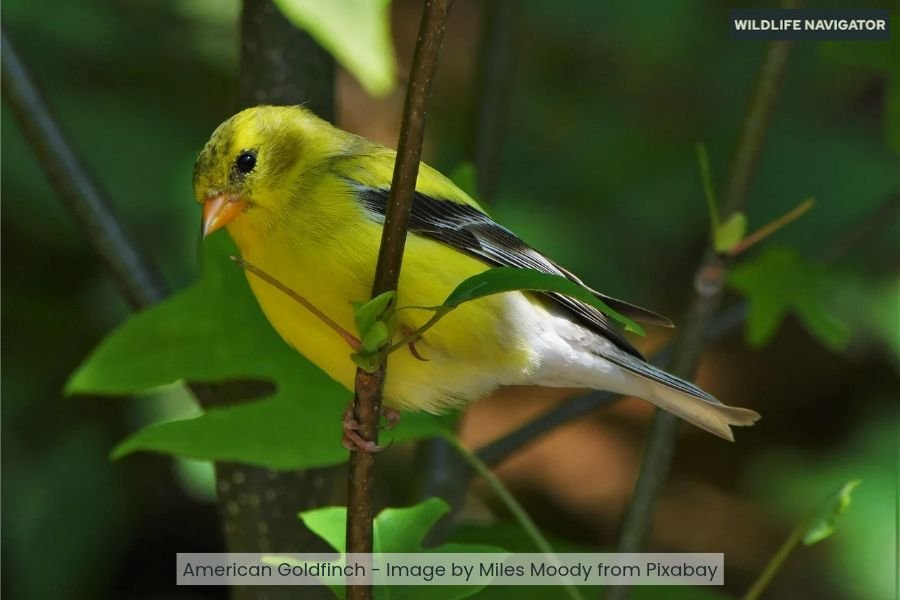
The American Goldfinch (Spinus tristis) is a small North American songbird recognised for its brilliant yellow breeding plumage, contrasting black wings and distinctive flight calls. Belonging to the finch family, Fringillidae, this colourful bird is commonly found in open fields, meadows, woodland edges, gardens and other habitats where seed-producing plants are abundant. Its seasonal changes in appearance, specialised seed-eating habits and unusual breeding schedule make it one of the most distinctive finches in North America.
Unlike many songbirds that raise their young during spring, American Goldfinches generally begin nesting in summer, when plants such as thistles and milkweeds produce abundant seeds and suitable nesting fibres. They are highly adaptable feeders, using their short, conical bills to extract seeds from different plants. Their characteristic bouncing flight, social feeding behaviour and cheerful vocalisations also make them familiar visitors to backyard bird feeders.
Although the species remains widespread and is currently classified as Least Concern, habitat quality and the availability of natural food sources remain important to its long-term survival.
American Goldfinch: Overview and Classification
The American Goldfinch is a small, seed-eating passerine bird native to North America. It belongs to the genus Spinus and is one of the most recognisable members of the finch family. Its bright breeding colours, compact body and distinctive wing markings make identification relatively straightforward, particularly during summer.
American Goldfinches are active birds that spend much of their time searching for seeds among grasses, flowering plants, shrubs and trees. They frequently gather in flocks outside the breeding season and can often be observed feeding together in fields and at bird feeders.
Scientific Classification
| Classification | Information |
|---|---|
| Kingdom | Animalia |
| Phylum | Chordata |
| Class | Aves |
| Order | Passeriformes |
| Family | Fringillidae |
| Genus | Spinus |
| Species | Spinus tristis |
| Common name | American Goldfinch |
The scientific name Spinus tristis identifies the species within the finch genus Spinus. The species is commonly called the American Goldfinch to distinguish it from other goldfinches, including the European Goldfinch and Lesser Goldfinch.
Three recognised subspecies are generally described:
- Spinus tristis tristis: The eastern form, distributed across much of eastern North America.
- Spinus tristis pallidus: A paler western and northern form.
- Spinus tristis jewetti: A relatively darker form found in parts of the Pacific coastal region.
These geographical variations show relatively subtle differences in plumage and distribution rather than major differences in behaviour or general biology.
Physical Characteristics and Identification
The American Goldfinch is a compact finch with a short, conical bill, pointed wings and a slightly notched tail. Its appearance changes considerably throughout the year, particularly in males, whose brilliant yellow breeding plumage becomes much duller after the breeding season.
Size, Weight and Wingspan
Adult American Goldfinches generally measure approximately 11–13 cm in length. Their wingspan ranges from around 19–22 cm, while their body weight is usually between 11 and 20 grams.
Their small body, lightweight structure and pointed wings help them move quickly through vegetation and perform their characteristic undulating flight.
Male American Goldfinch
During the breeding season, the adult male develops a striking appearance. Its body becomes bright yellow, contrasting with a black forehead, black wings and black tail. White markings on the wings and tail provide additional contrast.
This brilliant breeding plumage makes the male particularly noticeable in open fields and gardens. Its bright coloration also plays an important role in visual recognition during the breeding season.
After breeding, the male undergoes a seasonal moult and develops much duller olive-brown and yellowish plumage.
Female American Goldfinch
Female American Goldfinches are generally less brightly coloured than breeding males. Their upperparts are olive-brown or yellowish-olive, while the underparts are lighter yellow.
They have dark wings with pale wingbars and lack the male’s prominent black forehead and brilliant yellow body. Their more subdued appearance provides effective camouflage while nesting and moving through vegetation.
Juvenile and Winter Plumage
Young American Goldfinches initially have dull brownish or olive-yellow plumage, with darker wings and noticeable wingbars. They gradually develop adult characteristics as they mature.
During winter, both sexes appear considerably duller than breeding males. Their plumage becomes predominantly brownish or olive, with yellow tones remaining more noticeable in some individuals.
One particularly interesting characteristic is that American Goldfinches undergo two body moults each year: one in late winter or early spring and another in late summer. This seasonal replacement of feathers produces their distinctive changes in appearance.
Distinguishing Features
The following characteristics help identify the species:
- Small, compact body with a short conical bill.
- Pointed wings and a slightly notched tail.
- Black wings with contrasting white markings.
- Bright yellow breeding plumage in adult males.
- Olive-brown and yellowish plumage in females and winter birds.
- Distinctive bouncing flight pattern and characteristic calls.
Habitat and Geographical Distribution
The American Goldfinch is widely distributed across North America, occupying habitats that provide sufficient seeds, suitable nesting vegetation and access to water. It is particularly associated with open landscapes rather than dense, uninterrupted forests.
Its distribution changes seasonally as individuals move between breeding and wintering areas.
Geographical Range
The species occurs across much of the United States and southern Canada. During the breeding season, American Goldfinches are commonly found throughout large parts of the northern and central United States and southern Canada.
Their range extends across eastern, central and western regions of North America, although local abundance varies according to habitat conditions and seasonal food availability.
During winter, many northern populations move southwards into areas with milder conditions and accessible food. They can be found across much of the United States, including regions where they remain throughout the year.
Preferred Habitats
American Goldfinches prefer open or semi-open environments containing abundant seed-producing vegetation.
Meadows and grasslands: These habitats provide seeds from grasses, wildflowers and other herbaceous plants. They are important feeding grounds throughout the year.
Fields and agricultural landscapes: Overgrown fields and field margins often support thistles, asters and other plants that provide suitable food.
Woodland edges: Open woodland margins offer a combination of trees, shrubs and flowering plants. These environments also provide suitable nesting locations.
Wetlands and floodplains: Vegetation around wetlands and river floodplains can support abundant seeds and provide nearby nesting cover.
Gardens and urban environments: American Goldfinches regularly visit residential gardens, parks and suburban green spaces, especially where native flowers and bird feeders are available.
Seasonal Habitat Preferences
During the breeding season, American Goldfinches generally select locations with abundant seed-producing plants and suitable shrubs or small trees for nesting.
In winter, they often move into open fields, weedy areas and gardens where food remains accessible. Their ability to exploit different habitats helps them survive seasonal changes in food availability.
Diet and Feeding Habits
The American Goldfinch is primarily granivorous, meaning that seeds make up the majority of its diet. Unlike many other songbirds, it relies heavily on plant-based food throughout its life cycle, including during the breeding season.
Its short, strong and conical bill is well adapted for handling and extracting small seeds from plants.
What Do American Goldfinches Eat?
Their natural diet includes seeds from a wide variety of plants, particularly members of the sunflower family (Asteraceae).
Common food sources include:
- Thistle seeds.
- Sunflower seeds.
- Aster seeds.
- Dandelion seeds.
- Milkweed seeds.
- Grass seeds.
- Birch and alder seeds.
- Elm and other small tree seeds.
They may also consume certain plant buds, flowers and other plant materials. Insects are taken only occasionally and are not a major component of their usual diet.
Feeding Behaviour
American Goldfinches are agile feeders that frequently cling to the stems and seedheads of plants. They can balance on relatively thin branches and bend their bodies into unusual positions to reach food.
Their feeding behaviour is particularly noticeable when they visit thistles and other tall flowering plants. They may hang upside down or stretch their bodies to reach seeds that are otherwise difficult to access.
Unlike birds that regularly forage on the ground, American Goldfinches frequently collect food directly from standing vegetation.
Seasonal Changes in Diet
Food availability influences their feeding patterns throughout the year.
During spring and summer, they consume seeds from flowering plants, grasses and trees. As summer progresses, thistles and other plants produce large quantities of seeds that become particularly important.
During autumn and winter, they rely on whatever seeds remain available in fields, woodland edges and gardens.
Feeding at Bird Feeders
American Goldfinches readily visit backyard feeders, particularly those containing nyjer (often called thistle seed) and sunflower seeds.
Their small bills are well suited to handling these relatively small seeds. Tube feeders and specialised finch feeders can attract groups of goldfinches, especially during colder months.
Keeping feeders clean and providing fresh water can help create a safer feeding environment for visiting birds.
Behaviour and Social Life
American Goldfinches are active, agile and generally social birds. Their behaviour changes with the seasons, with individuals often becoming more closely associated with breeding territories and nesting pairs during reproduction.
Outside the breeding season, they commonly gather in flocks and move between feeding locations.
Daily Activity
American Goldfinches are primarily diurnal, meaning they remain active during daylight hours.
Much of their daily activity involves searching for seeds, feeding, preening, resting and maintaining contact with other individuals.
They frequently move between plants while feeding, using their feet and bills to maintain balance on stems and seedheads.
Social Behaviour and Flocking
Outside the breeding season, American Goldfinches often form small or medium-sized flocks. These groups may contain individuals of different ages and sexes.
Flocking allows them to exploit food-rich areas efficiently and may also help individuals detect potential predators.
They sometimes associate with other finches, including Pine Siskins and Common Redpolls, particularly around food sources.
Flight Patterns
One of the most recognisable characteristics of the American Goldfinch is its undulating flight.
Instead of flying in a completely straight line, the bird alternates between brief periods of wingbeats and short glides. This creates a distinctive bouncing movement through the air.
Its flight is often accompanied by characteristic calls that help maintain contact with other flock members.
Territorial and Defensive Behaviour
During breeding, males become more attentive to potential mates and competing males around suitable nesting areas.
Courtship displays and chasing behaviour may occur as pairs establish breeding relationships.
American Goldfinches generally avoid unnecessary confrontation and rely on alertness, flight and vegetation for protection from predators.
Vocalisation, Calls and Communication
The American Goldfinch is a vocal bird with a variety of songs and calls used during flight, feeding, courtship and social interactions.
Its vocalisations are useful for identifying the species, particularly when individuals are moving through vegetation or flying above open fields.
Songs and Calls
The male produces a lively, musical song, particularly during the breeding season. Its song consists of a series of varied notes and rapid phrases.
One of the best-known vocalisations is its flight call, often described as a cheerful, rhythmic “potato-chip” sound.
This call is frequently heard when the bird flies in its characteristic bouncing pattern.
Communication During Breeding
Male American Goldfinches use singing and visual displays during courtship. Their vocal activity helps attract females and maintain communication with their partners.
Pairs may also use softer contact calls when moving around feeding or nesting areas.
Flock Communication
Flight calls help individuals maintain contact while travelling together. They are especially useful when flocks move between feeding locations or become separated within open vegetation.
These vocalisations contribute to the species’ recognisable presence in meadows, fields and gardens.
Breeding, Nesting and Reproduction
The breeding behaviour of the American Goldfinch is particularly unusual because it generally nests later than many other North American songbirds.
While numerous species begin breeding during spring, American Goldfinches commonly start nesting in early or mid-summer. This timing is closely associated with the availability of seeds and nesting materials from plants such as thistles and milkweeds.
Breeding Season and Courtship
The breeding season varies geographically, but nesting commonly takes place between June and August, with considerable regional differences.
During courtship, males perform flight displays while singing to attract females. They may also chase potential mates through vegetation and display their bright breeding plumage.
Once a pair forms, both birds participate in selecting a suitable nesting location.
Nest Construction and Location
The female builds most or all of the nest, generally choosing a fork in the branches of a shrub or small tree.
The nest is usually placed in relatively open surroundings, often among vegetation that provides protection from direct sunlight and potential predators.
It is constructed using fine plant fibres, rootlets, spider silk and soft plant down. Thistle and other seed-bearing plants can provide especially useful nesting materials.
The completed structure is a compact, deep cup with a soft interior lining.
One remarkable feature is that a well-constructed American Goldfinch nest can hold water because its tightly woven fibres create a relatively dense structure.
Eggs and Incubation
The female generally lays between two and seven eggs, although four to six are common.
The eggs are pale bluish-white and may have faint brown markings.
Incubation usually lasts approximately 12–14 days and is carried out primarily by the female. During this period, the male helps by bringing food to his mate.
Hatching and Parental Care
The chicks hatch helpless and depend entirely on their parents for warmth and food.
Both parents participate in feeding the young. Their diet consists primarily of regurgitated seeds and other plant-based food.
As the nestlings grow, both adults continue providing food until the young become sufficiently developed to leave the nest.
The nestling period generally lasts approximately 11–17 days.
After fledging, young birds continue receiving parental care for a period while they develop their feeding and survival skills.
American Goldfinches may raise one or two broods in a breeding season, depending on local conditions.
Migration, Seasonal Movements and Annual Life Cycle
American Goldfinches are partial migrants. This means that some populations move seasonally, while others remain in the same general region throughout the year.
Their movements are strongly influenced by temperature, food availability and geographical location.
Migration Patterns
Birds breeding in northern parts of Canada and the United States generally move southwards during autumn.
Many travel into the central and southern United States, where winter temperatures are relatively mild and food remains accessible.
However, not every individual migrates. Some birds remain in northern areas during winter, particularly when seed supplies are sufficient and weather conditions are favourable.
Spring and Autumn Movements
Autumn movements generally begin as temperatures decline and food resources become less abundant in northern breeding areas.
During spring, individuals gradually move northwards again as conditions improve and breeding habitats become suitable.
Migration is relatively flexible, and movements can vary between years depending on environmental conditions.
Seasonal Moulting
American Goldfinches undergo two major body moults annually.
The late-winter or spring moult produces the brighter breeding plumage, particularly in adult males. A second moult in late summer replaces the breeding feathers with the duller nonbreeding appearance.
This seasonal change is one of the most distinctive characteristics of the species.
Annual Life Cycle
The annual cycle of an American Goldfinch generally includes:
- Spring: Northward movement, seasonal moult and courtship.
- Summer: Nest building, egg laying and raising young.
- Autumn: Post-breeding moult, flock formation and southward movements.
- Winter: Feeding in groups and occupying areas with suitable seed supplies.
Predators, Ecological Importance and Conservation Status
Although American Goldfinches are widespread and adaptable, they face natural predation and environmental pressures throughout their range.
Their small size makes them vulnerable to several predators, particularly when feeding in exposed locations or nesting in vegetation.
Natural Predators
Common predators include birds of prey such as hawks and falcons. Domestic and feral cats may also capture goldfinches, particularly around gardens and feeding stations.
Nests and eggs may be vulnerable to snakes, squirrels, raccoons and other animals that search vegetation for food.
The birds reduce predation risks through vigilance, rapid flight and the use of protective vegetation.
Ecological Importance
American Goldfinches contribute to natural ecosystems through their feeding activities.
By consuming seeds from wildflowers, grasses and other plants, they participate in the movement of plant material through ecological food webs.
Some seeds may also be transported or dispersed during feeding activities, although their primary ecological role is as seed consumers rather than specialised seed dispersers.
They also form part of the food chain, providing prey for larger birds and other predators.
Conservation Status
The American Goldfinch is classified as Least Concern (LC) on the International Union for Conservation of Nature (IUCN) Red List.
Its extensive geographical distribution and relatively large population contribute to its current conservation assessment.
However, widespread distribution does not mean that every population is free from environmental pressures.
Major Threats
Potential challenges include:
- Habitat loss and changes in agricultural landscapes.
- Reduction of native wildflower and seed-producing plants.
- Pesticide exposure and other forms of environmental contamination.
- Collisions with windows and other human-made structures.
- Predation by free-ranging domestic cats.
- Changes in seasonal food availability associated with climate and land-use changes.
Conservation Measures
Maintaining native flowering plants, preserving field margins and protecting natural vegetation can help support American Goldfinch populations.
Gardeners can contribute by planting native asters, sunflowers, coneflowers and other seed-producing plants.
Providing clean feeders and fresh water can also help birds, particularly during periods when natural food is limited.
Interesting Facts About the American Goldfinch
The American Goldfinch has several unusual characteristics that distinguish it from other North American songbirds.
- It is the state bird of three US states: Iowa, New Jersey and Washington have all adopted the American Goldfinch as their official state bird.
- It changes colour seasonally: Adult males develop brilliant yellow breeding plumage before becoming much duller during winter.
- It moults twice a year: Unlike most North American songbirds, the American Goldfinch undergoes two complete body moults annually.
- It breeds relatively late: Many individuals begin nesting during summer rather than spring, when important seed sources become available.
- It is primarily a seed eater: American Goldfinches are among the most strongly plant-based feeders among North American songbirds.
- Its nest can hold water: The tightly woven plant fibres used in nest construction can create a structure capable of retaining water.
- It has a distinctive flight call: Its familiar “potato-chip” call is frequently heard during its bouncing flight.
- It can survive in changing environments: The species uses a variety of habitats, including meadows, open woodland, agricultural landscapes and suburban gardens.
- It is less suitable as a host for cowbird chicks: Brown-headed Cowbird nestlings placed in American Goldfinch nests seldom survive beyond a few days because the seed-based diet supplied by the goldfinch parents does not meet their nutritional requirements.
- It can live for more than a decade: The oldest recorded American Goldfinch was approximately 10 years and 9 months old when it was recaptured during a bird-banding operation.
References and sources
- Cornell Lab of Ornithology – American Goldfinch — Classification, identification and general species information.
- Cornell Lab – American Goldfinch Life History — Habitat, diet, nesting, reproduction and behaviour.
- Audubon – American Goldfinch Field Guide — Identification, geographical distribution, migration and conservation.
- New Hampshire Audubon – American Goldfinch — Breeding season, population patterns and ecological information.
Curating and documenting wildlife and protected areas through detailed guides and the continuously updated WN Index.
- Rosan Prasad
- Rosan Prasad
- Rosan Prasad
- Rosan Prasad