Greater Roadrunner (Geococcyx californianus): Habitat, Diet, Behaviour and Facts

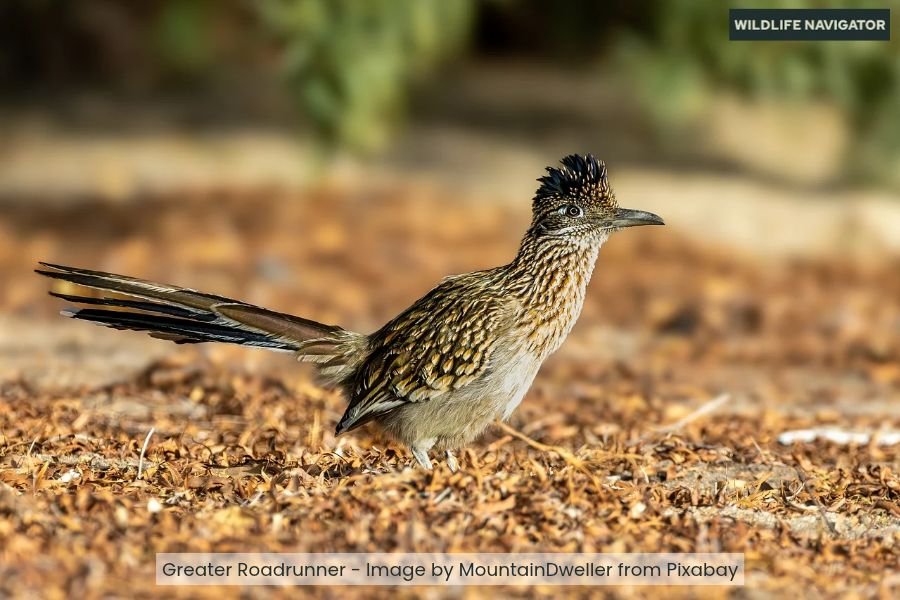
The Greater Roadrunner (Geococcyx californianus) is a distinctive ground-dwelling bird native to North America, particularly the arid and semi-arid landscapes of the southwestern United States and Mexico. A member of the cuckoo family, Cuculidae, it is recognised by its long legs, slender body, prominent head crest, streaked plumage and exceptionally long tail. Unlike many birds that spend most of their time flying between trees, the Greater Roadrunner is adapted for life on the ground, where it walks, runs and pursues prey through open landscapes.
The species is an opportunistic predator with a varied diet that includes insects, lizards, snakes, scorpions, spiders, rodents and small birds. Its ability to capture a wide range of prey allows it to survive in environments where food and water availability can change considerably throughout the year. Although capable of flight, it generally prefers running and uses its wings mainly when escaping danger or moving between elevated perches.
Greater Roadrunners inhabit deserts, scrublands, grasslands and open woodland habitats where scattered vegetation provides shelter and suitable hunting opportunities. They are generally resident birds, maintaining territories throughout the year rather than undertaking regular seasonal migrations. Their remarkable adaptations, unusual feeding habits and association with the American Southwest make them one of the most recognisable birds of the region.
Scientific Classification of the Greater Roadrunner
The Greater Roadrunner belongs to the family Cuculidae, which includes cuckoos, coucals and other related birds. Although many members of this family are associated with woodland habitats and arboreal lifestyles, the Greater Roadrunner has evolved a predominantly terrestrial way of life. It belongs to the genus Geococcyx, which contains two recognised species: the Greater Roadrunner and the Lesser Roadrunner (Geococcyx velox).
Its scientific name, Geococcyx californianus, reflects its taxonomic relationship with cuckoos and its historical association with California. The species was first described scientifically in the nineteenth century and is now widely recognised throughout its native range.
Scientific Classification
| Classification | Details |
|---|---|
| Kingdom | Animalia |
| Phylum | Chordata |
| Class | Aves |
| Order | Cuculiformes |
| Family | Cuculidae |
| Genus | Geococcyx |
| Species | Geococcyx californianus |
| Common Name | Greater Roadrunner |
The Greater Roadrunner is closely related to the Lesser Roadrunner, which occupies parts of Mexico and Central America. Both species share several characteristics, including long legs, elongated tails, strong bills and ground-oriented feeding behaviour. However, the Greater Roadrunner is generally larger and has a more extensive distribution across North America.
Unlike certain cuckoo species that lay their eggs in the nests of other birds, Greater Roadrunners normally construct and maintain their own nests. Both parents participate in incubation and the care of their offspring.
Physical Characteristics and Appearance
The Greater Roadrunner is a medium-to-large bird with a distinctive appearance that reflects its adaptation to terrestrial movement and hunting. Its elongated body, long legs and extended tail give it a relatively streamlined profile, particularly when running across open ground.
An adult typically measures approximately 50–62 cm (20–24 inches) in length, including its long tail. Its wingspan generally ranges from about 43–61 cm (17–24 inches), while body weight commonly falls between 227 and 341 grams (8–12 ounces). Individual measurements vary depending on sex, age and geographical location.
Plumage and Colouration
The upperparts of the Greater Roadrunner are predominantly brown, black and white, with streaked and mottled patterns across the back, wings and head. These markings provide effective camouflage among dry vegetation, rocky surfaces and desert soil.
Its throat and underparts are generally pale or whitish, with darker streaking across the breast and sides. The wings display a mixture of brown, black and white markings that become particularly noticeable when the bird spreads them during short flights or displays.
The combination of subdued colours helps the species remain relatively inconspicuous while moving through its surroundings. This camouflage is particularly useful when approaching prey or avoiding larger predators.
Head, Crest and Facial Features
One of the most recognisable features of the Greater Roadrunner is its prominent crest of dark feathers on the top of its head. The crest can be raised or lowered depending on the bird’s activity, alertness and social interactions.
It also has a long, slightly curved bill that is adapted for capturing and handling different types of prey. Its eyes are typically yellow, while the bare skin behind the eye contains colourful patches of blue and reddish-orange. These facial markings are especially noticeable in adult birds and can become more prominent during courtship and territorial displays.
Legs, Feet and Tail
The Greater Roadrunner has long, strong legs that support its terrestrial lifestyle. Its feet are adapted for walking, running and maintaining balance across uneven ground. Like other members of the cuckoo family, it has zygodactyl feet, with two toes pointing forward and two pointing backward.
Its exceptionally long tail is another important physical feature. The tail helps the bird maintain balance, change direction, brake while running and stabilise its body during sudden movements.
Males and females are similar in overall appearance, making visual identification of their sex difficult in the field. Juveniles generally have duller plumage and less prominent facial colouration than adults.
Habitat and Geographical Distribution
The Greater Roadrunner is native to North America, with its primary distribution centred on the southwestern United States and Mexico. It is particularly associated with dry landscapes where open ground, scattered shrubs and low vegetation create suitable conditions for hunting and nesting.
Its geographical range includes much of the southwestern United States, extending eastward into parts of the central and southern United States. It also occurs across extensive areas of northern and central Mexico.
Distribution in the United States
In the United States, Greater Roadrunners are commonly found in states such as California, Arizona, New Mexico and Texas. Their range also extends into Nevada, Utah, Colorado, Kansas, Oklahoma and parts of the southern Great Plains.
Smaller or more localised populations occur farther east, including areas of Arkansas, Missouri and Louisiana. Their distribution is not uniform throughout these states, as the availability of suitable habitat influences where established populations occur.
The Sonoran, Mojave and Chihuahuan desert regions provide some of the most characteristic habitats for this species. However, it is not restricted to deserts and can also occupy brushlands, grasslands and open woodland environments.
Distribution in Mexico
In Mexico, the Greater Roadrunner occurs across large parts of the northern and central regions. It is particularly associated with arid and semi-arid landscapes, including desert scrub, thorn scrub and open woodland.
Its distribution overlaps geographically with that of the Lesser Roadrunner in parts of Mexico, although the two species occupy different portions of the broader region.
Preferred Habitat
Greater Roadrunners favour environments that provide a combination of open ground and scattered vegetation. These conditions allow them to move rapidly while maintaining access to cover when threatened.
Their preferred habitats include:
- Deserts: Sonoran, Mojave and Chihuahuan desert landscapes with scattered shrubs, cacti and other drought-resistant vegetation.
- Desert scrublands: Areas dominated by low-growing shrubs and scattered bushes that provide shelter and hunting opportunities.
- Grasslands: Dry grasslands with patches of vegetation and open ground.
- Chaparral: Shrub-dominated habitats with a mixture of dense vegetation and exposed areas.
- Open woodlands: Woodland edges and areas with sufficient gaps for ground movement.
- Agricultural landscapes: Some cultivated and disturbed areas where prey remains available and suitable cover is present.
The species generally avoids extensive areas of completely open ground without vegetation, as well as dense, uninterrupted vegetation that restricts movement and visibility. A mixture of open spaces and protective cover is particularly important for its survival.
Greater Roadrunners are predominantly non-migratory. Established individuals and breeding pairs generally remain within their territories throughout the year, although local movements may occur in response to food availability, environmental conditions and breeding requirements.
Diet and Feeding Habits
The Greater Roadrunner is an opportunistic omnivore with a diet dominated by animal prey. It feeds on a wide variety of invertebrates and small vertebrates, allowing it to take advantage of different food sources throughout the year.
Its feeding habits are closely connected to the availability of prey in its surroundings. Insects and other arthropods may become particularly important during warmer months, while lizards, rodents and other small animals provide additional food when available.
Common Food Sources
The diet of the Greater Roadrunner includes:
- Insects: Grasshoppers, beetles, caterpillars, crickets and other large insects.
- Reptiles: Lizards, small snakes and occasionally larger reptiles that can be subdued.
- Arachnids: Spiders, tarantulas and scorpions.
- Small mammals: Mice, young rats and other small rodents.
- Birds: Small birds, including young individuals and occasionally adult birds.
- Amphibians: Frogs and other small amphibians when available.
- Eggs: Eggs from the nests of other birds.
- Plant material: Fruits, seeds and other plant foods, particularly when animal prey is less accessible.
Although its diet is varied, animal prey provides most of the nutritional value required by the species.
Hunting and Feeding Behaviour
Greater Roadrunners usually search for food while walking rapidly across the ground. They move through open areas, inspect vegetation and watch for movement among rocks, shrubs and patches of grass.
When prey is detected, the bird may suddenly accelerate and capture it with its bill. It can also leap into the air to catch flying insects or small birds.
Small prey is often swallowed whole. Larger or more difficult prey may be struck repeatedly against a hard surface, such as a rock, to kill or immobilise it before consumption. This behaviour is particularly useful when handling rodents, lizards and other animals that could otherwise injure the bird.
Greater Roadrunners are also known to consume venomous prey, including scorpions and certain snakes. Their ability to capture and eat such animals is an important aspect of their opportunistic feeding strategy.
Water Requirements
Living in arid environments requires efficient water management. Greater Roadrunners obtain a substantial amount of their moisture from the animals they consume, particularly reptiles and other prey with relatively high water content.
They can also drink from available water sources, including temporary pools and other natural or artificial water bodies. However, their dependence on dietary moisture helps them survive in environments where free-standing water is limited.
Behaviour and Lifestyle
The Greater Roadrunner is primarily terrestrial and spends much of its daily activity walking, running and searching for food. Although it can fly, it generally prefers to remain on the ground, where its long legs and streamlined body provide an advantage.
It is a diurnal species, meaning it is active mainly during daylight hours. Its activity often begins in the morning, when temperatures are relatively mild and prey may be easier to locate.
Running and Movement
Running is one of the defining characteristics of the Greater Roadrunner. It can reach speeds of approximately 30 km/h (19 mph) over short distances, although its actual speed varies depending on the terrain and circumstances.
During movement, the bird keeps its body relatively low and extends its long tail behind it. The tail acts as a stabilising structure, helping it maintain balance and make quick directional changes.
Its long legs allow it to cover ground efficiently while pursuing prey or escaping danger. This ability is particularly useful in open desert and scrubland habitats.
Flight Behaviour
Despite its running ability, the Greater Roadrunner is capable of flight. It may fly to escape predators, cross obstacles, reach elevated resting locations or move between nearby areas.
However, its flight is generally short and less sustained than that of many other birds. It usually relies on running rather than flying as its primary method of movement.
Territorial Behaviour
Greater Roadrunners are generally territorial birds. Breeding pairs may maintain and defend an area containing suitable feeding grounds, nesting sites and shelter.
Both members of a pair participate in territorial defence and may chase away intruding individuals. Their territories vary in size depending on habitat quality, prey availability and local population density.
Communication and Vocalisation
Greater Roadrunners communicate through a combination of vocalisations, physical displays and body movements.
Their most familiar call is a series of low-pitched, descending coos. These sounds are often delivered from an elevated perch, such as a shrub, fence post or low tree branch.
They may also produce other calls and sounds during territorial interactions, courtship and close-range communication.
Raising the crest, moving the tail and changing body posture are additional ways in which these birds communicate with one another.
Sunbathing and Temperature Regulation
One unusual behaviour of the Greater Roadrunner is sunbathing. During cool mornings, it may perch in a sunny location, raise or rearrange its back feathers and expose darker skin beneath the plumage.
This allows sunlight to warm the underlying skin and helps the bird increase its body temperature without relying entirely on metabolic heat production.
Like other birds living in hot environments, Greater Roadrunners also use physiological and behavioural methods to avoid overheating. These include seeking shade during extreme heat and adjusting their activity according to environmental conditions.
Hunting Techniques and Adaptations for Survival
The Greater Roadrunner is a highly capable ground hunter whose physical structure and behaviour are adapted to capturing a wide variety of prey. Its long legs, strong bill, quick reflexes and ability to change direction rapidly make it an effective predator in open and semi-open environments.
Rather than relying on flight to pursue prey, it generally hunts by walking, scanning the ground and making sudden dashes when an opportunity appears.
Ground-Based Hunting
The bird commonly searches for prey among rocks, shrubs, dry grass and patches of exposed soil. It moves relatively quickly while inspecting its surroundings for insects, reptiles and small vertebrates.
Once it identifies a potential target, it may approach cautiously before making a rapid forward movement to capture it. Its long legs allow it to pursue fast-moving prey, including lizards and large insects.
It can also make short jumps to catch insects or birds moving through the air. This flexibility allows it to exploit food sources both on the ground and slightly above it.
Capturing and Handling Snakes
The Greater Roadrunner is particularly famous for its ability to hunt snakes. Although snakes are not its only prey, the bird’s willingness to attack relatively large reptiles has contributed to its reputation as a skilled desert predator.
When hunting a snake, it may use rapid movements to avoid strikes and position itself to seize the animal with its bill. Once captured, the snake may be struck repeatedly against a hard surface to kill or immobilise it.
Larger snakes can be more difficult to handle, and the roadrunner must use caution to avoid injury. It is capable of killing and consuming rattlesnakes, although this behaviour should not be interpreted as immunity to snake venom or an ability to defeat every venomous snake.
In some observed encounters involving large snakes, two roadrunners have worked together. One bird may distract the snake while the other attempts to seize its head. Such coordinated hunting is particularly interesting because it demonstrates how the species can use behaviour, rather than physical strength alone, to overcome challenging prey.
Adaptations for Desert Survival
The Greater Roadrunner possesses several adaptations that help it survive in hot and relatively dry environments.
- Efficient water conservation: It obtains much of its moisture from food and has specialised salt-excreting glands near its eyes. These glands help remove excess salts while conserving water.
- Thermoregulation: It uses shade, changes in activity and sunbathing to regulate body temperature. It may also use gular fluttering, a rapid movement of the throat region, to increase evaporative cooling during hot conditions.
- Camouflaged plumage: Its mottled brown, black and white feathers help it blend into dry vegetation, rocky ground and desert surroundings.
- Long legs and strong feet: These features support efficient terrestrial movement, allowing the bird to travel quickly across open terrain and pursue prey.
- Flexible feeding habits: Its ability to consume different types of animals and occasional plant material reduces dependence on a single food source.
Together, these adaptations enable the Greater Roadrunner to occupy environments where temperature fluctuations and irregular food availability create considerable challenges for wildlife.
Breeding, Nesting and Life Cycle
Greater Roadrunners generally form monogamous breeding pairs, and many pairs maintain long-term relationships. They are territorial during the breeding season, with both partners participating in courtship, nest construction, incubation and the care of their young.
Breeding activity varies geographically and is influenced by rainfall, temperature and food availability. In many parts of the southwestern United States, nesting takes place during spring and early summer. In regions with favourable rainfall and sufficient food, breeding may occur later in the year or involve a second nesting attempt.
Courtship and Pair Formation
Courtship involves a series of movements, vocalisations and displays. Males may approach females while raising their crest, bowing, moving their tails and producing low-pitched calls.
One particularly distinctive courtship behaviour involves the male presenting food to the female. The offering may include a lizard, snake or other small prey item held in its bill.
Food presentation forms an important part of the courtship process and may help strengthen the pair bond before mating.
Nest Construction
Greater Roadrunners usually construct their nests in shrubs, small trees, cactus plants or dense vegetation. Nest sites are generally positioned above ground, although ground-level nests have occasionally been recorded.
The nest is an open cup constructed mainly from sticks and other plant materials. The interior may be lined with softer materials, including grass, leaves, feathers and other available items.
Both members of the pair participate in nest preparation. The male commonly collects nesting material, while the female contributes to arranging and constructing the nest.
Selecting a protected location helps reduce exposure to predators and extreme environmental conditions.
Eggs and Incubation
The female generally lays between two and six eggs, although clutch size can vary. The eggs are typically white to pale yellowish in colour.
Both parents participate in incubation, with the male often contributing a substantial share of this responsibility. The incubation period lasts approximately 19–20 days.
Eggs may hatch at different times because incubation can begin before the entire clutch has been laid. Consequently, chicks within the same nest may differ in size and development.
Chick Development and Parental Care
Newly hatched Greater Roadrunners are altricial, meaning they are relatively underdeveloped and depend on their parents for warmth, protection and food.
Both adults provide food to the chicks, bringing insects, small reptiles and other suitable prey to the nest.
As the young birds grow, they develop stronger legs and become increasingly capable of moving independently. They generally leave the nest at approximately 18–21 days of age.
However, leaving the nest does not mean they immediately become independent. The parents continue to provide food and protection for several weeks while the young develop their hunting and survival skills.
Young roadrunners may begin catching small prey relatively soon after leaving the nest, gradually improving their abilities through experience.
Lifespan
The Greater Roadrunner can live for several years in the wild. Records from banded individuals indicate that some birds have survived for at least seven years.
Actual lifespan depends on several factors, including food availability, predation, disease, habitat conditions and human-related threats.
Predators, Threats and Conservation Status
The Greater Roadrunner is a relatively widespread bird with a large geographical distribution across North America. It is currently classified as Least Concern (LC) on the IUCN Red List, indicating that it does not presently meet the criteria for a threatened category at the global level.
BirdLife International’s assessment published in 2022 also lists the species as Least Concern, with an estimated population of approximately 1.4 million mature individuals and an increasing overall population trend at the time of assessment.
However, a favourable global conservation status does not mean the species is free from threats. Local populations can experience declines when suitable habitat is destroyed or fragmented.
Natural Predators
Despite its speed and hunting ability, the Greater Roadrunner is vulnerable to several predators.
Potential natural predators include:
- Coyotes: These adaptable mammals can capture adult roadrunners and raid nests when opportunities arise.
- Hawks: Various hawk species may attack roadrunners, particularly in open landscapes.
- Eagles: Larger birds of prey can pose a threat to adults and juveniles.
- Owls: Some owl species may prey on roadrunners, particularly during periods of reduced visibility.
- Other carnivores: Raccoons, skunks and similar mammals may consume eggs or young birds.
Eggs and chicks are generally more vulnerable than healthy adults because they cannot escape predators effectively.
Habitat Loss and Fragmentation
Habitat degradation is one of the most significant long-term threats to Greater Roadrunner populations.
Urban expansion, road construction, agricultural development and other land-use changes can remove the shrubs, grasslands and open spaces required by the species.
Roadrunners depend on relatively large areas of suitable habitat for feeding, nesting and territorial activities. When natural landscapes become divided into isolated patches, birds may find it more difficult to locate prey, establish territories and find suitable nesting locations.
Habitat fragmentation can also increase encounters with vehicles, domestic animals and other human-related hazards.
Road Collisions
Despite their ability to run quickly, Greater Roadrunners sometimes cross roads while searching for food or moving through their territories.
Vehicle collisions can cause serious injuries and fatalities. Roads may also divide otherwise suitable habitats, restricting movement between feeding and nesting areas.
Domestic Animals and Human Disturbance
Free-roaming domestic cats and dogs can kill roadrunners, particularly young or inexperienced birds. Human disturbance around nesting locations may also affect breeding success.
Illegal shooting is another documented threat. In some areas, roadrunners have been killed because of mistaken beliefs that they threaten populations of popular game birds.
Climate Change
Climate change may create additional challenges for populations living in arid and semi-arid regions.
Prolonged droughts, extreme temperatures and changes in rainfall patterns can affect the availability of insects, reptiles and other prey. Changes in vegetation cover may also reduce suitable nesting and shelter locations.
Extreme heat during the breeding season can be particularly challenging for eggs and developing chicks.
Conservation Measures
Although the species is not currently globally threatened, maintaining suitable habitat remains important for its long-term survival.
Conservation efforts that can benefit Greater Roadrunners include:
- Protecting desert scrublands, grasslands and open woodland habitats.
- Maintaining connected natural vegetation between developed areas.
- Reducing unnecessary disturbance around nesting locations.
- Controlling free-roaming domestic animals.
- Reducing wildlife collisions through appropriate road planning.
- Monitoring local population trends and habitat conditions.
- Preventing illegal shooting and other forms of direct persecution.
Protecting the wider ecosystems in which the species lives also benefits numerous other desert and scrubland animals.
Ecological Importance of the Greater Roadrunner
The Greater Roadrunner plays an important role in the food webs of desert, scrubland and grassland ecosystems. As an opportunistic predator, it feeds on numerous small animals, including insects, reptiles, rodents and other birds.
Its feeding behaviour connects different parts of the food web and helps regulate populations of some smaller organisms.
Regulation of Insect and Small Animal Populations
Greater Roadrunners consume a wide range of insects and other invertebrates, including grasshoppers, beetles, spiders, scorpions and centipedes.
By feeding on these organisms, they contribute to the natural regulation of their populations. They also prey on lizards, small snakes and rodents, helping maintain predator-prey relationships within their habitats.
The extent of their influence varies according to local prey availability and environmental conditions.
Role in Desert Food Webs
The Greater Roadrunner occupies an important position as a mid-level predator in many of its habitats.
It feeds on smaller animals but is also vulnerable to larger predators, including coyotes, hawks and eagles. This makes it both a predator and a potential food source for other wildlife.
Its position in the food web illustrates the interconnected relationships that sustain arid ecosystems.
Ecological Relationships
Greater Roadrunners depend on a mixture of vegetation, open ground and prey-rich habitats. Their presence is therefore associated with landscapes that provide suitable conditions for a variety of smaller animals.
Although they are not considered a specialised indicator species, their habitat requirements highlight the importance of maintaining diverse vegetation structures within desert and scrubland environments.
Their feeding behaviour also demonstrates the ecological value of predators that can exploit several different prey groups rather than depending on a single food source.
Interesting Facts About the Greater Roadrunner
The Greater Roadrunner is one of the most recognisable birds of the American Southwest. Its unusual appearance, terrestrial lifestyle and remarkable hunting behaviour have made it a subject of scientific interest and popular culture.
Here are some interesting facts about this distinctive bird.
- It belongs to the cuckoo family: Despite its unusual running behaviour, the Greater Roadrunner is a member of Cuculidae, the same family that includes many familiar cuckoos.
- It prefers running to flying: Although capable of flight, it spends much of its time walking and running across the ground. Flight is generally used for short movements and escaping danger.
- It can run at approximately 30 km/h: Its long legs and streamlined body allow it to reach impressive speeds when pursuing prey or escaping threats.
- It can eat venomous animals: Its diet includes scorpions and venomous snakes. However, this does not make it immune to venom or prevent it from being injured during an encounter.
- It can hunt rattlesnakes: Greater Roadrunners are capable of capturing and killing rattlesnakes. Such encounters can be dangerous and require careful movements.
- It has a distinctive foot arrangement: Its zygodactyl feet have two toes pointing forward and two pointing backward, a characteristic shared with other cuckoo relatives.
- Its tail helps it change direction: The long tail acts as a stabilising structure during running, helping the bird balance, brake and make quick turns.
- It uses sunlight to warm its body: During cool mornings, it may expose darker skin beneath its back feathers to absorb solar heat.
- It can remove excess salt through specialised glands: Glands near its eyes help excrete concentrated salt, reducing the amount of water needed for this process.
- It is famous in popular culture: The Greater Roadrunner inspired the fictional Road Runner character from the Looney Tunes cartoons. The animated character’s familiar running behaviour reflects the real bird’s terrestrial lifestyle, although its speed and interactions with coyotes are exaggerated.
- It is generally a year-round resident: Rather than undertaking long-distance seasonal migrations, Greater Roadrunners usually remain within their established geographical ranges.
- It is an important predator in arid ecosystems: By consuming insects, reptiles, rodents, and other small animals, it contributes to the ecological balance of the environments it inhabits.
References and Sources
- Cornell Lab of Ornithology – Greater Roadrunner: Species Overview and Life History.
- Audubon – Greater Roadrunner Field Guide.
- BirdLife International – Greater Roadrunner Conservation Assessment.
- California Department of Fish and Wildlife – Greater Roadrunner Life History.
- University of Michigan Museum of Zoology – Animal Diversity Web: Greater Roadrunner.
Curating and documenting wildlife and protected areas through detailed guides and the continuously updated WN Index.
- Rosan Prasad
- Rosan Prasad
- Rosan Prasad
- Rosan Prasad