Garnet Pitta: Identification, Habitat, Diet, Behaviour and Facts

The Garnet Pitta (Erythropitta granatina) is a striking forest-dwelling bird native to Southeast Asia, recognised for its brilliant combination of crimson, deep blue, violet and black plumage. Belonging to the family Pittidae, this elusive bird is among the most visually distinctive members of the pitta family. Its colourful appearance, relatively small size and preference for dense tropical forests make it a particularly interesting species for birdwatchers and wildlife photographers.
The Garnet Pitta is found across parts of the Malay Peninsula, southern Thailand, southern Myanmar, Sumatra and Borneo. It primarily inhabits tropical lowland forests, where it spends much of its time close to the forest floor. Unlike many birds that forage in the canopy, it searches among fallen leaves, damp soil and decaying vegetation for insects and other small invertebrates. Its secretive nature and preference for thick forest cover can make locating it a challenging experience, even in areas where it occurs regularly.
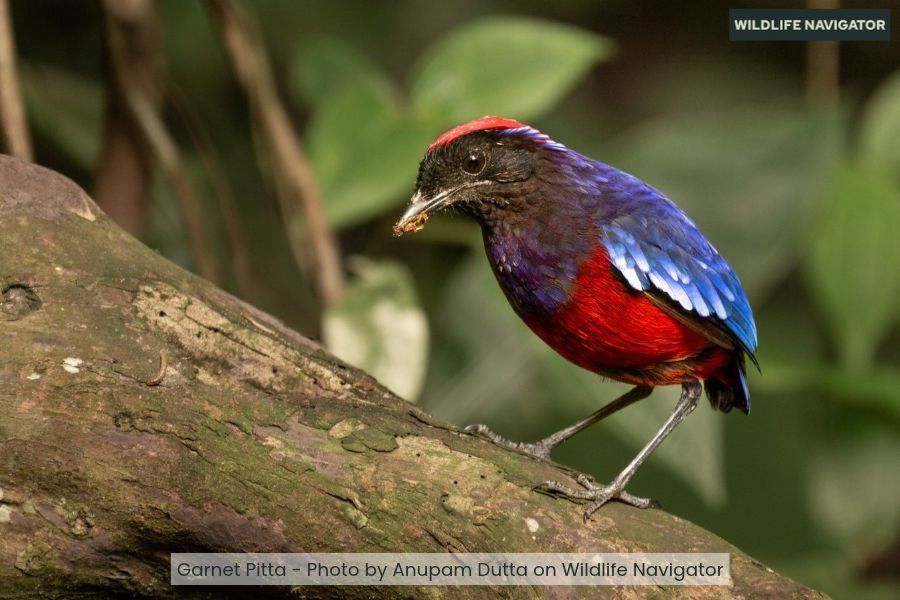
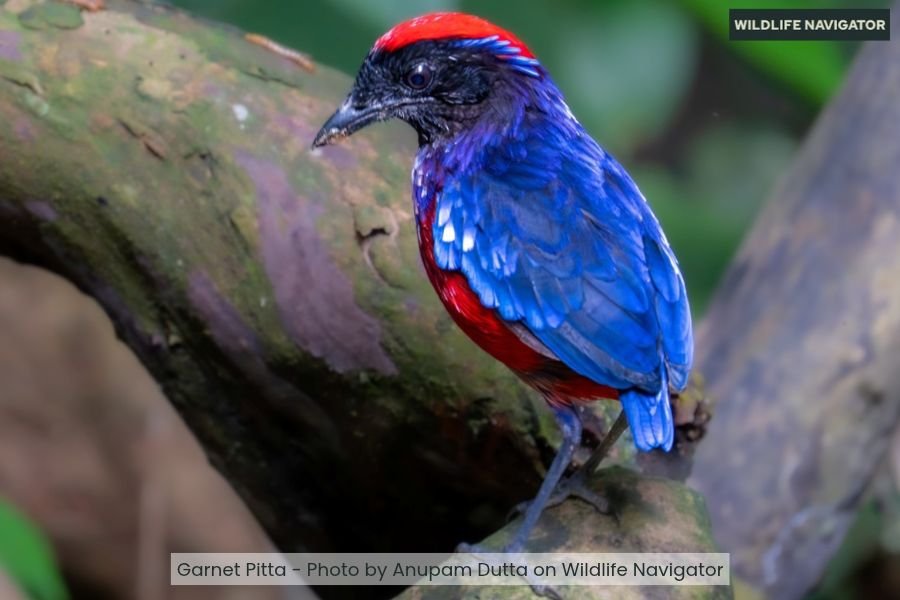
One of the most remarkable features of the Garnet Pitta is the contrast between its vivid plumage and the shaded forest environment it inhabits. Its bright red crown, dark facial markings, blue upperparts and crimson underparts create a distinctive appearance. These colours are particularly noticeable when the bird emerges from the undergrowth or pauses on a fallen tree branch.
Photographed in Kuantan, Pahang, Malaysia, in October 2026, the Garnet Pitta offers a fascinating subject for observing the beauty of Southeast Asia’s tropical forest birds. Through these photographs by wildlife photographer Anupam Dutta, the article explores the species’ identification, distribution, habitat, feeding habits, behaviour and conservation challenges.
Scientific Classification of the Garnet Pitta
The Garnet Pitta belongs to the family Pittidae, a group of colourful, predominantly forest-dwelling birds commonly known as pittas. It is classified under the genus Erythropitta, which includes several species of red and blue pittas found in Southeast Asia and surrounding regions.
The species was first described by Dutch zoologist Coenraad Jacob Temminck in 1830. It was historically placed in the genus Pitta under the name Pitta granatina, but subsequent taxonomic treatments recognise it as Erythropitta granatina.
| Taxonomic Rank | Classification |
|---|---|
| Kingdom | Animalia |
| Phylum | Chordata |
| Class | Aves |
| Order | Passeriformes |
| Family | Pittidae |
| Genus | Erythropitta |
| Species | Erythropitta granatina |
| Common Name | Garnet Pitta |
- Scientific name: Erythropitta granatina
- First described by: Coenraad Jacob Temminck, 1830.
- Former scientific name: Pitta granatina.
Subspecies and taxonomic classification
Two traditionally recognised subspecies are:
- Erythropitta granatina coccinea: Found across the Malay Peninsula, southern peninsular Thailand, southern Myanmar and Sumatra.
- Erythropitta granatina granatina: Found in Borneo, excluding its northern region under this traditional classification.
The subspecies differ in certain plumage characteristics, particularly the extent and distribution of red and blue colouring. Taxonomic arrangements can vary between bird-list authorities, so these names should be understood within the classification being followed.
Physical Characteristics and Identification
The Garnet Pitta is a small, compact bird with a distinctive combination of bright colours. Despite its relatively modest size, its striking plumage makes it one of the more recognisable pittas when seen clearly.
Body size and weight
The Garnet Pitta typically measures approximately 15–16 cm in length and weighs around 53–70 grams. It has a rounded body, relatively short tail, strong legs and a sturdy bill suited to searching for food among leaf litter and forest debris.
Its body structure is characteristic of ground-dwelling pittas. The relatively short wings and compact shape are suited to movement through dense vegetation rather than sustained long-distance flight.
Plumage and distinctive features
The Garnet Pitta’s plumage is its most remarkable identification feature. Different areas of its body display contrasting colours that become especially noticeable in good light.
Its principal identifying characteristics include:
- Crown and head: A bright red crown contrasts with the predominantly dark, almost black facial area.
- Facial markings: A vivid blue stripe behind the eye creates a noticeable contrast against the dark head.
- Upperparts: The back is predominantly dark, with glossy blue and violet tones.
- Wings: The upperwing coverts display brilliant blue colouring, sometimes appearing iridescent.
- Underparts: The breast and belly are predominantly crimson or deep red.
- Tail: The tail is relatively short and dark blue.
- Bill: The bill is dark and slightly pointed.
- Legs: The legs are generally greyish to bluish-grey.
The combination of a red crown, dark head, blue wings and crimson underparts provides a useful identification pattern.
Male, female and juvenile differences
Adult male and female Garnet Pittas are generally similar in appearance. There are no consistently obvious plumage differences that make field identification by sex straightforward.
Juvenile birds have a considerably less colourful appearance. They are predominantly brown, with paler underparts and less developed blue colouring on the wings and tail. Their plumage gradually changes as they mature, eventually developing the distinctive colours associated with adult birds.
Colour variations
The Garnet Pitta displays some regional variation in plumage, particularly between its recognised subspecies.
The Malay Peninsula and Sumatran form, E. g. coccinea, is particularly notable for its red crown and contrasting blue upperparts. The Bornean nominate form, E. g. granatina, has its own characteristic distribution of red and blue colouring.
These differences are useful when studying regional populations and identifying birds across the species’ geographic range.
Distribution and Geographic Range
The Garnet Pitta is native to Southeast Asia, with a distribution extending across parts of mainland and island Southeast Asia. Its range includes southern Myanmar, southern peninsular Thailand, the Malay Peninsula, Sumatra and Borneo, depending on the taxonomic treatment followed.
It is a predominantly lowland forest species, and its distribution is closely associated with areas that retain suitable tropical forest habitat.
Distribution across Southeast Asia
The species occurs in several countries and regions:
- Malaysia: Recorded in parts of Peninsular Malaysia, including Pahang and Johor, as well as in Borneo under the traditional classification.
- Thailand: Occurs in the southern part of the country, particularly in suitable forest habitats.
- Myanmar: Its distribution includes southern Myanmar.
- Indonesia: Found in Sumatra and Borneo.
- Brunei: Included within the wider Bornean distribution.
The distribution of the species is not continuous across all these regions. Suitable forest conditions and the availability of connected habitat influence where individual populations can survive.
Resident and migratory populations
The Garnet Pitta is generally considered a sedentary species rather than a long-distance migrant. Individuals are associated with suitable forest habitats throughout the year.
Its movements are likely to be influenced by local conditions, including food availability, breeding requirements and the distribution of suitable forest cover. However, detailed information about seasonal movements remains comparatively limited.
Garnet Pitta in Pahang, Malaysia
Pahang is an important location in Peninsular Malaysia for observing tropical forest birds. The Malaysian Biodiversity Information System records the Garnet Pitta in Pahang and Johor, providing documented evidence of its occurrence in the state.
The photographs featured in this article were taken in Kuantan, Pahang, in October 2026. They capture different views of the bird, including its distinctive plumage, its presence on fallen branches and its appearance among the leaf litter of the forest floor.
Habitat and Preferred Environment
The Garnet Pitta is primarily associated with tropical moist lowland forests, where dense vegetation, shaded ground and abundant leaf litter provide suitable conditions for feeding and shelter. It generally prefers areas with substantial forest cover, although it can also occur in some secondary and previously logged forests.
Its habitat preferences are closely connected to the availability of food, suitable nesting locations and protection from disturbance. Unlike many colourful forest birds that spend most of their time in the canopy, the Garnet Pitta is strongly associated with the lower layers of the forest.
Natural habitats
The species is commonly associated with the following environments:
- Primary tropical forests: Relatively undisturbed forests with dense vegetation and a naturally developed forest floor.
- Secondary forests: Regenerated woodland that can provide suitable feeding and shelter conditions.
- Logged forests: Some populations may persist in selectively logged areas where sufficient vegetation and forest structure remain.
- Swampy forest areas: Moist environments can provide favourable conditions for ground-dwelling invertebrates.
- Lowland forests: The species is primarily associated with lower elevations, generally occurring up to approximately 300 metres, although local records may extend higher.
These habitats provide a combination of shaded ground, fallen branches, decomposing vegetation and suitable foraging areas.
Adaptation to forest environments
The Garnet Pitta’s compact body and relatively short wings are suited to moving through dense vegetation. Its strong legs allow it to walk and search for food along the forest floor, where fallen leaves, roots and decaying wood provide potential feeding opportunities.
Forest cover also offers protection from direct sunlight and helps maintain the moist conditions associated with its preferred feeding environment.
Although it may occasionally appear on exposed fallen branches or relatively open patches of the forest floor, it remains closely associated with the surrounding vegetation.
Diet and Feeding Habits
The Garnet Pitta is primarily an insectivorous bird, feeding on small invertebrates found among leaf litter, damp soil and decaying vegetation. Its feeding habits are closely connected to the forest floor, where it searches for insects and other small food items.
Rather than relying on aerial hunting or catching flying insects, it generally searches for food by examining the ground and probing suitable places with its bill.
What does the Garnet Pitta eat?
Its diet includes a variety of small forest-dwelling organisms, such as:
- Insects and their larvae.
- Ants and termites.
- Small snails.
- Other small invertebrates.
- Occasionally, fruits.
Insects form an important part of its diet, while small snails and other invertebrates provide additional food sources. The precise composition of its diet can vary according to the availability of food in different forest environments.
Hunting and foraging techniques
The Garnet Pitta uses its bill to search through leaf litter and damp soil. It may move fallen leaves aside, examine decaying plant material and probe soft ground to locate hidden prey.
Its feeding techniques include:
- Ground searching: Walking slowly through leaf litter while looking for small insects and other invertebrates.
- Probing: Using its pointed bill to investigate damp soil and accumulated vegetation.
- Searching around fallen wood: Examining decaying branches and logs where insects and other small organisms may be present.
- Opportunistic feeding: Taking advantage of accessible food items encountered during its movements.
These techniques allow the bird to exploit food resources that may remain unnoticed by species feeding higher in the forest.
Feeding behaviour
The Garnet Pitta is generally a solitary forager. It searches for food independently and spends much of its feeding time close to the ground.
Its relatively secretive nature means that it can sometimes be difficult to observe while feeding. Dense vegetation, uneven ground and fallen leaves provide plenty of places for the bird to remain partially concealed.
The photographs from Pahang show the bird in two particularly interesting settings: perched on fallen branches and standing among dry leaves. Together, these images illustrate the close relationship between the species and its forest-floor environment.
Behaviour and Daily Activities
The Garnet Pitta is a secretive forest bird whose daily activities are closely associated with the lower vegetation layers. It is primarily active during daylight hours and spends much of its time searching for food, moving through the undergrowth and maintaining its territory.
Unlike birds that frequently travel between different forest levels, the Garnet Pitta generally remains close to the ground. Its movements are often difficult to follow because it can quickly disappear behind vegetation, roots and fallen branches.
Movement and flight
The Garnet Pitta is adapted more for short movements through dense vegetation than for extended flights.
Its relatively short, rounded wings and compact body allow it to move between nearby feeding and resting locations. When disturbed, it may make a quick flight into thicker vegetation before settling out of sight.
Although it is capable of flying efficiently over short distances, it is not commonly observed soaring or making prolonged flights in open areas.
Territorial behaviour
Pittas are generally territorial birds, and the Garnet Pitta is known to display territorial behaviour.
Territorial interactions can involve vocalisations and visual displays. Research on pitta behaviour has documented a distinctive bowing display in Garnet Pittas, in which two birds facing one another adopt upright postures before slowly lowering their bodies towards the ground. Such displays are associated with interactions along territorial boundaries. Territorial behaviour is particularly relevant during the breeding period, when individuals may defend areas associated with nesting and feeding.
Social behaviour
The Garnet Pitta is generally encountered individually rather than in large flocks. Its feeding habits and preference for dense forest environments contribute to its relatively solitary appearance.
During the breeding season, interactions between individuals become more important as pairs establish territories, engage in courtship and participate in reproductive activities.
Communication and vocalisations
Vocal communication plays an important role in the behaviour of pittas.
Their calls are generally composed of relatively short, distinctive notes that can carry through forest vegetation. Vocalisations help individuals communicate and establish territorial presence, particularly during the breeding period.
For birdwatchers, recognising the calls of the Garnet Pitta can be useful because the species may be heard before it is seen. Its preference for dense vegetation often makes sound an important clue when attempting to locate it.
Reproduction and Breeding Behaviour
The breeding biology of the Garnet Pitta is less extensively documented than its physical appearance and geographic distribution. Nevertheless, available species accounts provide information about its nesting habits, breeding period and reproductive behaviour.
Like other pittas, it is associated with ground-level nesting, using concealed locations within forest vegetation to provide shelter for its eggs and young.
Breeding season and courtship
The reported breeding season extends approximately from March to August, although the timing can vary with geographic location and local environmental conditions.
Vocal communication and territorial behaviour are important during this period. Calls may help individuals maintain contact and communicate their presence within suitable breeding territories.
Courtship and pair interactions take place within the forest environment, where dense vegetation provides protection and suitable nesting locations.
Nesting habits
The Garnet Pitta builds a domed nest, generally positioned on or close to the ground.
The nest is constructed using natural materials, including:
- Small twigs.
- Dry leaves.
- Plant fibres.
- Other available vegetation.
A characteristic feature of the nest is its side entrance, which provides access to the enclosed nesting chamber. Its structure helps conceal the nest within the surrounding forest-floor vegetation.
Eggs and incubation
Available species accounts report a clutch of approximately two eggs.
The eggs are laid inside the enclosed nesting chamber, where the surrounding vegetation and nest structure provide some protection from environmental conditions and potential predators.
Detailed information about the precise incubation period and the division of incubation duties between adults is limited in commonly available species accounts. It is therefore important not to assume that all breeding details are identical to those of other pitta species.
Chick development and parental care
After hatching, young Garnet Pittas depend on their parents for food, warmth and protection.
The adults must continue locating suitable food resources while attending to the needs of their developing offspring. The concealed nesting location is particularly important during this vulnerable stage.
Further field observations and breeding studies would help improve understanding of chick development, parental feeding patterns and the reproductive success of different populations.
Adaptations and Survival Strategies
The Garnet Pitta possesses several physical and behavioural characteristics that help it survive in dense tropical forests. Its specialised body structure, feeding techniques and ability to remain concealed are particularly important in an environment where visibility can be limited.
Strong legs and ground movement
One of the most noticeable characteristics of the Garnet Pitta is its relatively strong legs.
These allow it to walk across uneven forest floors, move between fallen branches and search through leaf litter for food. Its ground-oriented lifestyle makes leg strength especially important for daily movement and foraging.
Specialised bill
Its dark, pointed bill is suited to picking up small food items and probing through leaf litter and damp soil.
This adaptation allows the bird to investigate narrow spaces between leaves, roots and decaying wood where insects and other invertebrates may be found.
Compact body and short wings
The Garnet Pitta’s compact body and relatively short wings are suited to navigating dense vegetation.
Instead of depending on long-distance flight, it generally makes short movements between nearby locations. This helps it move through the forest undergrowth, where branches and vegetation can restrict movement.
Distinctive plumage
Its vivid red, blue, violet and black plumage is one of its most recognisable characteristics.
The colours are particularly striking when the bird is photographed in good light. However, the Garnet Pitta’s appearance should not be interpreted as evidence of a specific camouflage strategy without further research.
Its ability to remain difficult to observe is more closely associated with its preference for dense vegetation and its relatively secretive behaviour.
Flexible feeding behaviour
The Garnet Pitta feeds on different types of small invertebrates rather than depending on a single food source.
This dietary flexibility allows it to exploit different feeding opportunities within its forest habitat. Searching through leaf litter, probing soil and examining decaying wood provide several ways to locate food.
Ecological Importance and Role in the Ecosystem
The Garnet Pitta forms part of the complex food web of Southeast Asian tropical forests. Although it is a relatively small bird, its feeding habits connect it with several groups of organisms living on the forest floor.
Its ecological importance is primarily associated with its consumption of insects and other small invertebrates.
Regulation of invertebrate populations
By feeding on insects, larvae, ants, termites and other small organisms, the Garnet Pitta participates in the natural regulation of forest invertebrate populations.
These organisms form an important part of tropical forest ecosystems, contributing to decomposition, nutrient cycling and other ecological processes.
The Garnet Pitta is one of many predators that interact with these organisms, although its precise effect on local invertebrate populations has not been extensively quantified.
Position in the food chain
The Garnet Pitta occupies a position as a small insectivorous predator within the forest food web.
It consumes smaller organisms and may itself become vulnerable to larger predators, including forest-dwelling birds of prey and other animals capable of hunting small birds.
Its eggs and young are particularly vulnerable because its nests are located on or close to the forest floor.
Contribution to forest biodiversity
The presence of the Garnet Pitta contributes to the biodiversity of Southeast Asian tropical forests.
Its association with forest-floor habitats also highlights the importance of protecting vegetation layers that are sometimes overlooked in conservation planning.
Conserving a forest does not simply mean protecting its largest trees or canopy-dwelling wildlife. The undergrowth, leaf litter, fallen wood and moist ground also support a wide range of specialised species.
The Garnet Pitta is a good example of a bird whose survival depends on these less visible components of the forest ecosystem.
Conservation Status, Threats and Interesting Facts
The Garnet Pitta is a forest-dependent species whose long-term survival is closely linked to the protection of tropical lowland forests across Southeast Asia. Although it occurs across several countries, the availability of suitable habitat is an important factor influencing its distribution and population stability.
Conservation status
Near Threatened
IUCN Red List: Near Threatened (NT)
The Garnet Pitta is listed as Near Threatened on the IUCN Red List. This classification indicates that the species is not currently classified as threatened under the categories Vulnerable, Endangered or Critically Endangered, but it faces conservation concerns that warrant attention.
Its dependence on tropical forests makes it particularly vulnerable to extensive habitat destruction and degradation.
Major threats
Several human-related activities can affect the survival of the Garnet Pitta.
- Deforestation: The clearing of tropical forests for agriculture, plantations, infrastructure and development reduces the availability of suitable habitat.
- Forest fragmentation: When continuous forests are divided into smaller isolated patches, populations can become separated, potentially limiting movement and access to suitable resources.
- Logging: Forest logging can alter vegetation structure, disturb the forest floor and reduce the quality of suitable habitat.
- Forest fires: Fires can destroy vegetation, damage nesting locations and affect the availability of food and shelter.
- Agricultural expansion: Conversion of natural forest into plantations and agricultural land can reduce the amount of suitable habitat available to forest-dependent birds.
Habitat loss is particularly concerning because the Garnet Pitta relies on forest environments for feeding, nesting and shelter.
Conservation and protection
Protecting remaining tropical forests is essential for the long-term survival of the Garnet Pitta.
Important conservation measures include:
- Protecting remaining primary lowland forests.
- Maintaining forest connectivity between suitable habitats.
- Encouraging responsible forest management.
- Preventing illegal logging and destructive land clearing.
- Monitoring populations through field surveys.
- Supporting research into breeding ecology and habitat requirements.
- Promoting responsible birdwatching and wildlife photography.
Malaysia’s forest ecosystems are particularly important because they support a wide variety of specialised wildlife, including several species of pittas.
Long-term conservation efforts should focus not only on protecting individual species but also on maintaining the ecological conditions that allow entire forest communities to survive.
Interesting facts about the Garnet Pitta
- Colourful forest-floor bird: Despite its brilliant plumage, the Garnet Pitta spends much of its time close to the ground rather than in the forest canopy.
- Relatively small bird: It measures approximately 15–16 cm in length, making it a compact member of the pitta family.
- Striking colour combination: Its red crown, blue wings, dark facial markings and crimson underparts create an unmistakable appearance.
- Secretive species: Dense vegetation and its ground-dwelling habits can make it difficult to observe in the wild.
- Specialised forager: It searches through leaf litter and damp soil for insects and other small invertebrates.
- Distinctive nesting structure: Its nest is dome-shaped, made from natural vegetation and generally features a side entrance.
- Territorial display: Garnet Pittas have been documented performing a slow bowing display during territorial interactions.
- Southeast Asian forest species: Its distribution includes the Malay Peninsula, southern Thailand, southern Myanmar, Sumatra and Borneo under the traditional species classification.
- Two traditionally recognised subspecies: E. g. coccinea and E. g. granatina are the two commonly recognised geographical forms.
- Species facing habitat pressure: Its Near Threatened conservation status highlights the importance of protecting the tropical forests on which it depends.
Photographing the Garnet Pitta: A Field Perspective
Photographing the Garnet Pitta in Kuantan, Pahang, Malaysia, in October 2026 offered an opportunity to document one of Southeast Asia’s most visually distinctive forest birds.
The photographs by Anupam Dutta present the bird in different natural settings, from a close view of its brilliant blue wings and crimson body to wider compositions showing its relationship with the forest floor and fallen branches.
Some frames highlight its striking facial markings and bright red crown, while others show the bird standing among dry leaves and natural forest debris. These different perspectives offer more than a study of plumage; they also provide a glimpse into the environment in which this species lives.
For wildlife photographers, documenting a bird such as the Garnet Pitta requires patience, careful observation and respect for its natural surroundings. Maintaining a suitable distance, avoiding disturbance and allowing the bird to move naturally are essential parts of responsible wildlife photography.
The Garnet Pitta is a reminder that some of the most remarkable birds are found not in open skies or exposed treetops, but in the quieter, less visible layers of tropical forests.
Frequently Asked Questions (FAQs)
References and Sources

Documenting Dwarf Kingfishers across the world.
- Anupam Dutta