Jaguar (Panthera onca): Facts, Habitat, Diet, Behaviour & Conservation

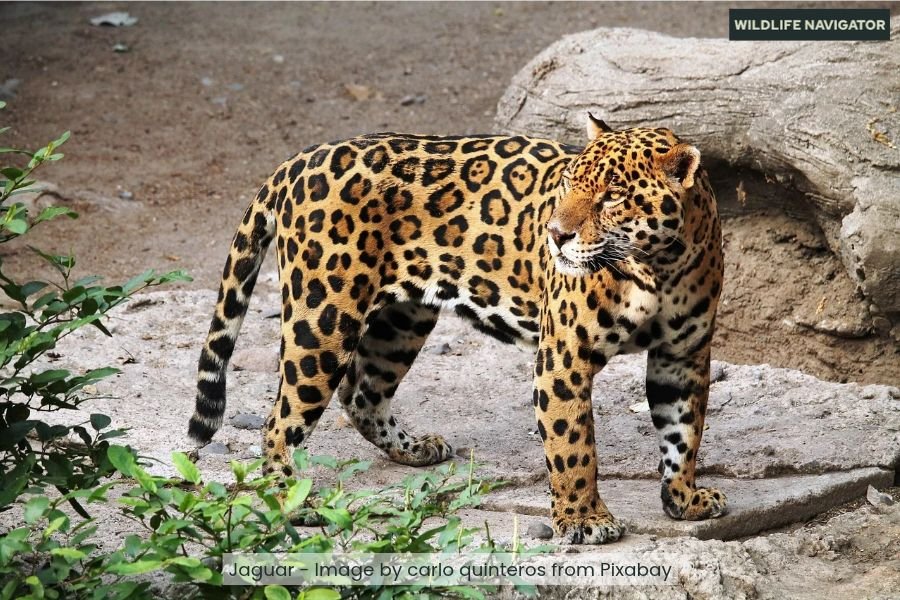
The jaguar (Panthera onca) is the largest wild cat in the Americas and one of the most powerful predators in the animal kingdom. Recognised by its muscular body, broad head, powerful jaws and distinctive black rosette patterns, this elusive big cat inhabits a wide range of environments, from tropical rainforests and wetlands to grasslands and dry forests. It is the only living member of the genus Panthera native to the Americas.
Jaguars are predominantly found across Central and South America, where they occupy important ecological landscapes, including the Amazon Rainforest and the Pantanal wetlands. Their strong association with water, excellent swimming abilities, and adaptable hunting techniques allow them to survive in diverse habitats. Unlike many other large cats, jaguars frequently hunt aquatic and semi-aquatic animals, including caimans and turtles.
As apex predators, jaguars play an important role in maintaining ecological balance by regulating prey populations and influencing food-web relationships. However, habitat destruction, fragmentation, illegal hunting, and conflicts with livestock owners have reduced their historical distribution. Although the species is currently classified as Near Threatened on the IUCN Red List, several regional populations face considerably greater conservation risks.
Scientific Classification of the Jaguar
The jaguar belongs to the family Felidae, which includes all living cats, and the genus Panthera, a group of large cats known for their ability to roar. Its scientific name, Panthera onca, identifies it as a distinct species within this genus. It is the only living representative of Panthera found naturally in the Americas.
Its classification reflects its position as a mammalian carnivore and a member of the big-cat lineage. Although jaguars share the genus Panthera with lions, tigers, leopards and snow leopards, they have developed distinctive physical and behavioural adaptations suited to the environments of Central and South America.
| Classification | Details |
|---|---|
| Kingdom | Animalia |
| Phylum | Chordata |
| Class | Mammalia |
| Order | Carnivora |
| Family | Felidae |
| Subfamily | Pantherinae |
| Genus | Panthera |
| Species | Panthera onca |
| Common Name | Jaguar |
Historically, several jaguar subspecies were proposed based on geographical and physical differences between populations. However, modern genetic and morphological research has not supported the continued recognition of those traditional subspecies as universally accepted taxonomic divisions. The jaguar is generally treated as a monotypic species, although geographically distinct populations and evolutionary lineages are recognised in conservation research.
Jaguars also display natural colour variations. Melanistic individuals, commonly called black jaguars, belong to the same species and are not a separate taxonomic group.
Physical Characteristics and Appearance of the Jaguar
The jaguar has a compact, muscular body, a broad head and relatively short, powerful limbs. These characteristics distinguish it from other large cats, particularly the more slender leopard. Its physical structure provides considerable strength for capturing large prey, moving through dense vegetation and swimming across rivers and wetlands.
Adult jaguars generally measure approximately 110–170 cm in head-and-body length, excluding the tail, which can measure around 44–80 cm. Their shoulder height is approximately 63–76 cm, although measurements vary geographically and between individuals.
Adult body weight generally ranges from approximately 36–148 kg. Males are usually larger and heavier than females, with some populations showing considerable differences in average body size. Jaguars living in the Pantanal and Venezuelan Llanos can be particularly large, while individuals from certain Central American and Amazonian populations are generally smaller.
Coat Colour and Rosette Patterns
The jaguar’s coat typically ranges from pale yellow and golden-brown to reddish-yellow. Its underside, throat, inner legs and parts of the belly are usually whitish or cream-coloured.
The most recognisable feature is its distinctive black rosette pattern. Unlike the smaller, more uniformly arranged spots of many leopards, jaguar rosettes are generally larger and often contain one or more small black spots in their centres. These markings extend across the back, shoulders and flanks, while the head, legs and underside also contain smaller dark spots.
Each jaguar has a unique arrangement of markings, making its coat pattern useful for identifying individual animals during wildlife research and camera-trap monitoring.
The spotted coat provides effective camouflage in forests, where sunlight passing through leaves creates alternating patches of light and shadow. This natural pattern helps jaguars remain concealed while resting, moving through vegetation or approaching prey.
Head, Jaws and Teeth
Jaguars have broad skulls, strong jaw muscles and exceptionally robust canine teeth. Their powerful jaws are among their most distinctive anatomical features and contribute significantly to their hunting success.
Unlike many large cats that commonly suffocate prey through a throat bite, jaguars can use a powerful bite directed at the skull or neck of certain animals. Their teeth and jaw structure also allow them to penetrate the protective coverings of some reptiles, including turtle shells and caiman armour.
This ability makes them particularly effective predators in environments where aquatic reptiles form part of the available prey.
Melanistic Jaguars (Black Jaguars)
Melanism is a genetic condition that causes increased pigmentation, resulting in a predominantly black coat. Jaguars with this condition are commonly known as black jaguars or black panthers.
Although their fur appears almost entirely black, the characteristic rosette patterns are often still visible under direct sunlight or suitable lighting. Melanistic jaguars are particularly associated with densely forested environments in parts of South America.
A black jaguar is not a different species. It is simply a colour variation of Panthera onca, just as melanistic leopards are colour variations of Panthera pardus.
Habitat and Geographical Distribution of the Jaguar
Jaguars inhabit a wide variety of natural environments across Central and South America. Although they are strongly associated with tropical rainforests, they are not restricted to dense forests. Their distribution also includes wetlands, seasonally flooded landscapes, grasslands, dry forests, shrublands and other habitats that provide sufficient prey, vegetation cover and access to water.
The species has a particularly strong association with freshwater environments. Rivers, lakes, marshes and wetlands provide important hunting opportunities, drinking water and movement corridors. However, habitat suitability also depends on prey availability, vegetation structure and the level of human disturbance.
Natural Habitat
The major habitats occupied by jaguars include:
- Tropical rainforests: Dense forests, particularly the Amazon, provide abundant prey, vegetation cover and access to freshwater.
- Wetlands: Seasonally flooded forests, marshes and swamps provide important feeding and breeding landscapes.
- Grasslands and savannas: Jaguars inhabit open landscapes where suitable vegetation, prey and water sources remain available.
- Dry forests: Some populations occupy tropical dry forests and woodland habitats with seasonal rainfall.
- Riverine forests: Vegetation along rivers provides shelter, hunting opportunities and natural movement routes.
Jaguars generally require sufficiently large territories with suitable prey populations. Habitat quality is therefore influenced not only by vegetation but also by the availability of connected landscapes.
Geographical Distribution
The jaguar’s historical distribution extended from the southwestern United States through Mexico and Central America to much of South America.
Today, its recognised range includes approximately 18 countries and territories across the Americas, extending from Mexico through Central America and into northern and central South America, with its southern distribution reaching Argentina.
Important countries supporting wild jaguar populations include:
- Mexico
- Belize
- Guatemala
- Honduras
- Nicaragua
- Costa Rica
- Panama
- Colombia
- Venezuela
- Ecuador
- Peru
- Brazil
- Bolivia
- Paraguay
- Argentina
- Guyana
- Suriname
- French Guiana
Brazil supports a particularly important proportion of the global jaguar population, especially across the Amazon and Pantanal landscapes.
The species has disappeared from significant portions of its former range, particularly in parts of the United States and northern Mexico, as well as several fragmented areas of Central and South America.
Important Jaguar Habitats
The Amazon Rainforest is one of the most extensive and important habitats for jaguars. Its vast forest systems, freshwater networks and diverse prey populations support substantial populations across several South American countries.
The Pantanal, a large tropical wetland spanning Brazil, Bolivia and Paraguay, is another major stronghold. Its seasonally flooded grasslands, forests and waterways provide favourable conditions for jaguar hunting and movement. The region is particularly well known for jaguar sightings along rivers.
Other important landscapes include the Gran Chaco, the Maya Forest and remaining sections of the Atlantic Forest.
Territory and Habitat Requirements
Jaguars are territorial animals, and the size of their home ranges varies according to prey availability, habitat quality, population density and sex. Males generally occupy larger territories than females, and individual territories may overlap.
Healthy habitat connections are particularly important because they allow individuals to disperse, find mates and maintain genetic exchange between populations. Roads, agricultural development and deforestation can divide formerly connected landscapes into smaller, isolated habitat patches.
Diet and Hunting Behaviour of the Jaguar
Jaguars are carnivorous predators with a highly adaptable diet. They hunt a broad range of mammals, reptiles, fish and occasionally birds, depending on the prey available in their environment.
Their powerful bodies, strong jaws, sharp claws and ability to move through both terrestrial and aquatic habitats make them versatile hunters. Unlike some large cats that rely heavily on a relatively narrow range of prey, jaguars can adapt their feeding habits to different ecosystems.
What Do Jaguars Eat?
The jaguar’s diet includes numerous species, particularly medium-sized and large animals.
Common prey includes:
- Capybaras
- Peccaries
- Deer
- Tapirs
- Caimans
- Turtles
- Armadillos
- Agoutis
- Monkeys
- Fish
- Iguanas
- Other reptiles and small mammals
Capybaras and caimans are particularly important prey in some Pantanal populations, while peccaries and other mammals are commonly hunted in forest environments.
Jaguars may also prey on livestock when natural prey becomes scarce or when agricultural development brings domestic animals into their territories. Such interactions can contribute to conflict between jaguars and livestock owners.
Hunting Techniques
Jaguars generally rely on stealth and ambush rather than prolonged pursuit. They move quietly through vegetation, use natural cover to approach prey and launch a short, powerful attack when an opportunity arises.
Their spotted coat helps them remain concealed in forest vegetation, while their muscular limbs allow them to accelerate quickly over short distances.
When hunting, a jaguar may approach an animal from behind vegetation, wait near a trail or position itself close to a water source where prey regularly gathers. Once within striking distance, it uses its forelimbs, claws and powerful jaws to capture and kill the animal.
The Jaguar’s Powerful Bite
One of the most remarkable characteristics of the jaguar is its exceptionally powerful bite relative to its body size.
Its broad skull and strong jaw muscles provide considerable biting force, allowing it to tackle prey protected by thick skin, scales or hard shells.
Jaguars are known to kill some prey by delivering a bite to the skull, including certain caimans and turtles. This hunting method differs from the throat-focused killing techniques commonly associated with other large cats.
Their ability to capture and kill heavily protected prey is an important advantage in wetlands and river systems.
Hunting and Feeding Patterns
Jaguars generally hunt alone because they are solitary animals. Their activity may occur during the day or night, although many populations show considerable nocturnal and crepuscular activity.
After a successful hunt, a jaguar may feed on its prey over an extended period, depending on the size of the animal and environmental conditions. Larger kills can provide food for several feeding sessions.
Their feeding behaviour is strongly influenced by prey availability, habitat conditions and competition with other predators.
Behaviour and Social Structure of the Jaguar
Jaguars are predominantly solitary animals. Unlike lions, which live in social groups called prides, adult jaguars generally spend most of their lives independently.
Their solitary lifestyle is closely associated with their territorial behaviour and hunting strategy. Individuals establish and maintain home ranges that provide access to prey, water and suitable resting locations.
Solitary Lifestyle
Adult jaguars generally live alone, with temporary associations occurring during mating and between mothers and their offspring.
Females raise their cubs without regular assistance from males. Young jaguars remain with their mothers during their early development, learning essential behaviours before eventually becoming independent.
Although adult individuals usually avoid unnecessary encounters, their territories can overlap, particularly between males and females.
Territorial Behaviour
Jaguars use several forms of communication to establish and maintain territories.
Common territorial behaviours include:
- Scratching tree trunks with their claws.
- Depositing urine and other scent marks.
- Rubbing their bodies against vegetation.
- Leaving scent signals along frequently used routes.
- Vocalising to communicate with other individuals.
These behaviours help jaguars communicate their presence and reduce the need for direct physical encounters.
Swimming and Climbing Abilities
Jaguars are among the most capable swimmers of the large cats. They frequently enter rivers, lakes and wetlands to cross waterways, hunt prey or move between different parts of their territories.
Their swimming ability is particularly important in the Amazon and Pantanal, where seasonal flooding can transform large areas of forest and grassland into interconnected waterways.
They are also capable climbers and can use trees for resting, observation and movement. However, unlike leopards, which frequently carry their kills into trees, jaguars generally rely more heavily on ground-based hunting.
Communication and Vocalisation
Jaguars communicate through vocal sounds, scent marking and physical signals.
Their vocalisations include growls, grunts and distinctive calls commonly described as roars or cough-like sounds. Roaring helps individuals communicate over distances, particularly during breeding interactions and territorial encounters.
Scent-based communication is also important because it allows jaguars to identify the presence of other individuals without direct contact.
Daily Activity Patterns
Jaguars can be active throughout the day, although many individuals show increased activity during dusk, nighttime and early morning.
Their activity patterns vary according to temperature, prey availability, human disturbance and local environmental conditions. In areas with substantial human activity, some jaguars may shift more of their movements towards nighttime.
Reproduction and Life Cycle of the Jaguar
Jaguars reproduce sexually, and females generally raise their offspring independently. Breeding can occur throughout the year across much of their range, although seasonal patterns may occur in certain geographical regions.
Reproduction and cub development are important aspects of jaguar population survival, particularly because young individuals require an extended period of maternal care before becoming fully independent.
Breeding Season and Mating
Jaguars do not have one universal breeding season across their entire geographical range. Mating may occur throughout the year, although environmental conditions and prey availability can influence reproductive timing.
During the breeding period, males and females temporarily associate. Courtship involves vocal communication, scent marking and physical interactions.
After mating, the male generally separates from the female, leaving her responsible for pregnancy, birth and raising the cubs.
Gestation Period
The gestation period of a jaguar lasts approximately 90–110 days, with an average of around 101 days.
Before giving birth, the female selects a sheltered location that provides protection from potential predators and environmental disturbances. Suitable locations may include dense vegetation, secluded forest areas, caves or other concealed sites.
Jaguar Cubs
A female usually gives birth to one or two cubs, although litters can contain up to four.
Newborn cubs are small, helpless and completely dependent on their mother. Their eyes remain closed during the earliest stage of development, and they rely on maternal milk for nourishment.
During their first few weeks, cubs gradually develop the ability to walk and explore their immediate surroundings. As they grow, they begin following their mother and learning about their environment.
The mother protects them from potential threats and provides food while gradually introducing them to hunting-related behaviours.
Growth and Independence
Jaguar cubs remain dependent on their mothers for an extended period. They gradually develop the physical strength and hunting skills necessary to survive independently.
Young jaguars may begin accompanying their mothers during hunting activities before eventually learning to capture prey themselves.
They generally become independent at approximately 18–24 months of age, although the exact timing varies.
Females usually reach sexual maturity earlier than males. Female jaguars can become reproductively mature at approximately two to three years, while males generally mature at around three to four years.
Lifespan
Jaguars typically live around 10–15 years in the wild, although survival varies considerably depending on habitat conditions, prey availability, disease and human-related threats.
Individuals living under managed care may survive longer, sometimes reaching approximately 20 years or more.
Ecological Importance and Role in the Ecosystem
Jaguars play an important ecological role in the forests, wetlands and grasslands they inhabit. As apex predators, they influence prey populations and contribute to the structure and functioning of natural food webs.
Their ecological importance extends beyond their direct hunting activities because their presence can influence the behaviour and distribution of other animals.
Jaguar as an Apex Predator
An apex predator occupies a position near the top of the food chain and has few natural predators as an adult.
Jaguars hunt numerous herbivorous and carnivorous species, including capybaras, deer, peccaries and reptiles. By regulating prey populations through predation, they contribute to the natural balance of their ecosystems.
Their presence also creates ecological pressure that can influence how prey species use available habitats.
Maintaining Ecological Balance
Predators such as jaguars help maintain ecological balance through their interactions with prey populations.
By removing individual animals from prey populations, they contribute to natural population regulation. Their hunting activities can also influence prey behaviour, including where animals feed, rest and move.
These interactions form part of wider ecological processes that connect predators, herbivores, vegetation and other organisms.
Jaguar as an Indicator of Ecosystem Health
Jaguars require sufficiently large habitats, suitable prey populations and access to resources such as water and shelter.
Consequently, the presence of a stable jaguar population can indicate that a landscape retains important ecological characteristics.
However, jaguar presence alone does not guarantee that an ecosystem is healthy. Conservation assessments must also consider population trends, habitat quality, prey availability and connectivity.
Importance for Biodiversity Conservation
Jaguar conservation can benefit numerous other species because protecting their habitats often involves conserving extensive forest, wetland and grassland landscapes.
This makes the jaguar an important flagship and umbrella species for conservation initiatives throughout the Americas.
Protecting suitable jaguar habitats also helps maintain freshwater systems, wildlife corridors and biodiversity-rich ecosystems that support many other animals and plants.
Threats to Jaguars and Conservation Status
Despite their strength and adaptability, jaguars face significant conservation challenges throughout their geographical range. Human activities have transformed many of their natural habitats, while hunting, illegal trade and conflict with livestock owners continue to threaten individual populations.
The survival of the species depends on maintaining large, connected landscapes and reducing the pressures that cause population decline.
IUCN Conservation Status
According to the IUCN Red List, the jaguar (Panthera onca) is currently classified as Near Threatened (NT).
Near Threatened means that a species does not currently meet the criteria for a threatened category but may qualify for one in the near future if existing pressures continue.
Although the global assessment places the species in this category, conservation conditions differ considerably between regions. Some populations remain relatively well supported in large landscapes, particularly parts of the Amazon, while others face much greater risks because of habitat fragmentation, hunting and human-wildlife conflict.
The species has also disappeared from substantial portions of its historical range.
Major Threats to Jaguars
1. Habitat Loss and Deforestation
Deforestation is one of the most significant threats to jaguars. Forests are cleared for agriculture, cattle ranching, logging, mining and infrastructure development.
The destruction of natural vegetation reduces available habitat and limits the resources jaguars need to survive.
2. Habitat Fragmentation
Road construction, settlements and agricultural expansion divide continuous habitats into smaller and increasingly isolated patches.
Fragmentation restricts movement, reduces access to prey and makes it more difficult for individuals to find mates. Isolated populations may also experience reduced genetic diversity over time.
3. Human-Wildlife Conflict
Conflicts frequently occur when jaguars prey on domestic livestock, particularly cattle.
Livestock owners may retaliate by killing jaguars to protect their animals and livelihoods. This problem becomes more serious when natural prey populations decline or agricultural development expands into jaguar habitat.
4. Illegal Hunting and Wildlife Trade
Although commercial hunting for jaguar skins has declined compared with historical levels, illegal hunting remains a conservation concern.
Jaguars may be killed for their teeth, claws, skins and other body parts, which can enter illegal wildlife-trade networks.
5. Declining Prey Populations
Hunting of wild animals by people can reduce the natural prey available to jaguars.
When prey becomes scarce, jaguars may travel longer distances to find food or increasingly encounter livestock and human settlements.
6. Infrastructure Development
Roads, dams, settlements and other development projects can alter natural landscapes, obstruct movement routes and increase the risk of vehicle collisions.
These changes can have particularly serious consequences for populations already isolated by habitat fragmentation.
7. Climate-Related Pressures
Changes in rainfall patterns, droughts, flooding and increasing temperatures can alter the condition of forests and wetlands.
Such changes may affect prey availability, freshwater resources and the suitability of important jaguar habitats.
Jaguar Conservation Initiatives
Several conservation organisations and government agencies work to protect jaguars through habitat management, scientific monitoring and community-based programmes.
Important conservation approaches include:
- Establishing and maintaining protected areas.
- Protecting forest and wetland habitats.
- Connecting fragmented populations through wildlife corridors.
- Reducing illegal hunting and wildlife trafficking.
- Supporting coexistence between jaguars and livestock owners.
- Monitoring populations through camera traps and other research technologies.
- Maintaining healthy prey populations.
- Promoting cooperation between countries that share jaguar populations.
Organisations such as Panthera and WWF support different jaguar conservation initiatives across the species’ range.
International cooperation is particularly important because jaguars can move across national boundaries. The Jaguar Corridor Initiative, for example, aims to maintain connectivity between important jaguar populations throughout the Americas.
Jaguar vs Leopard: Key Differences and Interesting Facts
Jaguars and leopards are frequently confused because both have golden coats covered with dark rosette-shaped markings. They also share similar body proportions and belong to the same genus, Panthera.
However, these two big cats are distinct species with different geographical distributions, physical characteristics and ecological adaptations.
Jaguar vs Leopard: Key Differences
| Feature | Jaguar | Leopard |
|---|---|---|
| Scientific name | Panthera onca | Panthera pardus |
| Native range | Central and South America | Africa and Asia |
| Body structure | Stocky and muscular | Generally more slender |
| Head | Broad and robust | Relatively narrower |
| Rosettes | Usually larger, often with central spots | Generally smaller, usually without central spots |
| Jaws | Exceptionally powerful | Powerful |
| Swimming | Strong swimmer | Capable swimmer |
| Hunting style | Ambush predator | Ambush predator |
| Preferred habitats | Forests, wetlands and grasslands | Forests, savannas and other habitats |
One of the easiest ways to distinguish them is through their geographical distribution. Jaguars are native to the Americas, while leopards naturally occur in parts of Africa and Asia.
Their rosette patterns also provide useful identification features. Jaguar rosettes commonly contain smaller central spots, whereas leopard rosettes generally do not.
Jaguars also have a noticeably more compact and muscular build, with a particularly broad head and powerful jaws.
Interesting Facts About Jaguars
- Largest wild cat in the Americas: The jaguar is the largest native wild cat species in the Western Hemisphere and the third-largest living cat species after the tiger and lion.
- Only American member of Panthera: It is the only living species of the genus Panthera naturally found in the Americas.
- Powerful jaws: Jaguars possess exceptionally strong jaws that allow them to tackle prey with hard protective coverings, including turtles and caimans.
- Excellent swimmers: Unlike many cats that avoid water, jaguars are strong swimmers and frequently hunt near rivers and wetlands.
- Black jaguars are not a separate species: Their dark appearance results from melanism, a naturally occurring genetic colour variation.
- Unique coat patterns: Every jaguar has a distinctive arrangement of rosettes and spots, which researchers can use to identify individuals.
- They hunt aquatic animals: Their diet includes fish, turtles and caimans, making them unusually versatile predators among large cats.
- They are solitary animals: Adult jaguars generally live independently, with females raising their cubs without regular assistance from males.
- They inhabit diverse landscapes: Although strongly associated with rainforests, jaguars can also survive in wetlands, grasslands, dry forests and shrublands.
- Their historical range was much larger: Jaguars once occupied areas of the southwestern United States, but their distribution has contracted significantly.
Frequently Asked Questions
Reference and Soucres
- IUCN Cat Specialist Group – Jaguar: Taxonomy, physical characteristics, distribution and biology.
- U.S. Fish & Wildlife Service – Jaguar: Reproduction, habitat, physical characteristics and lifespan.
- Panthera – Jaguar: Conservation status, geographical range, black jaguars and conservation initiatives.
- World Wildlife Fund – Jaguar: Diet, habitat, ecological importance and threats.
- Smithsonian – Jaguar: Ecological research and species information.
Curating and documenting wildlife and protected areas through detailed guides and the continuously updated WN Index.
- Rosan Prasad

- Rosan Prasad

- Rosan Prasad

- Rosan Prasad