Northern Cardinal: Facts, Habitat, Diet & Behaviour

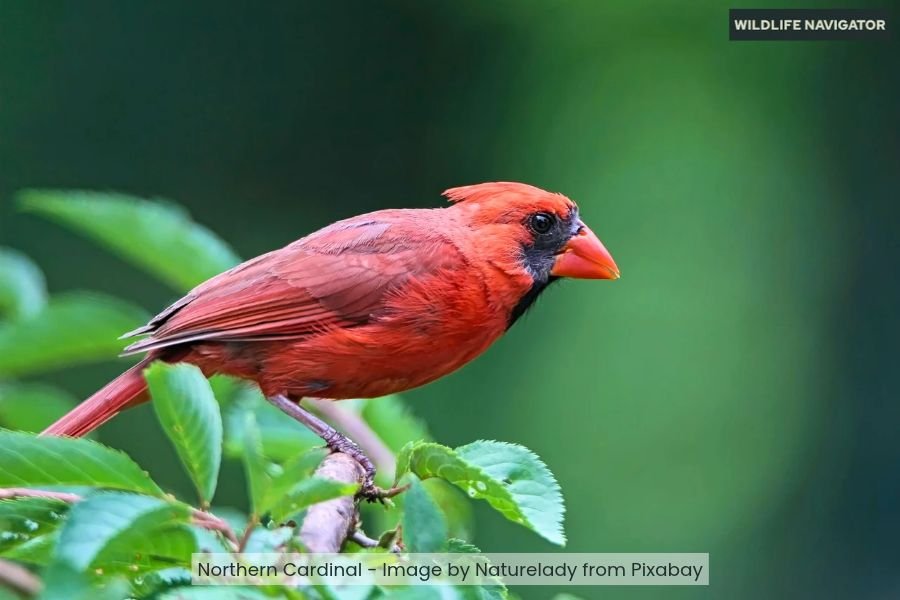
The Northern Cardinal (Cardinalis cardinalis) is one of North America’s most recognisable songbirds, distinguished by the male’s brilliant red plumage, prominent head crest and black facial mask. Females have warm brown plumage with reddish highlights, giving both sexes a distinctive appearance.
Belonging to the family Cardinalidae, this medium-sized bird inhabits woodlands, forest edges, shrublands, gardens and suburban environments across much of eastern and central North America. It feeds primarily on seeds and fruits, supplemented by insects, particularly during the breeding season.
Northern Cardinals are generally non-migratory, remaining within their geographic range throughout the year. Their varied vocalisations, territorial behaviour and strong associations between breeding partners make them particularly interesting to birdwatchers and wildlife researchers.
Beyond their ecological importance, Northern Cardinals hold cultural significance in the United States, where they serve as the official state bird of seven states.
Introduction to the Northern Cardinal
The Northern Cardinal is a non-migratory passerine bird native to North America. It belongs to the genus Cardinalis within the family Cardinalidae, a diverse group of songbirds that includes cardinals, grosbeaks and buntings.
Scientific Classification
| Classification | Details |
|---|---|
| Kingdom | Animalia |
| Phylum | Chordata |
| Class | Aves |
| Order | Passeriformes |
| Family | Cardinalidae |
| Genus | Cardinalis |
| Species | Cardinalis cardinalis |
| Common name | Northern Cardinal |
General Overview
The Northern Cardinal is recognised for its distinctive sexual dimorphism, with males displaying predominantly red plumage and females exhibiting brownish plumage with reddish accents.
It occupies a broad geographic range extending from southeastern Canada through the eastern and central United States, Mexico and parts of Central America. Its ability to use different habitats, including woodland edges, shrublands and residential landscapes, has contributed to its widespread distribution.
Although commonly associated with backyard bird feeders, Northern Cardinals naturally obtain food from their surroundings, consuming seeds, fruits, berries and insects.
Their distinctive whistles and contact calls are important forms of communication. Both males and females produce songs, making the species particularly interesting among North American songbirds.
Physical Characteristics and Identification
The Northern Cardinal is a medium-sized songbird with a prominent crest, long tail, compact body and thick, cone-shaped bill. Its physical features are adapted to its seed-based diet and the vegetation-rich environments in which it lives.
Size and Body Structure
Adult Northern Cardinals generally measure approximately 21–23 cm (8.3–9.1 inches) in length. Their wingspan ranges from about 25–31 cm (9.8–12.2 inches), while their body weight typically falls between 42 and 48 grams.
They have relatively short, rounded wings and a long tail that is often held downward when perched. Their strong body structure and powerful bill distinguish them from many smaller North American songbirds.
Plumage and Colouration
The adult male is particularly easy to recognise because of its brilliant red plumage. Its body, wings, tail and prominent crest are predominantly red, although the intensity of the colour can vary.
A black facial mask surrounds the base of the bill and extends around the throat. The bill itself is thick, powerful and reddish-orange, making it suitable for cracking hard seeds.
Females have a different appearance. Their plumage is mainly warm brown or buff, with reddish or reddish-orange tones on the wings, tail and crest. They also have a black facial mask and a reddish-orange bill.
This difference between male and female plumage is known as sexual dimorphism.
Distinctive Physical Features
The crest is one of the Northern Cardinal’s most recognisable characteristics. It can be raised or lowered depending on the bird’s behaviour and level of alertness.
Its short, thick bill is another important adaptation. The strong structure helps the bird break open seeds that may be difficult for smaller-billed species to handle.
Juveniles generally resemble females but have a darker bill before developing the reddish-orange bill colour associated with adults.
How to Identify a Northern Cardinal
The combination of a prominent crest, thick bill, long tail and distinctive colouration makes identification relatively straightforward.
Adult males are particularly conspicuous because of their bright red plumage. Females are more likely to be recognised by their brown bodies, reddish highlights and crest.
The Northern Cardinal can be confused with other red birds, especially in areas where several species overlap. In the southwestern United States, the Pyrrhuloxia is a useful comparison. However, the Northern Cardinal generally has a more extensive crest and a different bill shape and facial pattern.
Habitat and Geographic Distribution
Northern Cardinals occupy a broad range of habitats across North America. They are particularly associated with environments containing dense shrubs, small trees and sufficient vegetation for nesting and protection.
Geographic Range
The species is widely distributed across eastern and central North America. Its range extends from southeastern Canada through the eastern and central United States, reaching parts of the southwestern United States, Mexico, northern Belize and Guatemala.
Northern Cardinals are permanent residents across most of their range. They do not undertake regular long-distance seasonal migrations, although individuals may make local movements in response to food availability and environmental conditions.
Their geographic distribution has expanded northward over time. The growth of towns, suburbs, gardens and other landscapes containing shrubs and food resources has helped create suitable habitat in areas where the species was previously less common.
Preferred Habitats
The Northern Cardinal is adaptable but generally favours places with substantial low-growing vegetation.
Its preferred habitats include:
- Deciduous woodlands: Areas containing trees, shrubs and an established understory provide feeding and nesting opportunities.
- Forest edges: Open woodland boundaries offer access to food while maintaining nearby protective vegetation.
- Shrublands and thickets: Dense bushes and tangled vegetation provide shelter from predators and suitable nesting locations.
- Riparian habitats: Vegetation alongside rivers, streams and wetlands offers food, water and nesting cover.
- Grasslands and overgrown fields: Areas with scattered shrubs and small trees can provide suitable foraging opportunities.
- Urban and suburban environments: Gardens, parks, hedgerows and residential landscapes frequently support Northern Cardinal populations.
Seasonal Habitat Use
Because Northern Cardinals do not migrate, they use suitable habitats throughout the year. During the breeding season, territorial pairs occupy areas containing appropriate nesting vegetation and feeding resources.
During autumn and winter, individuals may gather in small or larger flocks, sometimes joining mixed-species feeding groups.
Dense shrubs remain important during colder months because they provide protection and access to naturally occurring food.
Diet and Feeding Habits
Northern Cardinals are primarily seed- and fruit-eating birds, although their diet includes a considerable variety of insects and other small invertebrates.
Their strong, conical bills are particularly effective at breaking seeds, allowing them to exploit food sources that are unavailable to some smaller-billed birds.
What Do Northern Cardinals Eat?
Their diet changes according to seasonal availability and local habitat conditions.
Common food sources include:
- Sunflower seeds and other seeds.
- Grass and weed seeds.
- Wild berries and fruits.
- Mulberries, blackberries and hackberries.
- Fruits from dogwood and other native plants.
- Corn and other available grains.
- Beetles, caterpillars, grasshoppers and crickets.
- Flies, leafhoppers, spiders and other small invertebrates.
Although seeds and fruits make up much of their diet, insects become particularly important during the breeding season.
Feeding Behaviour
Northern Cardinals usually forage on or near the ground, moving through leaf litter and low vegetation in search of food. They also feed in shrubs and trees, where they can collect fruits, seeds and insects.
Their feeding behaviour includes hopping between branches, searching beneath vegetation and visiting bird feeders when suitable food is available.
Black oil sunflower seeds are particularly attractive to cardinals because they provide a convenient, energy-rich food source.
Seasonal Dietary Changes
Food availability influences their feeding patterns throughout the year.
During spring and summer, cardinals consume a variety of insects, berries and seeds. Insects are especially valuable when adults are raising young because growing nestlings require protein-rich food.
During autumn and winter, seeds and fruits become particularly important. The birds also take advantage of naturally available berries and food provided by backyard feeders.
Feeding Their Young
Adult Northern Cardinals feed their nestlings mainly insects and other small invertebrates. These foods provide essential nutrients for rapid growth and development.
Both parents participate in feeding the young, bringing food to the nest and continuing to care for their offspring after they leave it.
Behaviour and Social Structure
Northern Cardinals display a combination of territorial, social and foraging behaviours that change throughout the year. They are particularly noticeable for their strong territorial responses, vocal communication and interactions between breeding pairs.
Daily Activity Patterns
Northern Cardinals are diurnal, meaning they are active during daylight hours.
They commonly forage during the early morning and later parts of the day, although their activity depends on weather, food availability and local conditions.
They spend considerable time moving through shrubs and low branches, searching for food and maintaining contact with nearby individuals.
Territorial Behaviour
Territorial defence is an important part of Northern Cardinal behaviour, particularly during the breeding season.
Males frequently sing from exposed branches to announce their presence and communicate territorial boundaries. They may chase or confront competing males that enter their territories.
One familiar behaviour occurs when cardinals attack their reflections in windows, mirrors and other reflective surfaces. The birds may mistake their reflection for a rival and repeatedly attempt to drive it away.
This behaviour can occur in both males and females, particularly during periods of heightened territorial activity.
Social Behaviour
During the breeding season, Northern Cardinals commonly move around in pairs. Their interactions include vocal communication, courtship feeding and coordinated activities associated with nesting.
Outside the breeding season, they may form small groups or larger flocks. These groups sometimes contain a dozen or several dozen birds.
They may also forage alongside other species, including sparrows, juncos, titmice and other seed-eating birds.
Adaptability to Human Environments
Northern Cardinals are among the North American birds that have adapted successfully to residential landscapes.
They frequently visit gardens, parks and bird feeders, especially where shrubs and trees provide nearby cover.
However, their presence in populated areas does not mean they prefer completely open environments. Dense vegetation remains important for protection, resting and nesting.
Vocalizations and Communication
Northern Cardinals are highly vocal songbirds. Their whistles and sharp calls are among the most recognisable sounds in many eastern North American neighbourhoods and woodlands.
Songs and Calls
Their songs consist of clear, repeated whistles arranged in different patterns. Common descriptions include phrases resembling “cheer-cheer-cheer” and “purty-purty-purty.”
Individual birds may produce variations in pitch, rhythm and phrase structure.
In addition to songs, they use sharp metallic-sounding chip notes. These calls are useful for maintaining contact and communicating alarm.
Why Northern Cardinals Sing
Singing serves several purposes, including:
- Establishing and defending territories.
- Communicating with potential mates.
- Maintaining contact between breeding partners.
- Responding to neighbouring birds.
- Signalling during territorial encounters.
Males often sing from prominent branches, making their songs easier to hear across surrounding vegetation.
Communication Between Males and Females
An interesting feature of this species is that both sexes sing.
Female Northern Cardinals may sing while sitting on the nest. Research observations suggest that these songs can communicate information to the male, including signals associated with the female’s need for food.
Mated pairs may share song phrases, although female songs can be longer and more complex than male songs.
Seasonal Vocal Activity
Singing is particularly noticeable during the breeding season, when territorial defence and pair communication become important.
However, Northern Cardinals do not stop communicating outside the breeding period. Their contact and alarm calls remain useful throughout the year.
Reproduction and Breeding Cycle
Northern Cardinals reproduce during the warmer months, with breeding activity influenced by geographic location, weather and food availability.
Their reproductive behaviour involves courtship, territory establishment, nest construction, incubation and parental care.
Breeding Season
The breeding season generally begins in spring and can continue into summer. In favourable conditions, some pairs may raise more than one brood in a single year.
Northern Cardinals commonly produce one or two broods annually, although the number can vary with regional conditions.
Courtship and Pair Bonding
Courtship involves vocal communication, displays and interactions between males and females.
One particularly recognisable behaviour is courtship feeding. The male may collect a seed or other food item and offer it directly to the female.
This behaviour is sometimes called mate feeding and helps strengthen the association between breeding partners.
Pairs may remain together through much of the year, although pair bonds do not necessarily last for life. Some partnerships change between breeding seasons.
Nest Construction
The female performs most of the nest construction, although the male may bring nesting material.
Nests are usually placed in dense shrubs, small trees or tangled vines, often between approximately 0.3 and 4.6 metres above the ground.
The nest is a compact open cup constructed from materials such as:
- Small twigs.
- Grasses and stems.
- Rootlets.
- Leaves.
- Bark strips.
- Other flexible plant material.
The female shapes the structure by arranging and pressing the materials into a secure cup.
Nests are generally well concealed within foliage, helping reduce their visibility to predators.
Eggs and Incubation
A typical clutch contains two to five eggs. They are generally whitish, buffy or greenish-white and marked with darker speckles.
The female performs most of the incubation, which generally lasts around 11–13 days.
During this period, the male may bring food to the female and continue defending the nesting territory.
Hatching and Chick Development
Northern Cardinal chicks hatch with their eyes closed and very little feather development. They depend entirely on their parents for warmth, protection and food.
Both adults participate in feeding the nestlings, bringing insects and other small invertebrates that support rapid growth.
The young generally leave the nest approximately 7–13 days after hatching.
Leaving the nest does not mean they are immediately independent. The parents continue feeding and protecting fledglings while they develop their flying and foraging abilities.
In some cases, the male continues caring for recently fledged young while the female begins preparing for another nesting attempt.
Lifespan, Predators and Natural Threats
The survival of Northern Cardinals depends on food availability, habitat quality, reproductive success and their ability to avoid predators.
Although the species is widespread and adaptable, individual birds face numerous natural and human-related threats.
Lifespan
Northern Cardinals can survive for several years in the wild, although actual lifespan varies considerably.
Many individuals do not reach advanced ages because of predation, disease, environmental conditions and other sources of mortality.
The oldest recorded Northern Cardinal in the Cornell Lab’s cited records was a female that reached 15 years and 9 months.
Natural Predators
Adult cardinals and their young are vulnerable to several predators.
Common threats include:
- Birds of prey: Hawks and other predatory birds can capture adult cardinals.
- Snakes: Some species prey on eggs, nestlings and occasionally adult birds.
- Domestic and feral cats: Free-roaming cats can kill adult birds and fledglings.
- Small mammals: Squirrels and other mammals may raid nests and consume eggs or young birds.
Nesting success is particularly vulnerable because eggs and nestlings cannot escape predators.
Natural Threats
Severe weather, food shortages, disease and parasites can also affect survival.
Cold conditions may increase energy requirements, while prolonged periods of unsuitable weather can reduce access to natural food.
Habitat disturbance can expose nests and reduce the availability of suitable feeding and sheltering areas.
Survival and Defence Mechanisms
Northern Cardinals rely on several behavioural adaptations to avoid danger.
Females’ brown plumage provides relatively effective concealment while nesting. Both sexes use alarm calls to communicate potential threats.
Dense vegetation offers protection, while territorial awareness and the ability to move quickly between shrubs help them avoid predators.
Ecological Importance and Relationship with Humans
Northern Cardinals contribute to their ecosystems through feeding interactions, seed consumption and their place in local food webs.
Their adaptability also makes them a familiar part of human-dominated landscapes across much of North America.
Ecological Role
One of their important ecological contributions is the consumption of fruits and berries.
By eating fruits and later depositing viable seeds in different locations, cardinals can contribute to seed dispersal. The extent of this contribution depends on the plant species and local conditions.
They also consume a variety of insects and other invertebrates, including beetles, caterpillars and grasshoppers.
This feeding activity makes them part of the ecological relationships that help regulate insect populations.
Northern Cardinals also serve as prey for larger predators, contributing to the food webs of woodland, shrubland and suburban ecosystems.
Relationship with Humans
Northern Cardinals are popular among birdwatchers because of their bright colours, recognisable songs and willingness to visit gardens and feeders.
They are commonly observed in residential areas where shrubs, trees and food sources are available.
Their presence can encourage people to develop an interest in local birdlife and backyard wildlife observation.
However, providing suitable natural vegetation is just as important as supplying supplementary food.
State Bird and Cultural Recognition
The Northern Cardinal is the official state bird of seven US states:
- Illinois.
- Indiana.
- Kentucky.
- North Carolina.
- Ohio.
- Virginia.
- West Virginia.
Its distinctive red plumage and familiar song have also made it a popular subject in artwork, seasonal decorations and wildlife photography.
For many people, seeing a Northern Cardinal during winter is a particularly memorable experience because its bright colour stands out against bare branches and snow-covered landscapes.
Conservation Status and Interesting Facts
The Northern Cardinal remains one of the more widespread and familiar songbirds in North America. Its broad distribution and ability to use different habitats have contributed to its continued presence across much of the continent.
Conservation Status
The Northern Cardinal is classified as Least Concern (LC) on the IUCN Red List.
Its population is considered large and widespread, and it is not currently regarded as globally threatened.
The Cornell Lab of Ornithology reports a substantial breeding population and a generally positive long-term population trend in its North American assessment.
However, a favourable global conservation classification does not mean individual birds are free from environmental threats.
Threats and Conservation Challenges
Several human-related factors can affect Northern Cardinal populations and individual survival.
Important concerns include:
- Habitat loss: Removal of shrubs, woodland edges and native vegetation can reduce suitable nesting and feeding locations.
- Window collisions: Birds may collide with reflective or transparent glass, particularly around buildings.
- Domestic cats: Free-roaming cats are a significant source of bird mortality.
- Pesticide exposure: Chemical use can affect insects that cardinals depend on, especially when feeding their young.
- Urban development: Poorly planned development can remove natural vegetation and fragment suitable habitats.
Conservation and Protection
Protecting Northern Cardinals involves maintaining the habitats and environmental conditions they depend on.
Useful conservation measures include planting native shrubs and trees, retaining dense vegetation, reducing unnecessary pesticide use and making windows more visible to birds.
Responsible bird feeding can provide supplementary food, especially during periods when natural resources are limited. Feeders should be cleaned regularly to reduce the risk of disease transmission.
Keeping domestic cats indoors or safely contained can also reduce unnecessary pressure on local bird populations.
Interesting Facts About Northern Cardinals
- Both sexes sing: Unlike many songbirds, female Northern Cardinals regularly produce songs as well as calls.
- Males are bright red: Their brilliant plumage makes them among the most recognisable birds in North America.
- Females are not completely brown: Their wings, tails and crests have noticeable reddish highlights.
- They do not migrate: Northern Cardinals remain within their geographic range throughout the year.
- They have strong bills: Their thick, cone-shaped bills help them crack a wide variety of seeds.
- Females build most of the nest: Males may provide material, but females perform the majority of construction.
- They can attack reflections: Territorial birds sometimes mistake their reflection in windows or mirrors for a rival.
- They are popular state birds: Seven US states have selected the Northern Cardinal as their official state bird.
- They form winter flocks: Outside the breeding season, individuals may gather in groups and forage with other bird species.
- They retain their red appearance in winter: Their plumage remains colourful throughout the year rather than changing into a dull winter coat.
The Northern Cardinal is much more than a familiar red bird visiting backyard feeders. Its adaptable feeding habits, complex vocal communication, territorial behaviour and distinctive reproductive biology make it an important and fascinating member of North America’s bird communities.
Understanding this species also highlights the value of maintaining natural vegetation in both wild and developed landscapes. Protecting the shrubs, trees and feeding habitats that support cardinals helps sustain not only this iconic bird but also the wider ecological communities with which it shares its environment.
Reference and Sources
The following references were consulted for information about the Northern Cardinal’s physical characteristics, habitat, geographic distribution, feeding habits, behaviour, reproduction and conservation status.
- Cornell Lab of Ornithology – All About Birds: Northern Cardinal
https://www.allaboutbirds.org/guide/Northern_cardinal/overview
Species identification, physical characteristics, vocalisations, geographic distribution and general information. - Cornell Lab of Ornithology – Northern Cardinal Life History
https://www.allaboutbirds.org/guide/Northern_cardinal/lifehistory
Habitat preferences, diet, feeding behaviour, nesting, eggs, incubation, parental care and population information. - Cornell Lab of Ornithology – Northern Cardinal Identification
https://www.allaboutbirds.org/guide/Northern_cardinal/id
Male and female identification, body measurements, plumage and distinguishing physical characteristics. - National Audubon Society – Northern Cardinal Field Guide
https://www.audubon.org/field-guide/bird/northern-cardinal
Geographic range, habitat, physical description, migration, vocalisations and feeding behaviour. - American Bird Conservancy – Northern Cardinal
https://abcbirds.org/birds/northern-cardinal/
Population trends, distribution, ecological characteristics, breeding behaviour and conservation information. - IUCN Red List – Northern Cardinal (Cardinalis cardinalis)
https://doi.org/10.2305/IUCN.UK.2018-2.RLTS.T22723819A132024136.en
Global conservation assessment, population trend, geographic range and habitat information. - Animal Diversity Web – Northern Cardinal (Cardinalis cardinalis)
https://animaldiversity.org/accounts/Cardinalis_cardinalis/
Taxonomy, ecological relationships, feeding habits, reproduction and natural history. - Texas Parks and Wildlife Department – Northern Cardinal
https://tpwd.texas.gov/huntwild/wild/species/northerncardinal/
Distribution, behaviour, nesting, feeding habits and natural history.
These sources provide supporting information for the species profile. Conservation assessments and population estimates should be interpreted according to the publication date of each source.
Curating and documenting wildlife and protected areas through detailed guides and the continuously updated WN Index.
- Rosan Prasad
- Rosan Prasad

- Rosan Prasad
- Rosan Prasad