Blue Jay: Appearance, Habitat, Diet, Behaviour, Lifespan & Facts

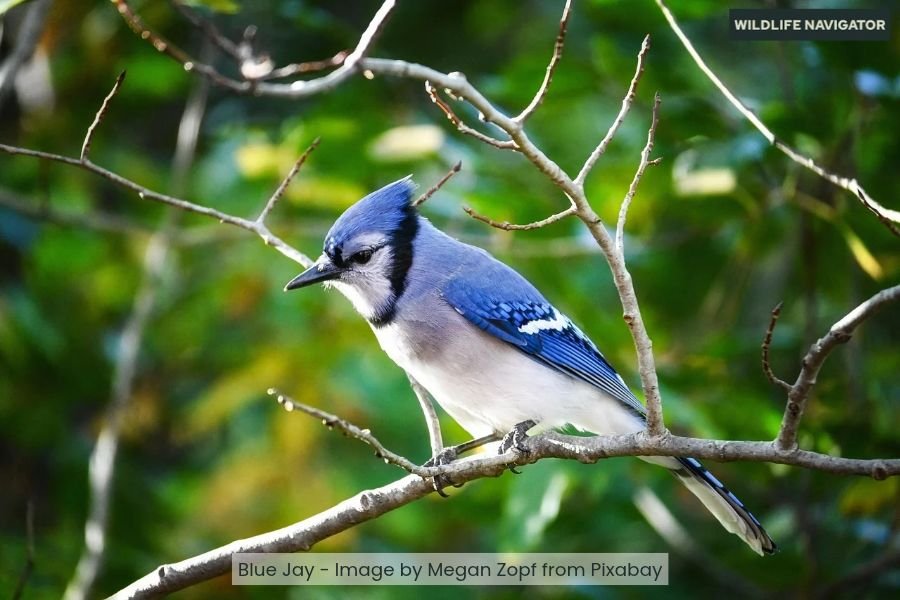
The Blue Jay (Cyanocitta cristata) is a striking North American songbird recognised by its bright blue plumage, prominent head crest, black facial markings and loud, varied calls. A member of the crow family, Corvidae, this intelligent bird is known for its problem-solving abilities, complex communication and remarkable food-caching behaviour.
Native to eastern and central North America, Blue Jays inhabit deciduous forests, mixed woodlands, parks and suburban neighbourhoods. They are adaptable omnivores, feeding on acorns, seeds, fruits, insects and occasional small animals. Their habit of collecting and burying acorns also makes them important contributors to seed dispersal and oak forest regeneration.
What Is a Blue Jay?
The Blue Jay is a medium-sized, crested songbird belonging to the genus Cyanocitta. It is one of North America’s most recognisable members of the jay family, distinguished by its colourful plumage, strong bill and expressive crest. Its blue appearance is produced by the microscopic structure of its feathers rather than blue pigment.
Blue Jays are primarily active during daylight hours and spend much of their time foraging, communicating, defending territories and moving between trees. Their varied vocalisations include harsh calls, whistles and imitations of certain birds of prey.
Scientific Classification of the Blue Jay
The scientific classification of the Blue Jay is as follows:
- Kingdom: Animalia
- Phylum: Chordata
- Class: Aves
- Order: Passeriformes
- Family: Corvidae
- Genus: Cyanocitta
- Species: Cyanocitta cristata
Its family, Corvidae, includes crows, ravens, magpies and other jays. Members of this family are recognised for their intelligence, learning abilities, memory and complex social behaviour.
Subspecies of the Blue Jay
Several geographical subspecies of the Blue Jay have traditionally been recognised. They are generally distinguished by subtle differences in body size, plumage characteristics and geographical distribution.
Their geographical variations do not represent separate species, and subspecies classifications may differ between taxonomic authorities.
Why Is the Blue Jay Famous?
Blue Jays are well known for several distinctive characteristics:
- Their brilliant blue, white and black plumage.
- Their prominent and expressive head crest.
- Their loud and varied vocalisations.
- Their ability to imitate certain hawk calls.
- Their intelligence and problem-solving abilities.
- Their habit of collecting and storing acorns.
- Their adaptability to forests, parks and residential environments.
Their relationship with oak trees is particularly important because forgotten food caches can develop into new trees, contributing to woodland regeneration.
Physical Characteristics and Appearance of a Blue Jay
The Blue Jay has a distinctive appearance that separates it from most other North American songbirds. Its bright blue upperparts, white underparts, black markings and raised crest create a recognisable combination of colours and features.
Size, Weight and Wingspan
Blue Jays are medium-sized birds with relatively broad wings and a long tail.
Typical measurements include:
- Body length: Approximately 22–30 cm.
- Wingspan: Approximately 34–43 cm.
- Body weight: Approximately 70–100 g.
Their body size can vary depending on geographical location, sex and individual condition.
The relatively large wings help them travel between feeding and nesting areas, while their long tails contribute to balance and manoeuvrability when moving through trees.
Plumage and Feather Colouration
The Blue Jay’s most noticeable feature is its blue plumage. Its upperparts are predominantly blue, while its underparts are whitish or pale grey.
The wings and tail contain distinctive black and white markings, including white wing bars and black transverse patterns.
An important scientific feature of Blue Jay colouration is that its blue appearance does not come from blue pigment. Instead, it results from structural coloration.
Microscopic structures within the feathers scatter shorter wavelengths of light, producing the blue colour visible to human observers. Melanin contributes to the darker markings.
This structural effect also explains why damaged or crushed blue feathers may appear dark rather than retaining their original bright blue appearance.
Distinctive Crest, Beak and Facial Markings
One of the most recognisable features of the Blue Jay is its prominent head crest.
The crest consists of elongated feathers that can be raised or lowered depending on the bird’s activity and social situation. A raised crest may accompany alertness or excitement, while a lowered crest is often seen when the bird is relaxed.
Blue Jays also have a strong black bill suitable for handling a variety of foods, including seeds, nuts and insects.
A distinctive black marking extends around the throat and sides of the head, forming a necklace-like pattern. The eyes are dark, and the facial area combines blue, white and black markings.
Wings, Tail, Legs and Feet
Blue Jays have broad, rounded wings with noticeable blue, black and white patterns. Their long tail is another important identification feature.
Their legs and feet are relatively short but strong enough to support perching and climbing along branches. Like other perching birds, they use their feet to grip branches and maintain stability.
They can also hold food with their feet while breaking or manipulating it with their bill.
Differences Between Male, Female and Juvenile Blue Jays
Male and female Blue Jays have very similar plumage, making visual identification of their sex difficult.
Males are generally slightly larger than females, but this difference is not always obvious in the field.
Juvenile Blue Jays develop the characteristic blue, white and black plumage as they mature. Young birds may initially have a less defined appearance, and their crest and feather patterns become more characteristic as they grow.
Blue Jay Habitat and Geographical Distribution
Blue Jays are native to North America and occupy a broad geographical range. They are especially common in eastern and central parts of the continent, although their distribution also extends into parts of western Canada and the United States.
Their adaptability allows them to inhabit natural woodlands, forest edges and landscapes influenced by human activity.
Where Do Blue Jays Live?
Blue Jays occur across much of eastern and central North America.
Their geographical distribution includes:
- Eastern Canada.
- Southern and central Canada.
- The eastern United States.
- Parts of the central United States.
- Areas extending westward into parts of Canada and the United States.
Their distribution is influenced by woodland availability, food resources, seasonal conditions and local habitat characteristics.
Blue Jays are not native to every part of North America. Their occurrence is more limited in some western and northern regions.
Natural Habitat and Preferred Environments
Blue Jays prefer habitats containing trees and suitable feeding opportunities.
Their natural habitats include:
- Deciduous forests.
- Mixed deciduous and coniferous woodlands.
- Oak forests.
- Forest edges.
- Woodland clearings.
- Parks and wooded agricultural landscapes.
Oak forests are particularly valuable because acorns provide an important seasonal food source.
However, Blue Jays are not restricted to oak-dominated environments. They can also forage in other woodland types where seeds, fruits, insects and nesting sites are available.
Blue Jays in Urban and Suburban Areas
Blue Jays have adapted successfully to many human-modified environments.
They are frequently observed in residential gardens, city parks, suburban neighbourhoods and other areas containing mature trees.
Backyard bird feeders can attract them, particularly when they provide peanuts, sunflower seeds and other suitable foods.
Their ability to use both natural and artificial food sources helps them survive in landscapes where woodland habitats have been modified.
Nevertheless, urban environments also expose them to threats such as window collisions, domestic cats and traffic.
Seasonal Distribution and Migration Patterns
Not all Blue Jays migrate. Some populations remain in the same general area throughout the year, while others undertake seasonal movements.
Migration is particularly noticeable in parts of the northern range, where birds may move southward during autumn.
These movements are influenced by food availability, weather conditions and other environmental factors.
Blue Jay migration is not completely understood. Some individuals migrate regularly, some remain resident, and others may change their movements between years.
Their seasonal movements are therefore more variable than those of bird species that follow a consistent long-distance migration route.
Climate and Environmental Preferences
Blue Jays tolerate a range of seasonal conditions, including cold winters and warm summers.
They can remain active during winter when food is available, using stored food and natural resources to survive periods when fresh food becomes less accessible.
The presence of trees, suitable nesting locations and reliable food supplies is generally more important than a particular temperature range.
What Do Blue Jays Eat? (Diet and Feeding Habits)
Blue Jays are omnivorous birds with a varied diet consisting of plant-based and animal-based foods. Their feeding habits change throughout the year depending on food availability, breeding requirements and environmental conditions.
Main Diet of Blue Jays
Plant material forms a major part of the Blue Jay’s diet.
Common food sources include:
- Acorns.
- Beechnuts.
- Seeds.
- Sunflower seeds.
- Peanuts.
- Berries.
- Wild fruits.
- Other available nuts and grains.
Acorns are especially important during autumn. Blue Jays collect them in large quantities and transport them to different locations for storage.
Their strong bills allow them to handle relatively hard foods, while their feet help hold food items during feeding.
Insects and Animal-Based Food
Blue Jays also consume a variety of animal-based foods, particularly during warmer months when insects are abundant.
Their animal-based diet can include:
- Caterpillars.
- Beetles.
- Grasshoppers.
- Spiders.
- Other insects and invertebrates.
- Small vertebrates on occasion.
They may also consume eggs and nestlings of other birds when opportunities arise.
However, this behaviour should not be interpreted as their primary feeding strategy. Blue Jays are opportunistic omnivores, and plant material forms a substantial part of their overall diet.
How Do Blue Jays Find and Eat Food?
Blue Jays use several techniques to locate and collect food.
They search for food on the ground, inspect tree branches, explore foliage and visit bird feeders.
Their strong bills help them break, pick up and manipulate different food items. When eating larger pieces of food, they may hold them against a branch or use their feet for support.
They are also capable of carrying food in their bills and transporting it to another location.
Food Storage and Acorn Caching Behaviour
One of the most interesting feeding behaviours of Blue Jays is food caching.
During periods of food abundance, especially autumn, they collect acorns and other food items and hide them in different locations.
They may transport individual acorns in their bills and temporarily carry additional food in their expandable throat or oesophageal area.
Stored food can be recovered later when natural food supplies become less abundant.
Their spatial memory helps them locate many of these hidden food items.
Not every stored acorn is recovered. Some remain buried and may eventually germinate, contributing to the dispersal of oak trees.
Feeding Habits Throughout the Year
Blue Jay feeding habits change according to seasonal conditions.
During spring and summer, insects and other invertebrates become more readily available. These foods are valuable during the breeding season, when adults require sufficient nutrition for themselves and their developing young.
During autumn, nuts and seeds become particularly important, and birds increase their food-collecting and caching activities.
In winter, they rely on available seeds, nuts, stored food and other natural resources. Some also visit backyard feeders.
Blue Jay Behaviour and Social Structure
Blue Jays are intelligent and socially active birds. Their behaviour includes territorial defence, communication, food storage, cooperation and interactions with other wildlife.
Daily Activities and Lifestyle
Blue Jays are primarily diurnal, meaning they are active during daylight hours.
Much of their day is spent searching for food, travelling between trees, communicating with other birds and monitoring their surroundings.
They often forage in wooded areas and move between feeding locations depending on the availability of food.
At night, they generally seek sheltered locations in trees and dense vegetation for roosting.
Social Behaviour and Group Living
Blue Jays can be seen alone, in pairs or in small family groups.
During the breeding season, adults are commonly associated with their partners and offspring. Outside the breeding season, they may gather in larger groups, particularly when food is plentiful or during seasonal movements.
These gatherings are not necessarily permanent social flocks. Individuals can move between different feeding locations and interact with neighbouring birds.
Intelligence and Problem-Solving Abilities
As members of the corvid family, Blue Jays display several behaviours associated with advanced avian intelligence.
They can learn from experience, remember food-storage locations and adjust their behaviour according to changing conditions.
Their food-caching behaviour requires the ability to locate suitable hiding places and remember where food has been stored.
They also show awareness of potential predators and use different vocalisations in response to environmental threats.
Territorial Behaviour and Aggression
Blue Jays can be territorial, particularly during the breeding season.
They may defend nesting locations and nearby feeding resources against other birds.
Their defensive behaviour includes loud alarm calls, aggressive displays and chasing intruders.
They may also participate in mobbing behaviour, in which several birds gather around a potential predator and repeatedly call or approach it to discourage it from remaining nearby.
Communication and Body Language
Blue Jays communicate using vocalisations and body movements.
Their crest is an important part of their visual communication. Its position can change depending on the bird’s emotional and social state.
Other body movements, including posture and head positioning, also contribute to communication.
Their calls help maintain contact, warn other birds of danger and coordinate interactions within social groups.
Relationship With Other Bird Species
Blue Jays interact with many other bird species within their habitats.
They compete with other birds for food and may defend feeding locations or nesting areas.
Their alarm calls can alert neighbouring birds to the presence of predators.
However, their interactions are not always beneficial to other species. Blue Jays may occasionally prey on eggs and nestlings, illustrating their complex position within woodland bird communities.
Blue Jay Flight, Vocalisations and Communication
Blue Jays have distinctive flight abilities and an extensive vocal repertoire. Their calls are among their most recognisable characteristics and play an important role in social communication and predator awareness.
Flight Characteristics and Flying Abilities
Blue Jays have broad, rounded wings and a relatively long tail.
Their flight usually consists of a series of steady wingbeats followed by short glides. They can move efficiently between trees and travel across open spaces when necessary.
Although they are capable of covering considerable distances, they are generally associated with woodland environments where trees provide food, shelter and nesting opportunities.
Their seasonal movements can involve longer journeys, particularly among populations that migrate.
Blue Jay Calls and Vocalisations
Blue Jays produce a wide variety of sounds.
Their most familiar call is a loud, harsh jay-jay sound, which is responsible for their common name.
Other vocalisations include:
- Whistles.
- Rattling sounds.
- Clicking noises.
- Harsh alarm calls.
- Softer conversational sounds.
- Calls used during social interactions.
Their vocal repertoire is considerably more varied than a single characteristic call might suggest.
Different sounds can be associated with alarm, contact, territorial behaviour and communication between individuals.
How Blue Jays Mimic Hawk Calls
One of the most fascinating abilities of Blue Jays is their capacity to imitate the calls of certain hawks.
They are particularly known for imitating calls associated with the Red-shouldered Hawk and other birds of prey.
These imitations may occur in different situations, including when birds are disturbed or interacting with their surroundings.
One proposed function is that hawk-like calls can influence the behaviour of other birds, potentially causing them to become alert or temporarily leave a feeding area.
However, the precise purpose of hawk-call mimicry is not fully established, and it should not be assumed that every imitation is a deliberate warning signal.
How Blue Jays Communicate With Each Other
Communication involves a combination of sounds and body movements.
Blue Jays use calls to maintain contact, signal potential danger and communicate during social encounters.
They may also use different vocalisations during courtship and interactions between breeding partners.
Changes in crest position and body posture provide additional visual signals.
Together, these behaviours help Blue Jays maintain social relationships and respond to environmental changes.
Blue Jay Reproduction, Nesting and Life Cycle
Blue Jays reproduce through seasonal breeding, generally during spring and early summer across much of their range.
Their reproductive cycle includes courtship, nest construction, egg-laying, incubation, chick development and parental care.
Breeding Season and Courtship Behaviour
The breeding season varies geographically but commonly occurs during spring and early summer.
Blue Jays generally form monogamous breeding pairs, and established partners may remain together across multiple breeding seasons.
Courtship behaviour can involve vocalisations, movements between branches and displays by potential mates.
During courtship, males may participate in feeding-related interactions and display behaviours that strengthen pair bonds.
Nesting Habits and Nest Construction
Blue Jays generally build their nests in trees or large shrubs.
Nesting sites are commonly located in wooded environments where suitable branches provide support and some protection from predators.
Both sexes participate in nest construction.
The nest is usually a relatively bulky cup-shaped structure made from twigs, roots, grasses and other plant materials. Mud may also be incorporated, while softer materials can form the inner lining.
Nest placement varies depending on vegetation and the availability of suitable locations.
Eggs and Incubation Period
A typical Blue Jay clutch contains approximately three to seven eggs, although clutch size can vary.
The eggs are generally pale greenish, bluish or buff-coloured, with darker brown or olive markings.
The female performs most of the incubation, which generally lasts around 17–18 days.
During this period, the male may bring food to the female and help defend the nesting territory.
Hatching and Development of Baby Blue Jays
Blue Jay chicks hatch in an underdeveloped condition.
They are initially dependent on their parents for warmth, protection and food.
Both adults participate in feeding the nestlings, bringing insects, caterpillars and other suitable food items to the nest.
As the chicks grow, their bodies become covered with developing feathers, and they gradually acquire the appearance of young Blue Jays.
Their eyes open, muscles develop and flight feathers begin to grow as they approach fledging.
Fledging and Parental Care
Young Blue Jays generally leave the nest approximately 17–21 days after hatching.
However, leaving the nest does not mean that they immediately become independent.
The parents continue to feed and protect the young birds while they develop their flying and foraging abilities.
During this period, juveniles gradually learn to identify food, move between branches and respond to potential dangers.
They eventually become capable of finding food independently.
Lifespan and Life Cycle
Blue Jays can live for several years in the wild, although many individuals do not survive their first year.
Their lifespan depends on several factors, including predation, disease, environmental conditions, food availability and human-related threats.
Some individuals can live considerably longer than the typical lifespan of many small songbirds.
Their life cycle includes egg development, hatching, nestling growth, fledging, juvenile development and reproductive maturity.
Ecological Importance and Relationship With Humans
Blue Jays play several important roles in woodland ecosystems. Their feeding behaviour, seed dispersal activities and interactions with other wildlife make them valuable members of North American forest communities.
Role in Seed Dispersal and Forest Regeneration
One of the most important ecological contributions of Blue Jays is their role in moving and storing acorns.
They collect acorns from oak trees and transport them to different locations, where they bury them for future consumption.
Some of these stored acorns are never recovered.
When suitable environmental conditions are present, forgotten acorns may germinate and develop into oak seedlings.
This behaviour contributes to seed dispersal and can influence the distribution and regeneration of oak trees.
Blue Jays are therefore important seed dispersers, particularly in landscapes where oak trees are common.
Role in the Food Chain
Blue Jays occupy several positions within woodland food webs.
As omnivores, they consume seeds, nuts, fruits, insects and occasional small animals.
At the same time, they are prey for larger predators, including hawks and owls.
Their eggs and nestlings are also vulnerable to various predators.
This combination of feeding and predator-prey relationships makes them an important part of the ecological balance within their habitats.
Relationship With Other Wildlife
Blue Jays interact with many other woodland species.
They compete with other birds for food and nesting resources, but their alarm calls can also alert nearby wildlife to approaching predators.
Their occasional predation on eggs and nestlings may affect the reproductive success of other bird species.
These interactions demonstrate that their ecological role is complex and extends beyond their contribution to seed dispersal.
Blue Jays and Human Settlements
Blue Jays are relatively comfortable living near people when suitable food and nesting resources are available.
They frequently visit residential gardens, parks and backyard bird feeders.
Their presence makes them familiar birds for many people living across their North American range.
However, human settlements can also expose them to hazards, including vehicle collisions, window strikes, domestic cats and habitat fragmentation.
How Humans Can Help Blue Jays
People can support Blue Jays through simple habitat-friendly practices.
Useful measures include:
- Planting native trees and shrubs.
- Protecting mature oak trees.
- Maintaining wooded areas and natural vegetation.
- Providing suitable bird-feeding stations.
- Cleaning bird feeders regularly.
- Keeping domestic cats away from birds.
- Making windows more visible to reduce collisions.
- Avoiding unnecessary disturbance near active nests.
Protecting natural woodland habitats remains one of the most effective ways to support healthy Blue Jay populations.
Blue Jay Natural Predators, Threats and Conservation Status
Although Blue Jays are widespread and adaptable, they face several natural and human-related threats.
Their eggs, nestlings and adults are vulnerable to different predators, while habitat changes and collisions can affect local populations.
Natural Predators of Blue Jays
Blue Jays face predation from several birds and mammals.
Important natural predators include:
- Cooper’s Hawks.
- Sharp-shinned Hawks.
- Great Horned Owls.
- Eastern Screech-Owls.
- Other larger birds of prey.
- Mammalian predators such as raccoons and squirrels, particularly at nests.
Predation risk varies depending on habitat, season and the availability of suitable nesting sites.
Adult Blue Jays may respond to predators through alarm calls, defensive behaviour and mobbing.
Major Threats to Blue Jay Populations
Blue Jays are exposed to several environmental threats.
Habitat loss: Forest clearing and urban development can reduce suitable nesting and feeding habitats.
Habitat fragmentation: Dividing continuous woodland into smaller patches can affect movement, nesting opportunities and access to food.
Window collisions: Birds may collide with reflective or transparent glass, particularly around buildings and residential areas.
Domestic cats: Free-ranging cats can prey on adult birds and young individuals.
Vehicle collisions: Roads passing through wooded landscapes create additional risks.
Environmental changes: Changes in climate, vegetation and seasonal food availability may influence local populations and distribution.
Diseases and Other Natural Challenges
Like other wild birds, Blue Jays can be affected by infectious diseases, parasites and environmental stress.
Severe weather, food shortages and unsuccessful breeding attempts can also affect survival.
West Nile virus is an important disease-related concern for Blue Jays and other corvids. Corvids are particularly susceptible to infection, although the effects vary between individuals and populations.
Maintaining healthy habitats and reducing unnecessary environmental stress can support their long-term survival.
Blue Jay Conservation Status
The Blue Jay is classified as Least Concern (LC) on the IUCN Red List of Threatened Species.
This classification indicates that the species does not currently meet the criteria for a threatened category at the global level.
Its extensive distribution and large population contribute to its relatively favourable conservation status.
However, Least Concern does not mean that individual populations are free from threats. Local habitat loss, collisions, predation and disease can still affect particular populations.
Conservation Efforts and Future Outlook
Although Blue Jays are not currently considered globally threatened, protecting their habitats remains important.
Conservation measures include woodland protection, maintaining mature native trees, restoring fragmented habitats and encouraging bird-friendly urban development.
People can also contribute by planting native vegetation, preventing window collisions and maintaining safe backyard feeding environments.
Continued population monitoring and research into migration, breeding success and habitat use will help improve understanding of the species.
Interesting Facts About Blue Jays
Blue Jays are much more than colourful backyard visitors. Their intelligence, food-storage behaviour, communication abilities and ecological contributions make them particularly fascinating birds.
Here are some interesting facts about Blue Jays:
- Blue Jays belong to the crow family: They are members of Corvidae, the same family as crows, ravens and magpies.
- Their scientific name is Cyanocitta cristata: The species belongs to the genus Cyanocitta.
- Their blue colour comes from feather structure: Microscopic structures within their feathers scatter light to produce their characteristic blue appearance.
- They have a distinctive head crest: Their prominent crest can be raised or lowered depending on their behavioural state.
- Male and female Blue Jays look alike: Their plumage is almost identical, making visual sex identification difficult.
- They can imitate hawk calls: Blue Jays are known to reproduce calls associated with certain birds of prey.
- They have a varied vocal repertoire: Their communication includes harsh cries, whistles, rattles and other sounds.
- They are intelligent food collectors: They remember food-storage locations and retrieve hidden food when needed.
- They help disperse oak seeds: Forgotten acorns can germinate and contribute to forest regeneration.
- They can carry food in their throat area: Their expandable oesophageal region helps them transport food items.
- They are omnivorous: Their diet includes seeds, nuts, fruits, insects and occasional small animals.
- They sometimes eat the eggs of other birds: This is an opportunistic feeding behaviour rather than their main food source.
- They can live in urban environments: Parks, gardens and residential areas provide suitable resources.
- Not all Blue Jays migrate: Some populations remain in the same region throughout the year.
- Their migration patterns vary: Seasonal movements can differ between individuals and geographical populations.
- They are active during daylight: Blue Jays are primarily diurnal birds.
- Both parents help build the nest: Male and female birds participate in preparing the nesting structure.
- The female performs most incubation: The male generally helps by providing food and defending the nesting area.
- Their eggs have distinctive markings: Eggs are generally pale greenish, bluish or buff-coloured with darker spots.
- Young birds depend on their parents after fledging: They continue receiving care while developing independent feeding and flying skills.
- They sometimes form family groups: Parents and young birds may remain associated after the breeding season.
- They can mob predators: Several Blue Jays may gather and make repeated calls to discourage a potential predator.
- Their diet changes with the seasons: Insects become important during warmer months, while nuts and seeds are particularly valuable in autumn and winter.
- They frequently visit bird feeders: Peanuts and sunflower seeds are among the foods that attract them.
- They are important woodland seed dispersers: Their food-caching behaviour can influence where oak trees grow.
- Their flight combines wingbeats and gliding: They use steady wing movements and short glides when travelling between trees.
- They are vulnerable to West Nile virus: This disease can have serious effects on Blue Jays and other corvids.
- They have a broad North American distribution: Their range includes substantial parts of Canada and the United States.
- Their crest communicates information: Its position can provide visual clues about their alertness and social behaviour.
- They are among North America’s most recognisable jays: Their distinctive appearance and loud calls make them familiar to birdwatchers and nature enthusiasts.
Reference and Sources
Curating and documenting wildlife and protected areas through detailed guides and the continuously updated WN Index.
- Rosan Prasad
- Rosan Prasad

- Rosan Prasad
- Rosan Prasad