Fungi and Wildlife Habitat

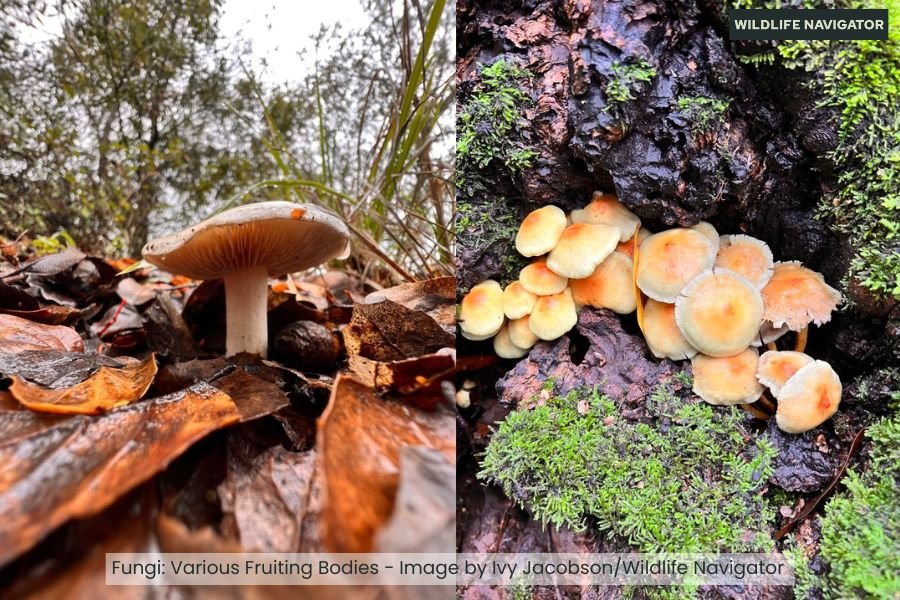
Fungi supply food, shelter, moisture, and breeding sites to a wide range of animals. Mycelium threads through soil, litter, and wood; fruiting bodies appear and rot within days or persist for years; and wood-decay fungi slowly turn a solid log into a spongy, chambered substrate that dozens of beetle, fly, and mite species can occupy. Animals return the favor in uneven ways. Some carry spores to new sites, some farm fungi inside trees, and some simply eat them.
Most of the research on these relationships comes from two directions. Forest ecologists in northern Europe have spent decades documenting the insects that live in deadwood and bracket fungi. Mammal ecologists, especially in Australia and the Pacific Northwest, have studied the small mammals that dig up and eat truffles and spread their spores. This article draws on both bodies of work, then turns to Southern California, where an invasive fungus-farming beetle has become the region’s most visible fungus–animal interaction.
Three recent studies anchor the deadwood sections. Bullington et al. (2026) showed that red turpentine beetle colonization changed fungal communities, nutrient distribution, and sapwood density in ponderosa pine logs. Korhonen et al. (2025) found that trunks, tops, and branches of the same fallen spruce held different fungal and beetle assemblages. Larsson Ekström et al. (2024) found that standing and fallen deadwood favored different groups a decade after forest restoration. None of these studies were done in California, and the limits of their use here are discussed in the final sections.
Throughout, the article separates three levels of evidence: an animal found on a fungus, an animal observed feeding on or breeding in a fungus, and an animal shown to depend on a fungus. Field photographs usually establish only the first.
Biological foundations
Mycelium
Most filamentous fungi grow as hyphae, microscopic branching tubes that together form a mycelium. The mycelium does the fungus’s work. It secretes enzymes into the substrate, absorbs the products, and extends toward new resources. Inside a log or patch of litter, it represents a concentrated, protein-rich food source and changes the moisture and chemistry of the surrounding material.
Small invertebrates use mycelium in several ways. Mites, springtails, nematodes, and some beetle and fly larvae graze directly on it. Moist, fungus-softened wood and litter offer refuge to animals that dry out quickly. Bacteria and yeasts grow on fungal surfaces, adding another food layer. A given fungus rarely offers all of these, and an animal sitting on mycelium may be doing none of them.
Santamaria et al. (2023) give a sense of scale. Their literature search found 209 papers documenting invertebrates feeding on fungi, covering seven fungal phyla and 19 invertebrate orders. Beetles and flies dominated the records, and most field observations came from North America and Europe. The review is a synthesis, not an experiment, but it is the best current map of what has and has not been studied.
Fruiting bodies
A mushroom is the reproductive organ of a much larger fungus. Soft, fleshy mushrooms usually last a few days to two weeks. During that window, they draw fungus gnats, rove beetles, slugs, and springtails, and the gills or pores offer sheltered, humid crevices. Size does not predict use. A small, rotting mushroom can hold more larvae than a large, fresh one.
For documentation, photograph the cap, the underside, the stem or point of attachment, and the substrate around the base. Those four views record the features needed for identification and show the microhabitat that animals were actually using.
Bracket fungi
Bracket fungi (polypores) are a different kind of habitat. Many are woody and perennial, adding a new spore layer each year and staying on the same trunk for a decade or more. That stability supports specialists. Insects breeding in long-lived brackets tend to be far more host-specific than those in short-lived mushrooms, a pattern Jonsell and Nordlander (2004) linked to how long the fruiting body lasts.
The minute tree-fungus beetles (family Ciidae) are the clearest example. Ciids often dominate the insect community inside polypores, and some species are restricted to a single host. In northern Norway, Fossli and Andersen (1998) found Ropalodontus strandi only in Fomes fomentarius and Orthocis festivus only in Stereum rugosum, while Cis bidentatus used many hosts. Several fungi also colonize brackets in sequence as the fruiting body ages and dies, which makes a single bracket a small successional system of its own.
Deadwood
Deadwood includes standing snags, fallen logs, branches, stumps, loose bark, and fine woody debris. Wood-decay fungi break down cellulose, hemicellulose, and lignin, the polymers that give wood its strength. As those polymers go, density drops, water retention rises, and galleries and cavities open up for other organisms.
A single tree is not one habitat. Korhonen et al. (2025) sampled trunks, tops, and branches of 31 fallen Norway spruce, using DNA metabarcoding for fungi and bark peeling and sieving for beetles. Trunks and branches held clearly different assemblages, and each had specialist species. Fungal richness peaked in the tops, while branches had the lowest richness of both fungi and beetles. Diameter, bark thickness, ground contact, and sun exposure all vary along one stem.
Position matters as well. In a Scots pine restoration experiment, Larsson Ekström et al. (2024) found that standing deadwood supported more beetle species, lying deadwood supported more fungal species, and the two held different assemblages of both groups. Deadwood type explained diversity better than tree-retention level after harvest.
Decomposition as a sequence
Decomposition is a sequence, though not a fixed one. Fresh wood with intact bark suits bark beetles and early fungal colonizers. As decay advances, the wood softens, and new species move in. The exact order depends on tree species, climate, the local species pool, and which organisms arrive first.
Bullington et al. (2026) showed how strongly an early arrival can steer the sequence. They compared ponderosa pine logs colonized by red turpentine beetles (Dendroctonus valens) with uncolonized logs, tracking fungi, carbon, nitrogen, phosphorus, and sapwood density over time. Both sets of logs lost their original endophytic fungi, but beetle-colonized logs developed different decomposer communities and lost more sapwood density. Isotope tracing showed nutrients moving from sapwood through the phloem and into the beetles, with fungi likely acting as carriers. The study did not test whether these changes increased invertebrate diversity. It shows that an insect–fungus partnership can reshape a substrate that many other organisms will later use.
How animals find fungi
Many insects locate fungi by smell. The “mushroom” odor most people recognize comes largely from 1-octen-3-ol and related eight-carbon compounds, which nearly all fungi release. Because these compounds are so widespread, researchers have asked whether they carry enough information to guide a specialist to the right host.
The answer appears to be yes, at least for some species. Thakeow et al. (2008) found that 1-octen-3-ol dominated the odor of the bracket fungus Trametes gibbosa. Antennae of the ciid beetle Cis boleti responded most strongly to it, and females were attracted to one mirror-image form of the molecule at doses ten times lower than males needed. Holighaus et al. (2014) found that the tenebrionid beetle Bolitophagus reticulatus was attracted by some eight-carbon compounds from its host Fomes fomentarius and repelled by others. The ratio between them shifted as beetles colonized the bracket, which may let incoming beetles judge how crowded or degraded a host already is.
Scent also draws non-specialists. In field trials, Fäldt and colleagues found that generalist wood-living beetles and a moth responded to 1-octen-3-ol alone, while host-specific ciids did not, suggesting specialists respond to fuller, species-specific blends.
This has a practical side for fieldwork. Damaged or sporulating fruiting bodies release more volatiles, so recently broken brackets and mushrooms at peak spore release may draw more insects than intact ones. Recording the condition of each fruiting body helps explain why visitor counts vary.
Invertebrate communities
Fungivores
Fungus feeding (mycophagy) turns up across many invertebrate groups, sometimes in only one life stage of a species. Groups worth watching for:
- Mites feed on hyphae, spores, and fungus-rich detritus. Oribatid mites are common inside old bracket fungi.
- Springtails graze fungi and microbes in soil, litter, and rotting wood.
- Beetles include obligate fungivores (cucujids, fungus beetles, many darkling beetles) and species that feed on fungi only as larvae.
- Flies, especially fungus gnats, often develop as larvae inside fleshy mushrooms.
- Nematodes include fungus-feeding species in soil and wood.
- Slugs and snails eat mushroom tissue and can strip a fruiting body overnight.
Diet varies widely within each group. A beetle photographed on a mushroom may be eating it, hunting on it, hiding under it, or crossing it.
Predators and parasitoids
Fungi gather prey, and predators follow. Spiders hunt on caps and in the gaps under brackets. Rove beetles, including the staphylinid Lordithon lunulatus, specialize in hunting the insects that live in fungi. Parasitoid wasps search galleries for beetle larvae. In each case, the fungus supports the predator through its prey. Proving that link takes a feeding observation or other direct evidence, not just co-occurrence.
Breeding and development
Some insects lay eggs in fruiting bodies or fungus-colonized wood, and their larvae develop there. This makes the fungus important for weeks or months after an adult is seen. The key distinction is between a visitor and a breeder. Eggs, larvae, pupae, exit holes, or repeated sightings over time are the usual evidence of breeding.
Refuges
A fungus’s physical form shapes how animals move, hide, and meet. Gills and pores create humid crevices. Brackets shelter the bark beneath them from rain and sun. Fungus-softened wood is easier to tunnel. Temperature and humidity can differ sharply between the exposed surface of a log and the space under loose bark a few millimeters away, so it is worth recording the microhabitat as carefully as the fungus.
Fungus-farming beetles in Southern California
Ambrosia beetles show how far an insect’s dependence on fungi can go. Adult females carry fungal spores in special pouches called mycangia. They bore into a tree, inoculate the gallery walls, and raise their young on the fungal garden that grows there. The larvae eat the fungus, not the wood. For these beetles, the fungus is the whole habitat: shelter, nursery, and food in one structure.
Two invasive ambrosia beetles from Asia now do this in Southern California. The polyphagous shot hole borer (Euwallacea fornicatus) and the Kuroshio shot hole borer (E. kuroshio) look almost identical and require DNA sequencing for reliable identification (Smith et al., 2019). Older sources call the polyphagous species E. whitfordiodendrus or simply Euwallacea sp. Each beetle carries its own set of fungi. The polyphagous shot hole borer is associated with Fusarium euwallaceae, Graphium euwallaceae, and Paracremonium pembeum. The Kuroshio shot hole borer carries Fusarium kuroshium and Graphium kuroshium.
The beetles were first detected in Los Angeles County in 2003, but their link to tree death was not recognized until 2012, when the polyphagous shot hole borer and its Fusarium were found killing backyard avocado trees. The fungus, not the borer, causes most of the damage. It blocks water transport and produces a disease called Fusarium dieback. Native hosts include California sycamore, coast live oak, box elder, bigleaf maple, and several willows.
The largest documented outbreak in a natural habitat struck the riparian forests of the Tijuana River Valley in San Diego County. Researchers found the Kuroshio shot hole borer there in late summer 2015. Within six months, Boland (2016) estimated that more than 280,000 willows (about 70%) were infested and more than 140,000 had major limb damage. Later work put mortality at roughly 120,000 willows, about 30% of the native trees, within three years (Boland & Woodward, 2019). The same study found that trees near the polluted main channel were hit hardest, and suggested such high mortality may not repeat in cleaner riparian systems.
For a local field project, this system is hard to beat. It shows mutualism between an insect and its fungus, alongside the harm that partnership does to a third organism, the tree. And it produces something observers can document without collecting: entry holes about 0.85 mm across, staining or “sugary” exudate around them, and frass or boring dust on the bark. Infested trees that die then become new deadwood, starting the decomposition sequence described above in a habitat type that the European studies never covered.
You can report suspected infestations through the University of California’s shot hole borer resources. Moving firewood from infested areas spreads the beetles and should be avoided.
Mycorrhizal fungi and vertebrates
The sections above deal mostly with fungi that decay wood. A second large group, the mycorrhizal fungi, lives in partnership with plant roots, trading soil nutrients and water for sugars. Oaks, pines, and many other trees depend on them. Their fruiting bodies, including many forest mushrooms and nearly all truffles, are a major food source for vertebrates.
Truffles and other underground (sequestrate) fruiting bodies cannot release spores into the wind. Instead, many produce strong odors when mature. Mammals dig them up, eat them, and pass viable spores in their scat, often some distance away. Elliott et al. (2022) compiled 1,154 references and documented 508 mammal species in 15 orders that eat fungi. Experiments have found viable fungal spores in the scat of at least 40 mammal species, including spores of at least 58 mycorrhizal fungi. The authors argue that this dispersal service helped drive the repeated evolution of truffle-like forms.
Related reviews by the same group cover birds (Elliott et al., 2019a) and reptiles (Elliott et al., 2019b). Together they make clear that “wildlife” using fungi includes squirrels, chipmunks, voles, deer, and some birds, not only insects.
For Southern California observers, this widens what counts as evidence. Small diggings at the base of oaks or pines, chewed mushroom caps, and mammal scat containing fungal material are all signs of vertebrate mycophagy. Camera traps aimed at fruiting mushrooms after rain can record which animals visit. These observations are easier to make without disturbance than most invertebrate work, and they are worth adding to the record for the region’s oak woodlands and chaparral.
Types of relationship
The same pair of organisms can help, harm, or ignore each other depending on conditions. The categories below are a starting vocabulary, not fixed labels.
Mutualism
In a mutualism, both partners gain. Ambrosia beetles and their fungal gardens are the strongest case: the fungus gets transport and a fresh substrate, and the beetle gets food. Many bark beetles have looser partnerships. The red turpentine beetle has no single obligate fungus, yet Bullington et al. (2026) found that its fungal associates still moved nitrogen and phosphorus toward the beetles. Not every beetle–fungus pairing is mutual. Some fungi harm their carriers, and many fungivores take food without giving anything back.
Fungivory
Eating fungi can damage a fruiting body, but it can also spread spores. The outcome depends on how much is eaten, whether spores survive digestion, and whether they land in a suitable place. Santamaria et al. (2023) flag spore dispersal by invertebrates as an important and understudied question. For mammals and truffles, dispersal is better established (Elliott et al., 2022).
Parasitism and disease
Some fungi infect insects. Beauveria and Metarhizium are the best-known insect pathogens, and both occur in soil worldwide. A dead insect covered in fungal growth suggests infection, but a photograph cannot tell whether the fungus killed the insect or colonized it after death. Record what is visible and leave the diagnosis open. Shot hole borers show the reverse arrangement, where a beetle–fungus mutualism acts as a tree pathogen.
Food-web links
Fungi can support animals they never touch. A rove beetle that eats fungus gnat larvae depends on the mushroom indirectly, and so does a bird that eats the rove beetle. These links run through prey supply, substrate structure, and microclimate. Showing them requires evidence at each step.
Environmental factors and seasonality
| Factor | Why it matters |
|---|---|
| Moisture | Controls fungal growth, fruiting, and decay rate, and the activity of animals that dry out easily |
| Temperature | Sets the pace of fungal metabolism and insect development |
| Tree or substrate species | Determines wood chemistry and structure, and which fungi and specialists can use it |
| Substrate diameter | Affects internal volume, microclimate stability, and decay pattern |
| Sun exposure and canopy | Changes temperature and moisture; some species occur only in warm, dry positions |
| Decay stage | Changes structure and resources, favoring different species over time |
| Fruiting body age and condition | Fresh, sporulating, damaged, and dead fruiting bodies attract different visitors |
| Disturbance history | Fire, clearing, pruning, and pest outbreaks alter how much deadwood exists and how continuous it is |
The studies cited above support several of these directly. Korhonen et al. (2025) tied assemblage differences to tree part and diameter. Larsson Ekström et al. (2024) tied them to deadwood position. Fossli and Andersen (1998) found three ciid species only in fungi in warm, dry spots.
In a Mediterranean climate, rain decides when most fleshy fruiting happens. A survey a few days after a storm will find mushrooms, fungus gnats, and slugs that are absent in a dry month. Perennial brackets and fungus-colonized wood remain available year-round, which makes them better targets for repeated monitoring. Record days since the last significant rain at every visit. Missing mushrooms do not mean missing fungi; mycelium persists in soil and wood through the dry season.
Conservation implications
Removing deadwood removes habitat. Clearing fallen logs, cutting snags, chipping branches, and removing bracket-bearing trees all shrink the space fungi and their associated animals can use.
European studies point in the same direction. Larsson Ekström et al. (2024) found that standing and lying deadwood support different species, so keeping both does more than keeping either alone. Korhonen et al. (2025) found that trunks, tops, and branches each hold distinct assemblages, supporting leaving whole fallen trees, crowns included, rather than removing the smaller wood. Bullington et al. (2026) showed that beetle–fungus interactions change decay rates and nutrient movement, so habitat quality depends on biological history as well as physical form. Stokland et al. (2012) review the broader evidence that deadwood volume, diversity, and continuity over time all affect saproxylic species.
Southern California adds problems those studies did not face. Fire risk drives deadwood removal in many wildland–urban interface areas. Shot hole borers are creating large amounts of new deadwood in riparian corridors, while also prompting removal of infested trees to slow spread. Urban parks and campuses remove brackets and dead limbs for safety. Each of these is a management decision with consequences for fungal habitat, and local data on what lives in that deadwood would help managers weigh the trade-offs.
The northern European and ponderosa pine results cannot be applied directly to chaparral, coastal sage scrub, oak woodland, or urban green space. They offer hypotheses that local observations can test.
Field protocol
Use the same fields every visit so records can be compared across sites and seasons.
| Field | What to record |
|---|---|
| Date, time | Start and end time of the search |
| Location | GPS coordinates with stated accuracy (m); obscure exact points for sensitive species |
| Habitat | Oak woodland, riparian, chaparral, coastal sage scrub, urban, other |
| Search effort | Minutes searched and number of substrates checked, so absences mean something |
| Fungal growth form | Mushroom, bracket, crust, jelly, cup, truffle, visible mycelium |
| Fruiting body condition | Fresh, sporulating, damaged, decaying, dead |
| Substrate | Soil, litter, living tree, snag, log, branch, stump, other |
| Tree species | If known |
| Diameter (cm) | For woody substrates |
| Decay class | 1–5 (see below) |
| Animal identification | Lowest confident rank |
| ID confidence | Confirmed, probable, or possible (see below) |
| Life stage | Egg, larva, pupa, adult, sign only |
| Behavior | Feeding, resting, ovipositing, entering gallery, hunting, crossing |
| Association evidence | Observed directly or inferred |
| Conditions | Days since rain, moisture, temperature, sun or shade |
| Photos | Cap, underside, attachment, substrate, animal, surroundings |
| Follow-up | Specialist ID needed, questions raised |
Decay classes. A simple five-class scale is enough for most field use: 1 = bark tight, wood hard; 2 = bark loosening, wood mostly hard; 3 = bark largely gone, outer wood soft; 4 = wood soft throughout, shape kept; 5 = wood crumbles, shape lost. Note which scale you use so others can compare.
ID confidence. Confirmed means checked by a specialist or verified on a platform such as iNaturalist at research grade. Probable means diagnostic features are visible in photos. Possible means a best guess from general appearance.
Sharing records. Uploading observations to iNaturalist, with the fungus and animal linked as an interaction, makes them usable by researchers and adds expert review. It also helps fill the geographic gaps Santamaria et al. (2023) identified.
Minimizing disturbance. Use existing openings and visible surfaces. Do not peel bark, cut fruiting bodies, or dig for truffles just to find animals. Many parks and reserves require permits for any collecting; check before each new site. Clean boots and tools between sites where shot hole borers or plant pathogens are known.
Limitations and research gaps
Detection. Many fungi and invertebrates are microscopic, hidden inside substrates, or active only briefly. A survey records what was found, not everything present.
Identification. Most fungi cannot be named to species from photos, and many small invertebrates need a microscope or a specialist. Shot hole borer species need DNA.
Association versus interaction. An animal on a fungus is not necessarily eating it or depending on it. Behavior, repeat observations, or published natural history are needed to go further.
Transferability. The three deadwood studies come from boreal spruce, restored Scots pine, and ponderosa pine. Their patterns may not hold in Southern California’s shrublands, oak woodlands, or cities, where drought, fire, and different tree species shape the deadwood.
Causation. Finding more animals where there are more fungi does not show that fungi caused the difference. Testing that requires paired comparisons or experiments.
Time. One visit is a snapshot. Seasonal patterns, decay sequences, and habitat use need repeated visits to the same substrates.
Gaps in the literature. Santamaria et al. (2023) found invertebrate mycophagy research concentrated in a few fungal groups, insect orders, and regions, mainly Europe and North America. That skew suggests Mediterranean-climate systems are underrepresented. Carefully documented observations from Southern California, with reliable identifications and clear behavior records, would strengthen this small evidence base.
Conclusion
Fungi feed, house, and hide a wide range of animals, from mites in a bracket to squirrels digging truffles. The habitat goes well beyond the visible mushroom. It includes the mycelium, the decaying wood it produces, the bark it loosens, and the odors that guide insects to it.
Research in northern forests shows that deadwood type and position shape fungal and beetle communities, and that an insect–fungus partnership can change how fast a log decays. In Southern California, invasive ambrosia beetles and their fungi have shown the same kind of partnership, killing more than 100,000 trees in a single valley.
Studying fungi as habitat ties together mycology, entomology, mammalogy, and conservation. Consistent field records of fungi, the animals using them, the substrate, and the behavior observed can build a useful regional dataset and generate questions worth testing.
References
Primary research
- Boland, J. M. (2016). The impact of an invasive ambrosia beetle on the riparian habitats of the Tijuana River Valley, California. PeerJ, 4, e2141. https://doi.org/10.7717/peerj.2141
- Boland, J. M., & Woodward, D. L. (2019). Impacts of the invasive shot hole borer (Euwallacea kuroshio) are linked to sewage pollution in southern California: the Enriched Tree Hypothesis. PeerJ, 7, e6812. https://doi.org/10.7717/peerj.6812
- Bullington, L., Martin, E., Lekberg, Y., Sadyrova, M., & Six, D. L. (2026). Bark beetle–fungi symbioses reshape nutrient dynamics, fungal decomposer succession, and decay rates in ponderosa pine. New Phytologist, 249(4), 2041–2054. https://doi.org/10.1111/nph.70778
- Fäldt, J., Jonsell, M., Nordlander, G., & Borg-Karlson, A.-K. (1999). Volatiles of bracket fungi Fomitopsis pinicola and Fomes fomentarius and their functions as insect attractants. Journal of Chemical Ecology, 25, 567–590.
- Fossli, T.-E., & Andersen, J. (1998). Host preference of Cisidae (Coleoptera) on tree-inhabiting fungi in northern Norway. Entomologica Fennica, 9, 65–78. https://doi.org/10.33338/ef.83967
- Holighaus, G., Weißbecker, B., von Fragstein, M., & Schütz, S. (2014). Ubiquitous eight-carbon volatiles of fungi are infochemicals for a specialist fungivore. Chemoecology, 24, 57–66. https://doi.org/10.1007/s00049-014-0151-8
- Jonsell, M., & Nordlander, G. (2004). Host selection patterns in insects breeding in bracket fungi. Ecological Entomology, 29(6), 697–705.
- Korhonen, A., Siitonen, J., & Hamberg, L. (2025). How do attached crown parts and branches contribute to the diversity of saproxylic fungi and beetles in downed and decaying spruce trees? Biodiversity and Conservation, 34, 481–494. https://doi.org/10.1007/s10531-024-02982-y
- Larsson Ekström, A., Djupström, L. B., Hjältén, J., Sjögren, J., Jönsson, M., & Löfroth, T. (2024). Deadwood manipulation and type determine assemblage composition of saproxylic beetles and fungi after a decade. Journal of Environmental Management, 372, 123416. https://doi.org/10.1016/j.jenvman.2024.123416
- Smith, S. M., Gomez, D. F., Beaver, R. A., Hulcr, J., & Cognato, A. I. (2019). Reassessment of the species in the Euwallacea fornicatus complex after the rediscovery of the “lost” type specimen. Insects, 10(9), 261. https://doi.org/10.3390/insects10090261
- Thakeow, P., Angeli, S., Weißbecker, B., & Schütz, S. (2008). Antennal and behavioral responses of Cis boleti to fungal odor of Trametes gibbosa. Chemical Senses, 33(4), 379–387. https://doi.org/10.1093/chemse/bjn005
Reviews and books
- Elliott, T. F., Jusino, M. A., Trappe, J. M., Lepp, H., Ballard, G.-A., Bruhl, J. J., & Vernes, K. (2019a). A global review of the ecological significance of symbiotic associations between birds and fungi. Fungal Diversity, 98, 161–194. https://doi.org/10.1007/s13225-019-00436-3
- Elliott, T. F., Bower, D. S., & Vernes, K. (2019b). Reptilian mycophagy: a global review of mutually beneficial associations between reptiles and macrofungi. Mycosphere, 10, 776–797. https://doi.org/10.5943/mycosphere/10/1/18
- Elliott, T. F., Truong, C., Jackson, S. M., Zúñiga, C. L., Trappe, J. M., & Vernes, K. (2022). Mammalian mycophagy: a global review of ecosystem interactions between mammals and fungi. Fungal Systematics and Evolution, 9, 99–159. https://doi.org/10.3114/fuse.2022.09.07
- Santamaria, B., Verbeken, A., & Haelewaters, D. (2023). Mycophagy: a global review of interactions between invertebrates and fungi. Journal of Fungi, 9(2), 163. https://doi.org/10.3390/jof9020163
- Stokland, J. N., Siitonen, J., & Jonsson, B. G. (2012). Biodiversity in Dead Wood. Cambridge University Press.

I am a biologist and graduate student pursuing my Master’s in Biology, with a passion for biodiversity, ecology, and conservation. My interests center on fungi, entomology, and the complex relationships between organisms, particularly plant-insect and fungi-insect interactions. I am fascinated by the ecological roles of fungi, their relationships with other species, and how these interactions shape ecosystems. With a background in biology, sustainability, and horticulture, I am especially interested in the connections between species and their environments, the conservation of native biodiversity, and the protection of ecological communities. I hope to continue expanding my field experience, contribute to meaningful conservation efforts, and deepen my understanding of the natural world through wildlife observation, research, and community science.