Bald Eagle: Facts, Habitat, Diet & Behaviour

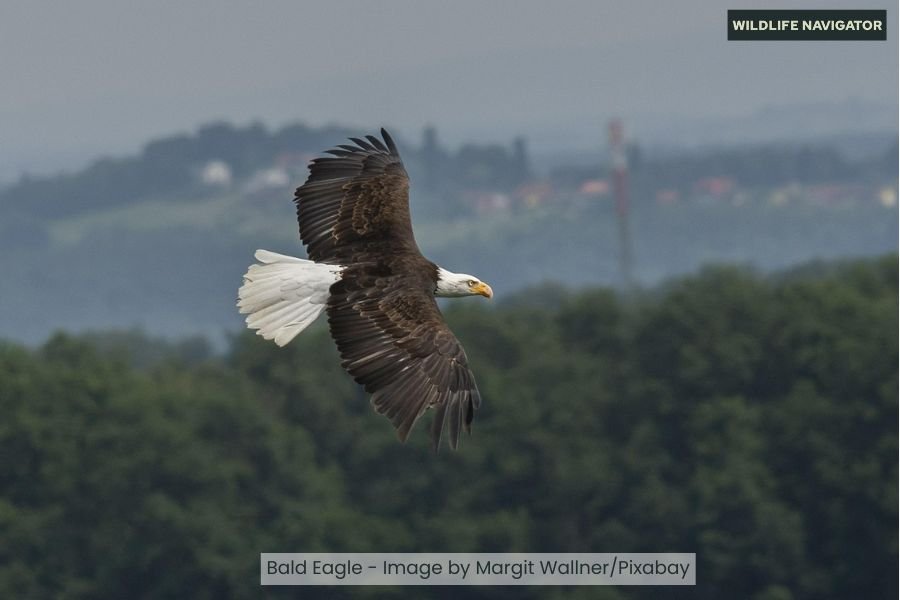
The bald eagle (Haliaeetus leucocephalus) is a large bird of prey native to North America, recognized by its powerful build, hooked yellow bill and, in adults, contrasting white head and tail. It inhabits a wide range of landscapes, particularly around lakes, rivers, wetlands and coastal waters where fish and other food sources are available. Its ability to hunt, scavenge and exploit changing food supplies has helped it thrive in diverse environments.
Beyond its distinctive appearance, the bald eagle is notable for its breeding behaviour, long-term pair bonds and enormous stick nests. It also has considerable cultural significance in the United States, where it became a national symbol in 1782. Once severely affected by persecution, habitat changes and pesticide contamination, the species has made a remarkable recovery through legal protection and conservation efforts.
Today, bald eagles can be found across much of their historical North American range. Nevertheless, lead poisoning, habitat disturbance, collisions and environmental contamination remain concerns. Understanding this species involves examining not only its appearance and behaviour but also its ecological role and the conservation measures that support its continued survival.
Bald Eagle Quick Facts
| Attribute | Details |
|---|---|
| Common name | Bald Eagle |
| Scientific name | Haliaeetus leucocephalus |
| Kingdom | Animalia |
| Phylum | Chordata |
| Class | Aves |
| Order | Accipitriformes |
| Family | Accipitridae |
| Genus | Haliaeetus |
| Species | Haliaeetus leucocephalus |
| Animal group | Birds of prey |
| Average body length | Approximately 71–96 cm |
| Wingspan | Approximately 2–2.4 m |
| Weight | Approximately 3–6.3 kg |
| Native range | North America |
| Primary habitat | Lakes, rivers, wetlands and coastal areas |
| Main food source | Fish |
| Other foods | Birds, mammals, reptiles and carrion |
| Reproduction | Egg-laying |
| Typical clutch size | 1–3 eggs |
| Incubation period | Approximately 34–36 days |
| Adult plumage | Usually attained at around 4–5 years |
| Lifespan | Can reach around 30 years in the wild |
| Global conservation status | Least Concern |
| National significance | National bird of the United States |
What Is a Bald Eagle?
The bald eagle is a large raptor belonging to the family Accipitridae, which also includes hawks, kites and other eagles. Its scientific name, Haliaeetus leucocephalus, identifies it as a member of the sea eagle group. These eagles are generally associated with aquatic environments and often depend heavily on fish or other prey found near water.
Despite its name, the bald eagle is not bald. Its head is covered in white feathers, which contrast sharply with its dark brown body and wings once it reaches adulthood. The name reflects an older use of the word bald, which was associated with a pale or white appearance.
Bald eagles are powerful fliers and adaptable feeders. Although fish form a major part of their diet, they also hunt birds and mammals, consume carrion and sometimes take prey from other predators. This flexibility allows them to use a variety of habitats and food sources.
The species is native to North America, with a range extending from Alaska and Canada through the contiguous United States to parts of northern Mexico. Its association with waterways is especially strong because these habitats offer feeding opportunities, nesting sites and suitable trees for resting.
The bald eagle is also an important conservation example. Its population declined dramatically during the nineteenth and twentieth centuries, particularly in parts of the United States. Restrictions on harmful pesticides, stronger legal protection and habitat conservation helped the species recover.
What Does a Bald Eagle Look Like?
The bald eagle has a large body, broad wings, a prominent head and a heavy hooked bill. Its overall shape is well suited to soaring over open landscapes and carrying prey between feeding and resting locations.
Size and Body Structure
Adult bald eagles generally measure around 71–96 cm from the tip of the bill to the end of the tail. Their wingspan commonly reaches approximately 2–2.4 m, although individual measurements vary.
Females are generally larger and heavier than males, a pattern known as reverse sexual size dimorphism. This difference is common among many birds of prey. Size also varies geographically, with individuals from northern populations tending to be larger than those from some southern regions.
Their long, broad wings provide lift during soaring flight, while strong flight muscles power take-offs and sustained wingbeats. The tail helps with steering and balance, particularly during turns and approaches to prey.
Plumage and Colouration
The adult bald eagle is easily recognized by its white head and tail, dark brown body and wings, and yellow bill and feet. These contrasting colours make mature individuals relatively straightforward to identify, even from a considerable distance.
Young bald eagles look different. Their plumage is predominantly brown, with varying amounts of white mottling across the body, wings and tail. Their bills and eyes are also darker than those of adults.
The transition to adult plumage occurs gradually over several years. As the bird matures, its head and tail become increasingly white, while the bill and other bare parts develop their characteristic yellow colour. Most bald eagles acquire their familiar adult appearance at around four to five years of age, although individual variation occurs.
Beak, Eyes and Talons
The bald eagle’s large, hooked bill is adapted for gripping and tearing food rather than chewing it. Its powerful feet and curved talons help capture fish, restrain other prey and hold food while feeding.
Its eyesight is particularly important during hunting. Bald eagles often search for prey from an exposed perch or while soaring above water. Once they locate a potential target, they can adjust their flight path to approach and attempt a capture.
The legs are mostly bare below the feathered upper portion, unlike those of golden eagles, whose legs are feathered much farther down. This distinction can help separate the species when plumage alone is inconclusive.
How to Identify a Juvenile Bald Eagle
A juvenile bald eagle generally lacks the clean white head and tail associated with adults. Instead, it has a dark bill, a mostly brown head and body, and irregular white patches across the wings, belly, and tail.
The exact pattern changes as the bird ages. Some immature individuals have substantial white areas underneath, while others remain predominantly dark. Consequently, a single patch of white feathers is not sufficient to determine its age.
Juvenile bald eagles may be confused with golden eagles, particularly when seen at a distance. Body proportions, the shape of the head and bill, the amount and arrangement of white plumage, and the presence or absence of feathers on the lower legs can help distinguish them.
Where Do Bald Eagles Live?
Bald eagles occupy a broad range of habitats across North America. They are particularly common around large bodies of water, where they can find fish and other prey. Their distribution includes coastal environments, inland lakes, rivers, wetlands and reservoirs.
Geographic Distribution
The bald eagle’s native range extends across Alaska, Canada, and much of the contiguous United States, reaching into northern Mexico. The species occurs in a variety of climatic regions, from cold northern landscapes to warmer coastal environments.
Population distribution changes throughout the year. Some birds remain close to their breeding territories, while others move considerable distances when food becomes scarce or water bodies freeze. As a result, bald eagles may be more numerous in certain areas during winter than during the breeding season.
The availability of food and nesting habitat strongly influences where they occur. Areas with productive fisheries, mature trees, and relatively undisturbed nesting locations can support breeding pairs, while open water and concentrated food supplies attract birds outside the breeding season.
Preferred Habitat
Bald eagles typically use several habitat features within a home range rather than relying on a single location. They need access to feeding areas, elevated perches, safe resting sites and suitable places to nest.
Common habitats include:
- Lakes and reservoirs: Provide fish, open-water feeding areas and trees along the shoreline.
- Rivers and streams: Offer aquatic prey, especially where flowing water remains open during winter.
- Wetlands and marshes: Support fish, waterbirds and other potential food sources.
- Coastal areas and estuaries: Supply fish, seabirds and carrion, sometimes in large quantities.
- Forested shorelines: Provide tall trees for nesting, roosting and observing the surrounding landscape.
Bald eagles can also use human-modified environments. Reservoirs, agricultural landscapes, urban waterways and some developed shorelines may provide suitable feeding opportunities. Their presence, however, does not mean that all forms of development are harmless; construction and disturbance around breeding sites can still affect their success.
Where Do Bald Eagles Build Their Nests?
Bald eagles usually nest in large, sturdy trees that offer good visibility and room for a substantial nest. They often select mature conifers or deciduous trees near feeding areas, although the exact choice depends on local vegetation and landscape conditions.
Where suitable trees are unavailable, nests may occur on cliffs, the ground or human-made structures. Such nesting sites are less typical across the species’ range but demonstrate its ability to adapt to different surroundings.
Nests are commonly placed high above the ground, often below the crown of a large tree. This location provides space for the adults to approach and leave the nest while allowing them to observe the surrounding area.
A breeding territory may contain more than one nest. Pairs can use alternate nests in different years, particularly if a nest becomes damaged or conditions change.
Do Bald Eagles Migrate?
Bald eagles show varied migration patterns. Some remain in the same general region throughout the year, while others travel seasonally between breeding and wintering grounds.
In northern areas, freezing lakes and rivers can make fish harder to reach. Eagles may then move toward coastal waters, open rivers or other places where food remains accessible. Some western populations follow seasonal food opportunities, including salmon runs.
Juveniles may disperse over greater distances than established breeding adults. Movement also varies with age, weather, prey availability, and breeding-territory location. It is therefore inaccurate to describe every bald eagle as either permanently resident or obligatorily migratory.
Bald Eagle Diet and Feeding Behaviour
Bald eagles are opportunistic predators and scavengers. Fish are their principal food source in many areas, but they can exploit a wide range of animals and food opportunities. Their diet varies with habitat, season, and the availability of prey.
What Do Bald Eagles Eat?
Fish such as salmon, herring, shad, and catfish can be important food sources, depending on the region. Eagles also consume waterfowl, shorebirds, rabbits, muskrats, turtles, snakes, and other animals. In some environments, they feed on carrion, including dead fish and mammals.
The proportion of each food type changes according to local conditions. An eagle living beside a productive river may rely heavily on fish, while one in a different landscape may obtain a larger share of its food from birds, mammals, or carrion.
This flexible diet helps bald eagles survive seasonal changes. Rather than depending entirely on a single prey species, they can switch to alternative foods when their usual sources become less accessible.
How Do Bald Eagles Catch Fish?
Bald eagles often hunt from a perch overlooking the water or while soaring above a lake, river or coastal area. Their vision helps them detect prey near the surface.
When an eagle identifies a target, it may descend in a controlled swoop and extend its feet to seize the fish with its talons. Successful captures depend on factors such as the fish’s position, water conditions and the eagle’s approach.
Not every attempt succeeds. A fish may escape, or the eagle may decide that pursuing it is not worthwhile. Capturing prey also requires energy, so an eagle benefits from choosing opportunities that offer a reasonable chance of success.
If the fish is small enough, the eagle may carry it to a perch or nest. Larger prey can be more difficult to transport, and an eagle may need to feed near the capture site.
Do Bald Eagles Steal Food?
Yes. Bald eagles sometimes obtain food by harassing other animals until they release their prey. This behaviour is called kleptoparasitism.
One well-known example involves ospreys, which catch fish using their own hunting skills. A bald eagle may pursue an osprey carrying a fish, forcing it to drop the catch or occasionally taking the fish directly.
Food theft is not unique to bald eagles, but it demonstrates their ability to exploit another predator’s effort. The strategy may be especially useful when prey is difficult to capture or when an easily obtained meal becomes available.
Bald eagles can also compete with other eagles and scavengers around concentrated food supplies. Their size and strength may help them dominate some encounters, although outcomes depend on the individuals and circumstances involved.
Are Bald Eagles Scavengers?
Bald eagles readily consume carrion when it is available. They may feed on dead fish, mammals, birds and other animal remains. In some locations, carrion becomes particularly important during winter or when seasonal food sources are abundant.
Scavenging allows bald eagles to obtain food without pursuing and capturing live prey. It also connects them to natural processes that make animal remains available to other scavengers and decomposers.
However, scavenging can expose eagles to harmful substances. For example, fragments of lead ammunition in the remains of hunted animals can be swallowed during feeding. This is an important conservation concern because toxic exposure can impair health and may cause death.
How Do Bald Eagles Feed?
Like other raptors, bald eagles use their bills to tear food into pieces that can be swallowed. Their feet help secure prey while they feed, particularly when handling slippery fish.
They may consume a large meal and then spend time digesting it rather than hunting continuously. When food is abundant, an eagle may feed heavily; when it is scarce, the bird must search more widely or use alternative sources.
Food availability also affects breeding. Adults raising chicks need sufficient prey to support both their own energy requirements and the rapid growth of their offspring. A territory with reliable food can therefore be important for successful reproduction.
Bald Eagle Behaviour and Lifestyle
Bald eagles spend much of their time searching for food, resting, maintaining their plumage and interacting with other eagles. Their behaviour changes with the season, particularly during courtship and nesting, when adults defend territories and invest considerable time in raising their young.
Flight and Soaring
Bald eagles are powerful fliers capable of soaring, gliding and sustained flapping flight. Their broad wings help them remain airborne while using rising air currents to gain height or travel across open landscapes.
They may soar over lakes and rivers while searching for fish, circle above forests or move between feeding areas and resting sites. When conditions are suitable, soaring reduces the energy needed to cover long distances.
During hunting, an eagle can change from soaring to a controlled descent toward prey. It may also fly low over the water, using its feet to seize an animal near the surface. Take-off with heavy prey requires considerable effort, and an eagle may sometimes remain on the ground or water briefly before getting airborne.
Social Behaviour
Bald eagles are not strictly solitary. Breeding pairs generally maintain territories around their nests, but outside the breeding season they may gather in areas with abundant food or suitable communal roosts.
Winter concentrations can occur near open water, fish-rich rivers and other dependable food sources. Such gatherings may include adults and immature birds, sometimes in substantial numbers.
These temporary groups do not mean that the eagles have formed permanent social colonies. Instead, individuals are responding to favourable feeding and resting conditions. Competition can occur around food, but several eagles may use the same general area when resources are plentiful.
Calls and Communication
Bald eagles communicate through vocalizations, body posture and aerial displays. Their calls are often described as high-pitched or chattering rather than the deep, powerful cry sometimes associated with eagles in popular films.
Calls can occur during territorial interactions, courtship and communication between members of a pair. Visual displays also help signal intentions or respond to other birds.
In some courtship displays, two eagles fly together at considerable height, lock their talons and tumble downward before separating. These dramatic movements are associated with pair bonding and courtship, although not every display follows the same pattern.
Territorial Behaviour
Breeding adults defend areas surrounding their nests against potential competitors. The size and intensity of territorial defence depend on the availability of nesting sites, food and neighbouring pairs.
Suitable trees can be especially valuable where mature woodland has been reduced or disturbed. A productive territory offers not only a place to raise young but also access to nearby feeding grounds.
Outside the breeding season, territorial behaviour may become less pronounced in feeding areas where multiple eagles gather. Individual birds can still compete for food, but shared feeding locations are common where prey is abundant.
Bald Eagle Reproduction and Life Cycle
Bald eagles reproduce by laying eggs and raising their young in large nests. Breeding usually begins when birds reach maturity, often around four or five years of age, although some individuals may begin later.
The timing of reproduction varies across the species’ range. Eagles in warmer southern regions may begin nesting much earlier in the calendar year than those in colder northern areas.
Pair Bonds and Courtship
Bald eagles commonly form long-term pair bonds, and established pairs may remain together for many breeding seasons. If one member dies or disappears, the surviving bird can form a new pair.
Courtship may involve aerial displays, calls, chasing and coordinated flight. These behaviours help reinforce the bond between partners before breeding.
Both adults contribute to reproduction and parental care. Their responsibilities include preparing the nest, incubating eggs, protecting the young and obtaining food for the growing chicks.
Nest Construction
Bald eagles build large nests from sticks and branches, adding softer materials such as grass, moss or other vegetation to the interior. Both members of a pair collect material, although the female often carries out much of the placement and arrangement.
The nest is usually positioned in a substantial tree with strong branches capable of supporting its weight. Its location provides suitable access for the adults and a relatively secure platform for eggs and chicks.
Bald eagle nests are among the largest built by North American birds. A nest may measure several metres across after repeated use and enlargement. Over time, the accumulation of new material can make an established nest extremely heavy, so the supporting tree must be sufficiently strong.
Pairs may return to the same nest in successive years, repairing and adding to it. They can also maintain alternative nests within their territories. Reuse is not guaranteed: storms, structural damage, disturbance or changing conditions may lead the birds to choose another site.
Eggs and Incubation
A typical bald eagle clutch contains one to three eggs, often two. The eggs are generally dull white and may be laid several days apart.
Both adults participate in incubation, helping maintain the temperature needed for embryonic development. Incubation lasts approximately 34–36 days, although exact timing varies.
Because eggs are laid at different times, chicks may hatch at different times as well. This can produce differences in size within a brood. When food is limited, the youngest chick may face particular challenges competing with larger siblings.
Successful hatching depends on more than incubation alone. Weather, disturbance, adult condition and other environmental factors can influence whether eggs hatch and whether the resulting chicks survive.
Eaglets and Parental Care
Newly hatched eaglets are covered in pale down and depend on their parents for warmth, protection and food. During their early development, adults remain closely involved with the nest and bring prey to the chicks.
As the young grow, they develop additional down and then juvenile feathers. Their food requirements increase, and adults must obtain enough prey to support their own needs as well as those of their offspring.
Both parents contribute to feeding and protecting the brood. They may defend the nest against threats, shelter chicks during poor weather and bring food to the nest over a period of weeks.
Brood survival varies considerably. Food shortages, severe weather, disease, disturbance and other hazards can affect young eagles. The presence of two chicks at hatching does not guarantee that both will eventually leave the nest.
Fledging and Independence
Young bald eagles generally begin flying at around 10–12 weeks of age, although development varies. Fledging is an important milestone, but it does not mean that the young birds immediately become independent.
After leaving the nest, fledglings continue to practise flying, improve their coordination and learn how to obtain food. Their parents may continue supplying food for several weeks while the young birds develop their hunting and foraging abilities.
Eventually, the juveniles disperse from their natal territory. They may travel widely before settling in a suitable area or returning to a region where they can eventually breed.
The gradual transition from eaglet to independent adult illustrates why nesting success should be measured by more than the number of eggs laid. Survival through fledging and the subsequent juvenile period is equally important to population persistence.
How Long Do Bald Eagles Live?
Bald eagles can live for around 30 years in the wild, although many individuals die much earlier. Longevity depends on factors such as food availability, injury, disease, environmental hazards and survival during the vulnerable early stages of life.
Young birds face numerous challenges while learning to fly and obtain food. Collisions, starvation, severe weather and other hazards can reduce survival before they reach adulthood.
Adult eagles generally have greater experience locating food and navigating their environment, but they remain vulnerable to poisoning, accidents and habitat disturbance. Lead exposure is a particular concern because eagles may ingest ammunition fragments while feeding on carcasses.
Captive bald eagles can live longer than wild individuals under suitable care. However, longevity records from captivity should not be treated as representative of the typical lifespan in nature.
Bald Eagle Adaptations and Survival Skills
The bald eagle’s success comes from a combination of physical adaptations and flexible behaviour. Its hunting ability, flight efficiency and capacity to exploit different food sources allow it to occupy a wide range of North American environments.
Vision and Hunting
Bald eagles rely heavily on vision to locate prey. From a perch or during flight, they scan their surroundings for fish, birds and other potential food sources.
Their hunting method depends on the prey available. An eagle may swoop down to seize a fish, pursue a bird or capture a small mammal. It can also take advantage of carrion rather than spending energy hunting live prey.
Feet and Talons
The eagle’s strong feet and curved talons help it grasp and hold food. This is particularly important when capturing fish, which can be slippery and difficult to secure.
Its hooked bill then tears the prey into manageable pieces. Together, the feet and bill allow the eagle to capture and process a range of animals.
Flight Efficiency
Broad wings support soaring and gliding, allowing bald eagles to travel while conserving energy. This is useful when searching large areas for food or moving between feeding grounds and nest sites.
The birds can also use rising warm air and other favourable air currents to gain altitude. Their ability to combine powered flight with soaring is valuable in landscapes where feeding areas may be widely separated.
Dietary Flexibility
Bald eagles are not restricted to a single prey species. Their ability to consume fish, birds, mammals and carrion allows them to respond to seasonal changes and local food availability.
This flexibility does not make them immune to environmental change. A decline in major prey populations, contamination of food sources or loss of access to feeding habitat can still affect their health and reproductive success.
Bald Eagle Conservation Status
The bald eagle is currently classified as Least Concern on the global IUCN Red List assessment. This indicates that it does not presently meet the criteria for a higher global threat category, but it does not mean the species is free from risks.
Its recovery is one of the best-known examples of successful wildlife conservation in North America. The historical decline and subsequent rebound demonstrate how pollution control, legal protection and habitat management can influence the future of a species.
Why Did Bald Eagle Populations Decline?
Bald eagle numbers declined substantially during the nineteenth and twentieth centuries. Several pressures contributed to the decline, including habitat destruction, direct persecution and contamination of the environment.
Historically, eagles were sometimes killed because they were perceived as threats to livestock or game species. Shooting and other forms of persecution reduced populations in parts of their range.
Habitat loss also affected breeding and feeding opportunities. The removal of mature trees near waterways, disturbance around nesting sites and changes to aquatic environments reduced the suitability of some areas.
One of the most significant causes of the twentieth-century decline was exposure to the pesticide DDT and its breakdown products. Contamination affected reproduction, particularly by causing eggshell thinning. Thin shells were more likely to break during incubation, reducing the number of chicks successfully hatched.
How Did Bald Eagles Recover?
Several major conservation measures helped reverse the decline.
The United States banned most uses of DDT in 1972. Restrictions on this pesticide reduced an important source of reproductive harm, while habitat protection and other conservation measures improved the prospects for surviving populations.
The Endangered Species Act, enacted in 1973, provided additional protection and supported recovery efforts. Restrictions on killing and disturbance, habitat management, monitoring and public conservation initiatives also contributed.
As populations increased, bald eagles returned to many areas where they had become uncommon or disappeared as breeding birds. In 2007, the species was removed from the US federal list of threatened and endangered species because of its recovery.
Delisting did not eliminate every legal protection. Bald eagles remain protected under other federal laws, including the Bald and Golden Eagle Protection Act and the Migratory Bird Treaty Act, as well as applicable state and other regulations.
Current Threats to Bald Eagles
Despite their recovery, bald eagles continue to face several threats.
Lead poisoning: Eagles can ingest fragments of lead ammunition when feeding on remains of hunted animals. Even relatively small amounts of lead can be harmful, affecting the nervous system and other bodily functions. Severe exposure can be fatal.
Habitat loss and disturbance: Development near nesting areas can remove trees, reduce access to food or disturb breeding adults. Repeated disturbance may cause birds to abandon a nest or reduce their reproductive success.
Collisions and electrocution: Roads, vehicles, power infrastructure and other structures can cause injuries or deaths. Risk depends on local conditions and the design and placement of infrastructure.
Environmental contaminants: Oil spills and other pollution events can harm eagles directly or contaminate the food sources on which they depend.
Changes in food availability: A decline in fish or other prey can make it harder for adults to maintain their condition and raise young. Local impacts vary according to the ecosystem and the severity of the change.
How Can Bald Eagles Be Protected?
Continued conservation requires maintaining suitable habitat and reducing avoidable sources of mortality. Protecting mature trees, shoreline forests and other nesting areas helps preserve breeding opportunities.
Reducing lead exposure is also important. Hunters can help by using non-lead ammunition where appropriate and by following local wildlife guidance for handling carcasses and remains. Wildlife managers can monitor known threats and identify areas where additional action is needed.
People observing bald eagles should keep a respectful distance, especially near nests and roosting sites. Approaching too closely, repeatedly disturbing birds or attempting to attract them can interfere with normal behaviour.
Injured eagles should be reported to authorized wildlife rehabilitators or the relevant wildlife agency rather than handled without training. Because bald eagles are legally protected, any handling, possession or rehabilitation must follow applicable regulations.
Bald Eagle’s Role in the Ecosystem
Bald eagles occupy an important position in aquatic and terrestrial food webs. Their role includes both hunting live prey and consuming animals that have already died.
As predators, they feed on fish, waterbirds and other animals. Their feeding relationships connect aquatic ecosystems with the surrounding forests, wetlands and shorelines.
As scavengers, bald eagles consume carrion that may otherwise be eaten by other scavengers or decomposed by microorganisms. They are part of a wider community of animals that use available food resources and contribute to nutrient cycling.
Their dependence on productive feeding areas and suitable nesting habitat also makes them useful subjects for ecological monitoring. Changes in breeding success, survival or local distribution can reveal environmental pressures, although no single species can fully represent the condition of an entire ecosystem.
The bald eagle’s history also shows how contaminants can affect wildlife far beyond the point where pollutants are released. Chemicals entering aquatic food webs may accumulate through feeding relationships and affect predators at higher levels. Understanding these connections is important for protecting both individual species and the habitats they share.
Bald Eagle vs. Golden Eagle
The bald eagle and golden eagle are two of North America’s largest birds of prey. Although they can appear similar at a distance, differences in plumage, leg feathering, habitat preferences and feeding behaviour can help distinguish them.
| Feature | Bald Eagle | Golden Eagle |
|---|---|---|
| Scientific name | Haliaeetus leucocephalus | Aquila chrysaetos |
| Adult appearance | White head and tail, dark brown body | Predominantly dark brown with golden-brown feathers on the nape |
| Bill | Large and yellow in adults | Darker bill with a yellow cere |
| Leg feathering | Lower legs mostly bare | Legs feathered down to the feet |
| Typical habitat | Lakes, rivers, wetlands and coastal areas | Mountains, open country, grasslands and rugged terrain |
| Main food sources | Fish, birds, mammals and carrion | Mammals and birds, including rabbits and other medium-sized prey |
| National significance | National bird of the United States | No equivalent national designation in the United States |
The bald eagle is strongly associated with aquatic environments because fish are a major food source in many parts of its range. Golden eagles are more closely associated with open and mountainous landscapes, where they hunt terrestrial prey.
However, habitat and diet alone are not definitive identification features. Both species are adaptable, and their ranges overlap in parts of North America. Juvenile bald eagles can also resemble golden eagles because they have not yet developed the white head and tail of adults.
Bald Eagle and Its Cultural Significance
The bald eagle has a prominent place in American history and national identity. It was adopted as a national symbol in 1782 and has since appeared on official seals, government insignia and other representations of the United States.
Its large size, commanding flight and distinctive appearance contributed to its association with strength, freedom and independence. The species became particularly recognizable through its use in national emblems and public imagery.
In December 2024, the bald eagle was formally designated the national bird of the United States in federal law, making official a role it had held symbolically for more than two centuries.
The eagle also holds cultural and spiritual significance for many Indigenous peoples of North America. These relationships differ among communities and traditions, so they should not be reduced to a single interpretation.
The bird’s national symbolism is closely connected to its conservation history. Its dramatic decline and subsequent recovery demonstrated that even a widely recognized species can face serious environmental pressures. Its return to many parts of its range has become an important example of the potential benefits of sustained conservation action.
Interesting Facts About Bald Eagles
- They are native to North America. Their natural range extends from Alaska and Canada through the contiguous United States to parts of northern Mexico.
- Their heads are feathered, not bald. The name refers to the white appearance of the adult head rather than a lack of feathers.
- Females are usually larger than males. This difference is common among birds of prey and can be noticeable in adult pairs.
- Fish are a major food source. Bald eagles also consume birds, mammals, reptiles and carrion, depending on local availability.
- They sometimes steal prey. Bald eagles may pursue ospreys and other predators to obtain food caught by another animal.
- Their nests can become enormous. Pairs may add material to established nests over successive breeding seasons, creating structures several metres across.
- Young eagles look different from adults. Their brown and white mottled plumage gradually changes as they mature.
- They may form large winter gatherings. Groups can assemble near open water and dependable food supplies, particularly when northern lakes and rivers freeze.
- They can live for decades. Some individuals survive for around 30 years in the wild, although many die considerably earlier.
- Their recovery followed major conservation efforts. DDT restrictions, legal protection and habitat management helped reverse severe population declines.
- They are skilled scavengers as well as hunters. Feeding on carrion gives them another way to obtain food when hunting opportunities are limited.
- They are legally protected in the United States. Their recovery did not end federal protection under other wildlife laws.
Frequently Asked Questions About Bald Eagles
References and Further Reading
The following authoritative resources provide information for verifying the bald eagle’s identification, biology, distribution and conservation history.
- U.S. Fish and Wildlife Service: Bald Eagle species profile — biology, habitat, feeding behaviour, life cycle and conservation.
- Cornell Lab of Ornithology: Bald Eagle identification and overview — physical characteristics, range, behaviour and natural history.
- Cornell Lab of Ornithology: Bald Eagle life history — nesting, reproduction, food and habitat.
- U.S. Fish and Wildlife Service: Bald Eagle fact sheet — species biology, historical decline and recovery.
- U.S. Congress: Federal legislation formally designating the bald eagle as the national bird in December 2024.
- IUCN Red List species assessment and record : Least Concern.
Curating and documenting wildlife and protected areas through detailed guides and the continuously updated WN Index.
- Rosan Prasad
- Rosan Prasad

- Rosan Prasad
- Rosan Prasad