Egmont National Park – North Island, New Zealand

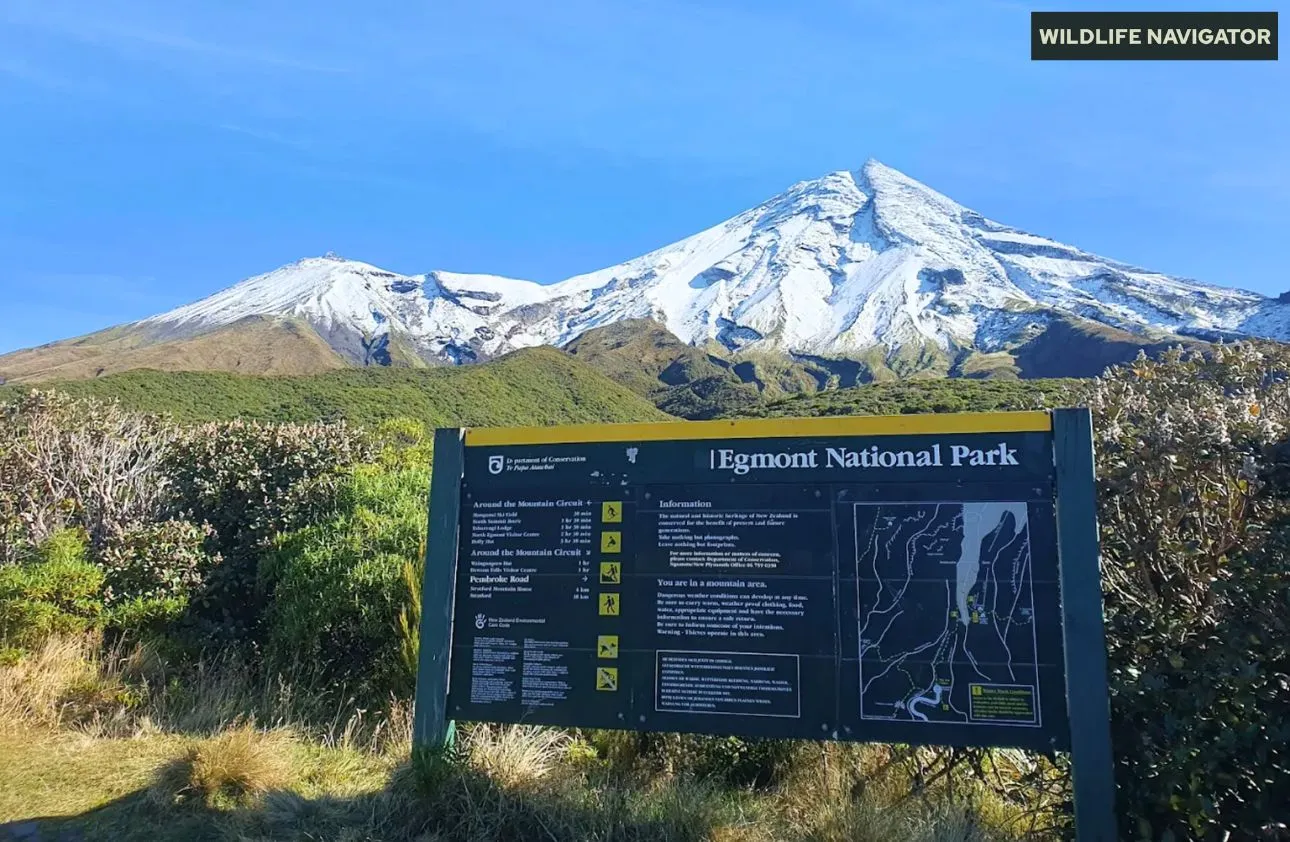
Egmont National Park is one of New Zealand’s most visually striking wilderness areas—an almost perfect circle of deep green rainforest surrounding the solitary volcanic cone of Mount Taranaki. As one of the most distinctive landscapes within the National Parks in New Zealand, it stands out for its dramatic geography and powerful cultural significance. Located on the west coast of the North Island, the park feels both dramatic and mythical, shaped by the power of eruptions, glacial carving, and centuries of natural regeneration.
Dominated by the 2,518-metre Mt Taranaki, often compared to Japan’s Mt Fuji for its near-symmetrical profile, the park offers a landscape that changes rapidly as you move upward: moss-draped goblin forests, cascading waterfalls, icy alpine slopes, and sweeping ridgelines that reveal the full circular boundary of the park.
Sacred to Māori and celebrated by hikers, nature lovers, and photographers from around the world, Egmont National Park is a place where ancient volcanoes, lush biodiversity, and moody weather combine to create an unforgettable wilderness experience. Whether you’re chasing the iconic Pouakai Tarn reflection or planning a summit attempt, this park promises both challenge and wonder in equal measure.
Geological & Natural History
Egmont National Park is built around one of the youngest and most symmetrical volcanoes in Aotearoa—Mount Taranaki (Mt Egmont). Rising 2,518 metres above the Taranaki region, the volcano has been active for around 130,000 years, with its last major eruption occurring in the mid-18th century. Although currently dormant, it is still considered potentially active, and its perfect cone shape is a result of repeated eruptions, lahars, and slow glacial sculpting over millennia.
The landscape surrounding Mt Taranaki is a remarkable record of volcanic evolution. The park also contains the remains of two older volcanic ancestors—the Pouakai and Kaitake Ranges—once enormous volcanoes themselves. Over hundreds of thousands of years, erosion reduced them to the rugged, forested ranges we see today, framing the modern volcanic cone at the centre.
For Māori, particularly the local iwi Te Āti Awa, Taranaki, and Ngāruahine, the mountain holds deep cultural and spiritual significance. It is personified in traditional stories and regarded as a living ancestor. The park’s dramatic terrain, ever-changing weather, and iconic form all contribute to a sense of mythic presence that has shaped cultural connections for centuries.
From violent eruptions to ancient glaciers and sacred narratives, Egmont National Park’s geological story is one of constant transformation—an evolving landscape that continues to define the region’s character and identity.
Landscape & Habitat Diversity
Egmont National Park is famous for its astonishingly rapid ecological transitions—few places in New Zealand offer such dramatic changes in landscape over such short distances. As you move from the low foothills to the alpine slopes of Mt Taranaki, the environment shifts from dense, mossy rainforest to open tussocklands and volcanic rock, creating a rich mosaic of habitats.
Rainforests & Goblin Forests
The lower slopes are cloaked in lush podocarp–broadleaf forests, dominated by rimu, kamahi, and mountain cedars. Here, high rainfall and constant moisture create the park’s signature goblin forests—a surreal world of twisted trees draped in green mosses, lichens, and epiphytes. These forests are some of the most enchanting in the country, shaped by centuries of cloud cover and volcanic soil.
Montane Shrublands & Alpine Zone
Higher up, the forest gives way to subalpine scrub—a landscape of hardy shrubs, mountain daisies, and flax that can withstand cold winds. Above this lies the alpine zone, where tussock grasses, herbfields, and exposed volcanic rocks dominate. In winter, snow blankets the upper mountain, transforming it into a crisp white landscape.
Wetlands & Unique Ecological Niches
One of the most spectacular features is the Ahukawakawa Swamp, an elevated wetland perched between Mt Taranaki and the Pouakai Range. This sphagnum bog is thousands of years old and supports species found nowhere else in the region. Nearby, rivers and waterfalls cascade through steep ravines, feeding a network of streams that radiate outward from the mountain.
The Circular Boundary
The park’s perfectly circular boundary—created when it was established in 1900—makes its landscape even more striking. Inside lies a lush, intact ecosystem; outside are cleared farmlands. From above, this sharp contrast highlights the park’s ecological isolation and integrity.
From enchanted forests to alpine ridges and ancient wetlands, Egmont National Park’s landscapes are as diverse as they are dramatic—offering endless opportunities for exploration, photography, and discovery.
Flora & Fauna
Egmont National Park shelters an impressive variety of plant and animal life, shaped by its volcanic soils, high rainfall, and sharply defined ecological zones. From moss-draped forests to alpine herbfields, the park supports species uniquely adapted to the mountain’s cool, wet climate.
Flora
The lower and mid-slopes are dominated by rich temperate rainforests, featuring:
- Kamahi – the most common canopy species, forming dense, mossy forests.
- Rimu & Kahikatea – towering podocarps adding height and age to the forest.
- Mountain Cedar & Totara – hardy trees that cling to steeper, colder slopes.
- Tree ferns, epiphytes & lichens – thriving in the humid, cloud-covered forests.
- Alpine plants such as snowberries, mountain daisies, and tussock grasses at higher elevations.
The iconic goblin forest—with its twisted trunks, emerald moss layers, and thick fern carpets—is one of New Zealand’s most enchanting and photogenic forest types, shaped by constant moisture and frequent fog.
Fauna
While the park’s wildlife is subtle compared to larger forests, it remains an important refuge for native species:
- Tūī – often seen feeding on nectar-rich plants.
- Kererū (New Zealand pigeon) – vital for seed dispersal.
- North Island Robin, Tomtit, and Grey Warbler – common in mid-forest zones.
- Fantail – often follows hikers for insects.
- Western Brown Kiwi – elusive and primarily found in controlled areas.
- Long-tailed & Short-tailed bats – New Zealand’s only native land mammals, occasionally recorded in forested areas.
Wetlands like Ahukawakawa Swamp support specialised species adapted to acidic bog conditions, including rare sedges, mosses, and aquatic insects.
Conservation Notes
Predator control programs, forest restoration, and replanting initiatives are ongoing. Stoats, rats, and possums remain major threats, but continuous monitoring and community involvement have helped strengthen bird populations and protect sensitive habitats.
Major Attractions & Top Places to Visit
Egmont National Park is full of dramatic landscapes, iconic photo spots, and easily accessible natural attractions. Whether you’re chasing reflections, exploring mossy forests, or planning a summit climb, the park offers a diverse set of experiences for all types of travellers.
Mount Taranaki Summit
The park’s most iconic feature and a bucket-list challenge. The summit route is demanding and weather-dependent, but rewards hikers with panoramic views across the Taranaki region, the Pouakai Range, and even Mount Ruapehu on clear days.
Pouakai Tarn
One of New Zealand’s most photographed locations. On calm days, the tarn offers a perfect mirror reflection of Mount Taranaki—especially at sunrise and sunset. A must-visit spot for photographers.
Goblin Forest (Kamahi Loop)
A mystical, otherworldly forest with twisted, moss-covered kamahi trees. The humidity and constant mist create an enchanting green world that feels almost fairytale-like.
Dawson Falls
A stunning 18-metre waterfall surrounded by lush rainforest. Easily accessible, it’s one of the most popular short walks in the park and a great spot for long-exposure photography.
Wilkies Pools
Naturally sculpted pools formed by ancient lava flows and polished by centuries of water. Located near Dawson Falls, it’s an easy family-friendly walk with beautiful river views.
Ahukawakawa Swamp
A unique high-altitude wetland nestled between the Pouakai Range and Mt Taranaki. This ancient sphagnum bog is ecologically important and offers sweeping views of the surrounding peaks.
Pouakai Circuit
A multi-day loop offering some of the best scenery in the park—alpine ridgelines, wetlands, forest, and up-close viewpoints of Mt Taranaki. It also includes access to the famous tarn.
Manganui Ski Area
On the eastern slopes of Mt Taranaki, this club-operated field offers winter skiing and snowboarding with raw, backcountry-style terrain.
Best Hikes & Walking Tracks
Egmont National Park is a paradise for walkers, offering everything from gentle forest loops to demanding alpine climbs. The trails here highlight the park’s dramatic elevation changes, mystical rainforests, volcanic terrain, and sweeping mountain vistas.
Pouakai Circuit – 2–3 Days
One of New Zealand’s classic multi-day hikes. The circuit loops through forests, alpine ridges, and wetlands—including the famous Pouakai Tarn, where Mt Taranaki’s reflection is captured perfectly on calm days.
Ideal for: Experienced trampers seeking a scenic overnight or multi-day adventure.
Mount Taranaki Summit Route – Full Day
A challenging and steep alpine climb to the summit of Mt Taranaki. The route demands fitness, good weather, and proper gear, as conditions can change rapidly.
Highlights: 360° mountain-top views, volcanic terrain, and an iconic summit crater.
Ideal for: Experienced hikers with alpine awareness.
Wilkies Pools Loop – Easy
A short, family-friendly trail winding through Goblin Forest to a series of natural rock pools carved by lava flows.
Highlights: Mossy trees, polished pools, and gentle riverside scenery.
Ideal for: Casual walkers, families, beginners.
Dawson Falls to Wilkies Pools Track – Easy–Moderate
A scenic forest walk linking two popular attractions—Dawson Falls and Wilkies Pools.
Highlights: Fairy-like forests, waterfalls, volcanic rock formations.
Ideal for: Beginners wanting a slightly longer but manageable trail.
Lake Dive Track – Moderate
A rewarding forest-to-lake tramp leading to the remote Lake Dive Hut.
Highlights: Dense rainforest, serenity at the lake edge, views of Mt Taranaki reflected in dark waters.
Ideal for: Intermediate hikers and photographers.
Enchanted Track Loop – Short Walk
A brief but atmospheric walk through moss-laden kamahi forest.
Highlights: Storybook-like greenery and photogenic woodland scenes.
Ideal for: Quick nature escapes near Dawson Falls.
Other Notable Tracks
- York Loop Track – Gentle forest walk with scenic viewpoints.
- Holly Hut Track – Leads to one of the park’s popular backcountry huts.
Egmont’s trail network is incredibly diverse, offering something for every skill level. Whether you want a peaceful forest stroll or a full alpine challenge, each hike delivers a unique perspective on Mt Taranaki’s ever-changing landscapes.
Climate & Best Time to Visit
Egmont National Park is known for its dramatic and unpredictable weather. Mt Taranaki stands alone on the Taranaki coastline, meaning the mountain creates its own microclimate—capable of switching from clear skies to thick cloud and rain in minutes. Understanding these conditions is essential for a safe and enjoyable visit.
Weather Patterns
- The mountain receives very high rainfall, feeding its lush rainforests and wetlands.
- Cloud cover is extremely common, especially around mid-altitude forests.
- The upper mountain is often cold, windy, and icy, even in summer.
- Winter brings heavy snowfall to higher slopes, turning the summit and alpine areas into technical, alpine terrain.
Best Time to Visit
December to April (Summer–Early Autumn) is the safest and most rewarding time to explore the park.
- Trails are more stable and less slippery.
- Snow and ice retreat from most tracks.
- Clear-weather windows are more frequent—ideal for photography and summits.
- Pouakai Tarn reflections are most reliable on calm summer mornings.
Winter Conditions (May–October)
- Snow and ice can cover the higher tracks.
- Summit attempts often require crampons, ice axes, and alpine experience.
- Lower forest walks remain accessible but can be cold, wet, and muddy.
Safety Note
Because weather can change rapidly, hikers should:
- Check the Taranaki Maunga weather forecast before any hike.
- Carry warm layers, waterproofs, and navigation tools.
- Avoid the summit in poor visibility or high wind.
How to Reach Egmont National Park
Egmont National Park is easily accessible from the Taranaki region on New Zealand’s North Island. While the area is well connected by road, public transport options are limited, so most visitors arrive by self-drive.
Nearest Major Town: New Plymouth
New Plymouth is the primary gateway to the park, offering accommodation, supplies, fuel, and visitor services.
- Distance to North Egmont Visitor Centre: ~30 minutes by car
- Distance to Dawson Falls (East Egmont): ~50 minutes
- Distance to Stratford (another access town): ~35 minutes
Main Entry Points
Egmont National Park has three major access points, each leading to different regions of the mountain:
1. North Egmont
- The most popular entrance.
- Access point for the Mount Taranaki Summit Route, Holly Hut, and several forest and alpine tracks.
- Features the North Egmont Visitor Centre with information, maps, and updates.
2. East Egmont (Dawson Falls)
- Known for Dawson Falls, Wilkies Pools, and short forest walks.
- Good for families and casual hikers.
- Home to the historic Dawson Falls Visitor Centre.
3. Stratford Plateau
- Provides access to the Manganui Ski Area in winter.
- Offers high-altitude vantage points and shorter walks.
By Road
- From New Plymouth → North Egmont: SH3 to Egmont Road
- From New Plymouth → Dawson Falls: SH3 → Manaia Road → Manaia Road end
- From Stratford → Dawson Falls: Follow signposted routes along Manaia Road
- Roads are sealed until the park boundary, with gravel sections inside.
Public Transport
- There is no direct public transport to the park entrances.
- Visitors without a car must rely on tours, shuttles (seasonal), or taxis.
Airports
- New Plymouth Airport (NPL) is the closest and has regular domestic flights from Auckland, Wellington, and Christchurch.
- Car rentals are available at the airport.
Accommodation Options
Egmont National Park offers a mix of backcountry huts, campsites, and nearby town stays—making it easy for both casual visitors and multi-day trampers to plan their stay. Whether you want to sleep inside the forest, wake up to mountain views, or base yourself in New Plymouth, there are options for every travel style.
Backcountry Huts
Managed by the Department of Conservation (DOC), these huts provide simple, rustic accommodation for trampers on longer routes.
Pouakai Hut
- The most popular hut in the park.
- Located near the Pouakai Range with access to the iconic Pouakai Tarn.
- Ideal for photographers chasing sunrise and sunset reflections.
Holly Hut
- Positioned on the northern slopes.
- A key stop on the Pouakai Circuit and offers views across volcanic valleys.
- Surrounded by diverse alpine and subalpine landscapes.
Lake Dive Hut
- Remote and peaceful, located beside the scenic Lake Dive.
- Perfect for those wanting solitude and forest immersion.
All huts operate on a first-come, first-served or bookable (season-dependent) basis. Facilities generally include bunks, mattresses, toilets, water (untreated), and basic heating.
Campsites
Egmont National Park doesn’t have large car-campgrounds inside its boundaries, but there are a few basic DOC campsites near access points.
Facilities are limited—expect toilets, water sources, and natural settings.
Lodges & Cabins Near Park Entrances
Several privately run stays sit just outside the park, offering comfort close to trailheads:
- Dawson Falls Mountain Lodge – A historic lodge near Dawson Falls with cosy rooms and forest views.
- Cabins and alpine lodges near Stratford Plateau and East Egmont.
- Ideal for hikers wanting early starts or photography-focused visits.
Accommodation in New Plymouth
New Plymouth is the most convenient base, offering a wide range of stays:
- Hotels & luxury lodges
- Boutique stays & apartments
- Budget motels & holiday parks
- Backpacker hostels
Staying in town also gives access to supermarkets, restaurants, gear shops, and coastal attractions.
Accommodation in Stratford & Inglewood
For quicker access to Dawson Falls or Stratford Plateau, these smaller towns offer:
- Holiday parks
- Motels & homestays
- Quiet local accommodation options closer to the mountain
From rustic huts to comfortable lodges, Egmont National Park caters to every type of traveller—whether you’re here for a challenging multi-day tramp or a scenic weekend escape.
Travel Tips, Responsible Tourism & Conservation
Visiting Egmont National Park requires good preparation and mindful travel. Mt Taranaki’s fast-changing weather, fragile ecosystems, and culturally significant landscapes make responsible behaviour essential.
Travel Tips
- Check weather forecasts frequently—conditions can shift from clear to dangerous quickly.
- Start early for safer hiking conditions and the best visibility at Pouakai Tarn.
- Carry proper gear, including waterproof clothing, warm layers, sturdy boots, and navigation tools.
- Stay on marked tracks to avoid getting lost in foggy areas and to protect delicate vegetation.
- Summit safety: Attempt only in perfect weather; winter climbs require alpine equipment and experience.
- Pack essentials like water, food, headlamp, and a charged phone.
- Photography tip: Sunrise and sunset produce the best golden light on Mt Taranaki.
Responsible Tourism & Conservation
- Follow Leave No Trace—pack out all rubbish and avoid disturbing wildlife.
- Respect cultural significance—Taranaki Maunga is a taonga (treasure) for local iwi.
- Protect fragile habitats such as Ahukawakawa Swamp by staying on boardwalks.
- Support conservation efforts by using DOC-maintained huts and facilities responsibly.
- Be predator-aware—check gear and food storage to avoid attracting pests.
- Minimise noise in forest areas where birdlife is active.
Conclusion
Egmont National Park is one of New Zealand’s most striking wilderness destinations—an almost perfectly symmetrical volcano wrapped in lush rainforest, ancient wetlands, and dramatic alpine terrain. Whether you’re chasing the iconic reflection at Pouakai Tarn, wandering through mossy goblin forests, or taking on the challenge of a summit climb, the mountain delivers experiences that feel both raw and breathtaking.
Its mix of natural beauty, cultural significance, and accessible trails makes it a must-visit for hikers, photographers, and nature lovers alike. Yet Mt Taranaki also demands respect: the weather is unpredictable, the terrain can be challenging, and the ecosystems are fragile. Travelling thoughtfully ensures this remarkable landscape remains protected for generations to come.
From tranquil forest walks to sweeping volcanic vistas, Egmont National Park is a reminder of the wild power and quiet magic that define Aotearoa’s natural heritage.