Pench National Park – A Complete Travel Guide

Pench National Park is a magical blend of wilderness, history, and culture. Straddling the states of Madhya Pradesh and Maharashtra, this renowned tiger reserve is more than just a forest—it’s a living storybook. The park gained worldwide fame as the inspiration for Rudyard Kipling’s timeless classic, The Jungle Book, where Mowgli’s adventures with Bagheera, Baloo, and Shere Khan came alive amidst the deep sal forests and flowing rivers of Pench.
Spread across lush teak forests, bamboo thickets, and undulating hills, Pench offers visitors an authentic jungle experience where nature reigns supreme. Its name comes from the Pench River, which meanders through the park and sustains its rich biodiversity. The sight of a tiger emerging from the dense foliage to quench its thirst by the river is one of the most thrilling moments a wildlife enthusiast can dream of.
But Pench is not only about tigers. It is home to a vibrant ecosystem that includes leopards, wild dogs, sloth bears, and over 300 species of birds. This makes it a paradise for nature lovers, wildlife photographers, and adventure seekers alike. What sets Pench apart is its serene and less crowded environment compared to some of India’s busier reserves, offering a peaceful and immersive safari experience.
Whether you are drawn by its connection to literature, its rich wildlife, or simply the call of the wild, Pench National Park promises an unforgettable journey into the heart of India’s wilderness.
Location of Pench National Park
Pench National Park is strategically located in central India, spread across the states of Madhya Pradesh and Maharashtra. The park lies in the Seoni and Chhindwara districts of Madhya Pradesh and extends into the Nagpur district of Maharashtra. Its central location makes it one of the most accessible wildlife destinations in India.
The park covers an area of 758 sq. km, out of which 299 sq. km forms the core critical tiger habitat. The landscape is a beautiful mix of rolling hills, river valleys, and dense forests, with the Pench River flowing right through the heart of the park. This river not only nourishes the ecosystem but also acts as a lifeline for the diverse wildlife that thrives here.
Nearby Cities and Accessibility
- Nagpur (Maharashtra) – The nearest major city, just about 80–90 km away, makes Pench one of the most easily reachable tiger reserves from a metro.
- Jabalpur (Madhya Pradesh) – About 200 km away, another common entry point for visitors.
- Seoni (Madhya Pradesh) – A smaller city located around 30 km away, often considered the gateway to Pench.
Connectivity
- By Air: The nearest airport is Dr. Babasaheb Ambedkar International Airport in Nagpur, well-connected to major Indian cities like Delhi, Mumbai, Bangalore, and Hyderabad.
- By Train: The closest railway stations are Nagpur (90 km) and Seoni (30 km), from where taxis and buses are available.
- By Road: Pench is well connected by highways. The NH 44 (formerly NH 7) runs close to the park and links Nagpur to Seoni, making road trips smooth and scenic.
Thanks to its convenient location, many travellers combine a visit to Pench with other nearby wildlife destinations like Kanha National Park, Satpura National Park, and Tadoba-Andhari Tiger Reserve, creating a wildlife circuit in central India.
History & Geography of Pench National Park
Historical Background
The history of Pench National Park is deeply rooted in India’s cultural and natural heritage. The forests of Pench have been mentioned in ancient Indian texts such as the Ain-i-Akbari (written by Abu’l-Fazl, court historian of Mughal Emperor Akbar), where they are described for their abundance of wild animals and rich natural beauty.
Pench gained international fame as the landscape that inspired Rudyard Kipling’s The Jungle Book. Though Kipling never explicitly mentioned Pench by name, the descriptions of Mowgli’s jungle bear a striking resemblance to these forests. Even today, many travellers feel an uncanny connection to the world of Bagheera, Baloo, and Shere Khan while on safari here.
In terms of official protection, Pench has seen several important milestones:
- 1965 – Declared a wildlife sanctuary.
- 1975 – Elevated to the status of a national park.
- 1992 – Recognised as the 19th Tiger Reserve of India under Project Tiger.
- Today, Pench is a critical tiger habitat that plays an important role in central India’s tiger conservation landscape.
Geography & Landscape
Pench is spread across an area of 758 sq. km, straddling Madhya Pradesh (core region) and Maharashtra (buffer zones and extensions). The park is part of the Satpura Hills, a chain of forested ridges, plateaus, and valleys that provide a mosaic of habitats.
The Pench River, which originates from the Satpura ranges, flows through the park from north to south, dividing it almost equally. This river creates a lifeline for the flora and fauna, and during the dry months, its waterholes attract a wide variety of wildlife, making it an excellent spot for sightings.
The terrain is mostly undulating hills, open grasslands, dense teak forests, and bamboo thickets. This diverse landscape provides habitats for carnivores like tigers and leopards, as well as large herbivores like gaur (Indian bison), sambar deer, and spotted deer.
Fun Fact
Pench’s geography has another highlight—the Totladoh Reservoir, formed by the damming of the Pench River. This massive water body not only adds to the park’s scenic charm but also serves as an important water source for wildlife, especially during summer.
Flora of Pench National Park
The forests of Pench are a vibrant canvas of greenery, changing hues with the seasons and offering a stunning backdrop for wildlife encounters. The park lies in a tropical dry deciduous forest zone, dominated by teak and mixed vegetation, which supports a rich variety of fauna.
Dominant Vegetation
- Teak (Tectona grandis): The most dominant tree species in Pench, covering large swathes of forest. Its tall, straight trunks and broad leaves define the park’s landscape.
- Other Major Trees: Mahua, Saja, Bijiyasal, Tendu, Bija, and Palash. These trees are vital for the ecosystem, providing food, shade, and shelter to numerous species.
- Fruit-Bearing Trees: Bel (stone apple), Amla (Indian gooseberry), and Mango are often found in scattered patches, attracting birds, monkeys, and deer.
- Medicinal Plants: The forest also harbours a variety of plants with traditional medicinal value, used by local tribes for generations.
Bamboo & Shrubs
Bamboo thickets are common in several parts of the park, creating dense covers where predators like leopards and tigers often seek shade or ambush prey. Shrub species such as Lantana and Karonda also form thick undergrowth, offering smaller animals protection.
Grasses & Meadows
Apart from forests, Pench has beautiful open grasslands and meadows. These patches are especially important as grazing grounds for herbivores like spotted deer, sambar, and gaur. During safaris, visitors often spot large herds feeding in these clearings, with predators lurking nearby.
Seasonal Changes
The beauty of Pench’s flora lies in its seasonal transformation:
- Summer: The forest floor is often dry, with teak trees shedding leaves, offering better visibility for spotting wildlife.
- Monsoon: The landscape turns into a lush green paradise, with streams flowing and flowers blooming.
- Winter: A mix of golden-brown and green shades creates a photogenic backdrop for safaris.
The interplay of teak forests, bamboo thickets, grasslands, and riverine vegetation makes Pench one of the most ecologically diverse habitats in central India.
Fauna of Pench National Park
If the forests of Pench are the stage, its incredible wildlife is the cast that brings the jungle to life. Known as one of India’s prime tiger habitats, Pench is home to a rich diversity of mammals, reptiles, and birds that thrive in its varied landscapes.
The Big Predators
- Royal Bengal Tiger: The star attraction of Pench. The park has a healthy population of tigers, and sightings, though dependent on luck and timing, are considered quite rewarding here. Watching a tiger emerge from the teak forests or rest along the Pench River is an unforgettable experience.
- Leopard: These stealthy predators are often seen in the rocky outcrops and dense bamboo thickets. They are elusive but frequently photographed during safaris.
- Indian Wild Dog (Dhole): Pench is particularly famous for its packs of dholes. Known for their cooperative hunting strategies, these fiery-coated carnivores are thrilling to witness in action.
- Sloth Bear: Another iconic resident, the shaggy sloth bear is often spotted foraging for termites and honey.
Herbivores & Ungulates
- Gaur (Indian Bison): The largest bovine species in the world, gaur are commonly seen grazing in grasslands.
- Spotted Deer (Chital): The most abundant prey species, often seen in large herds, alerting the jungle with alarm calls at the presence of predators.
- Sambar Deer & Nilgai: These large antelopes and deer species are commonly sighted during safaris.
- Wild Boar & Barking Deer: Smaller herbivores that play a key role in the prey base.
Smaller Mammals
Pench is also home to jackals, foxes, civets, jungle cats, and palm squirrels. These smaller mammals add to the diversity of the jungle and are often spotted near forest edges.
Birdlife – A Paradise for Birdwatchers
With over 300 recorded bird species, Pench is a dream destination for bird enthusiasts.
- Raptors: Crested serpent eagle, white-eyed buzzard, and changeable hawk eagle.
- Waterbirds: Lesser whistling teal, herons, and cormorants near rivers and reservoirs.
- Colourful Birds: Indian roller, racket-tailed drongo, paradise flycatcher, and peafowl.
- Migratory Visitors: In winter, Pench welcomes birds like bar-headed geese and pochards.
Reptiles & Others
The reptilian world is represented by pythons, monitor lizards, cobras, and various other snakes. Marsh crocodiles are also occasionally seen near the Pench River and Totladoh reservoir.
Fun Fact
Pench gained fame through a real-life “Jungle Book” moment—a tigress named Collarwali (Queen of Pench) became a legend by raising more than 25 cubs in her lifetime, earning a Guinness World Record and bringing global recognition to Pench’s conservation success.
Safari Experience in Pench
A safari in Pench National Park is like stepping into the pages of The Jungle Book. The thrill of driving through teak forests, listening to alarm calls, and scanning the riverbanks for movement makes every safari an adventure filled with anticipation.
Types of Safaris
- Jeep Safari: The most popular option, accommodating up to 6 tourists, a guide, and a driver. Jeeps allow flexibility and access to deeper forest areas.
- Canter Safari: A larger open vehicle that can accommodate around 20 tourists, best for groups or those who couldn’t secure jeep permits.
- Night Safari (limited zones): Available in buffer areas, offering a unique chance to see nocturnal animals like civets, porcupines, and owls.
Safari Zones & Entry Gates
Pench is divided into several core and buffer zones, each accessed through different gates. Some of the most popular include:
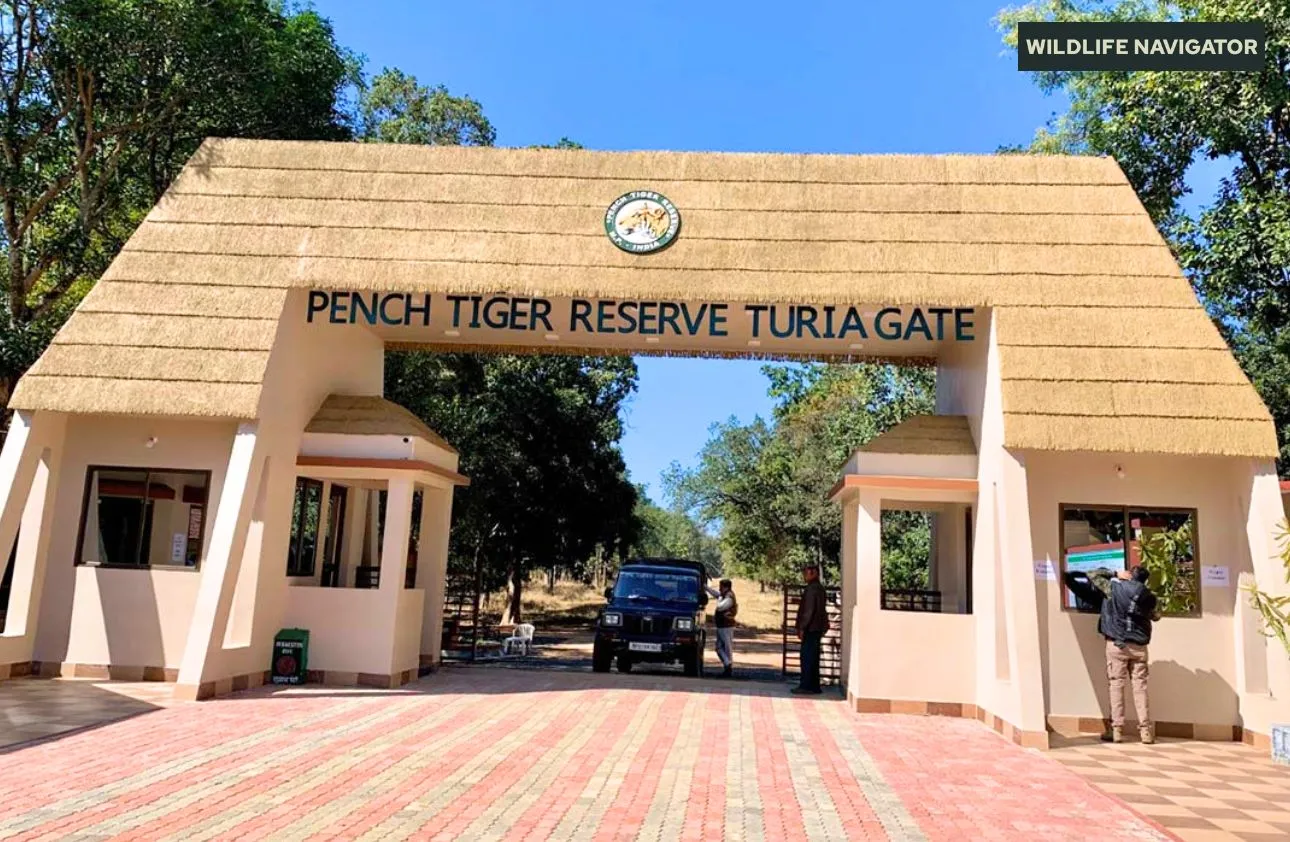
- Turia Gate (Madhya Pradesh): The most frequented entry point, located close to Nagpur. Offers high chances of tiger sightings.
- Karmajhiri Gate: Quieter and less crowded, ideal for birdwatchers and those seeking a more serene jungle experience.
- Jhamtara Gate: Known for its rustic charm and unique safari routes.
- Rukhad, Sillari & Khursapar Gates (Maharashtra side): Equally rich in wildlife, often less crowded than the Madhya Pradesh side.
Each zone offers different landscapes—riversides, bamboo forests, open meadows—ensuring no two safaris feel the same.
Best Time for Safari
- Early Morning (Sunrise Safaris): The jungle is alive with fresh activity. Predators are often spotted returning from hunts, and birds fill the forest with calls.
- Late Afternoon (Sunset Safaris): Animals emerge to waterholes, making this another great time for sightings.
- Summer (March–June): Excellent visibility as animals gather around water sources.
- Winter (November–February): Comfortable weather, lush scenery, and high bird activity.
Safari Timings
- Morning Safari: Usually starts at sunrise (around 5:30–6:00 AM, depending on the season) and lasts 3–4 hours.
- Afternoon Safari: Begins around 2:30–3:00 PM and continues until sunset.
- Night Safari (buffer zones): Conducted between 6:30 PM and 9:30 PM.
Safari Experience Highlights
- Watching a tiger padding silently along a forest track.
- Seeing wild dogs hunt in coordinated packs.
- Spotting colourful birds like the Indian roller against a golden sunrise.
- Crossing the Pench River in a jeep, surrounded by the sounds of the forest.
Pro Tips for Visitors
- Book early: Safari permits are limited and sell out fast, especially in peak seasons.
- Carry essentials: Binoculars, a camera, water, and a hat are must-haves.
- Stay quiet: Silence increases your chances of spotting elusive animals.
- Hire a naturalist: Guides with sharp eyes and deep knowledge can make your safari far more rewarding.
In Pench, every safari feels different—sometimes filled with thrilling big-cat sightings, other times showcasing the subtle beauty of deer herds, playful langurs, or vibrant birdlife. That unpredictability is what makes Pench’s safari experience so addictive.
Best Time to Visit Pench National Park
The beauty of Pench National Park lies in its seasonal transformations. Each time of year offers a different jungle experience—lush greenery during monsoons, pleasant weather in winters, and thrilling animal sightings in the dry summers. Deciding when to visit depends on what kind of experience you’re looking for.
Summer (March – June)
- Highlights:
- The best season for tiger and predator sightings as animals are drawn to waterholes and the Pench River.
- Visibility is excellent as teak trees shed their leaves, making the forest more open.
- Weather: Hot, with temperatures often reaching 40°C, but safaris are rewarding for serious wildlife enthusiasts and photographers.
- Tip: Carry light cotton clothing, hats, sunscreen, and plenty of water.
Monsoon (July – September)
- Highlights:
- The forest transforms into a lush green paradise, with streams gushing and wildflowers blooming.
- Great for experiencing the park’s scenic beauty and rich plant life.
- Weather: Heavy rainfall, humid conditions.
- Note: The core zones remain closed during monsoon (July 1 to mid-October) to allow the forest to rejuvenate, but some buffer zones may stay open for safaris.
Winter (October – February)
- Highlights:
- The most popular tourist season. The weather is cool and comfortable, making safaris very enjoyable.
- Migratory birds arrive, making it a paradise for birdwatchers.
- The jungle atmosphere is magical with misty mornings and golden light.
- Weather: Day temperatures range from 10°C to 25°C, nights can get chilly.
- Tip: Carry light woollens for early morning and evening safaris.
Ideal Months for Travel
- November to February: Best for families, birdwatchers, and general tourists.
- March to May: Best for wildlife photographers and tiger enthusiasts.
Park Timings
- Open Season: Mid-October to June.
- Closed Season: July to mid-October (monsoon).
Whether you prefer the lush romance of monsoon, the comfortable winters, or the raw thrill of summer sightings, Pench has something unique to offer in every season.
How to Reach Pench National Park
Thanks to its central location on the Madhya Pradesh–Maharashtra border, Pench National Park is easily accessible by air, train, and road. This makes it one of the most convenient wildlife destinations for travellers from across India.
By Air
The nearest airport is:
- Dr. Babasaheb Ambedkar International Airport, Nagpur (90 km / 2 hours) – Well connected to major Indian cities like Delhi, Mumbai, Bangalore, Kolkata, and Hyderabad.
- Jabalpur Airport (200 km / 4–5 hours) – Another option, though less frequently used compared to Nagpur.
From the airport, taxis and private cabs are readily available to reach Pench’s main entry gates (Turia being the closest from Nagpur).
By Train
The nearest railway stations are:
- Nagpur Junction (90 km) – A major rail hub with trains from almost every metro city.
- Seoni (30 km) – Closer but smaller station, with limited train options.
- Jabalpur (200 km) – Useful if you’re combining Pench with Kanha or Bandhavgarh safaris.
From these stations, travellers can hire taxis or use buses to reach the park gates.
By Road
Pench is well-connected by national highways, making it a great option for road trips.
- From Nagpur: Approx. 90 km via NH 44 (smooth drive of 2–2.5 hours).
- From Jabalpur: Approx. 200 km (4–5 hours).
- From Bhopal: Approx. 350 km (7–8 hours).
- From Kanha National Park: Around 180 km (4–5 hours), making it easy to combine both parks in one trip.
Nearest Safari Entry Gates
- Turia Gate (Madhya Pradesh): Closest to Nagpur, most popular entry point.
- Karmajhiri Gate (Madhya Pradesh): Quieter alternative for those seeking less touristy routes.
- Sillari & Khursapar Gates (Maharashtra side): Ideal for visitors coming from Nagpur.
Travel Tip
- Most travellers prefer Nagpur as the base city due to its proximity, flight connectivity, and availability of hotels.
- Hiring a pre-booked cab is highly recommended, as public transport near the forest gates is limited.
Accommodation in and around Pench
One of the highlights of visiting Pench National Park is the range of accommodation options available, catering to every type of traveller—from luxury seekers to budget backpackers. Whether you want to experience the jungle in style at an eco-luxury lodge or stay close to nature in a rustic forest guesthouse, Pench has something for everyone.
Luxury Resorts & Jungle Lodges
For those seeking comfort without compromising on the wilderness experience, Pench has some of India’s finest jungle resorts. These stays often come with private cottages, swimming pools, curated wildlife experiences, and guided safaris.
- Pench Jungle Camp – Popular luxury lodge near Turia Gate, offering eco-friendly cottages and tents.
- Taj Baghvan (Taj Safari Lodge) – A world-class property by Taj Hotels, blending luxury with wilderness.
- Tathastu Resort – Known for themed cottages, tree houses, and unique jungle stays.
- Banyan Tree Camp – A boutique resort with personalised experiences.
Mid-Range Resorts & Hotels
Ideal for families and groups who want comfort at reasonable prices.
- Village Machaan Resort – Cottage-style accommodation with jungle views.
- Olive Resort Pench – Stylish and budget-friendly, located close to Turia Gate.
- Tiger N Woods Resort – Unique wooden cottages, popular among couples and nature enthusiasts.
Budget-Friendly Stays & Guesthouses
For backpackers and budget travellers, several lodges and homestays near the park gates provide basic but comfortable facilities.
- Local guesthouses in Turia village and Sillari range offer affordable stays.
- Dormitory-style options and small family-run lodges are also available for solo travellers.
Forest Rest Houses
The Madhya Pradesh Forest Department operates guesthouses at select entry gates like Karmajhiri. These are perfect for travellers who want a no-frills, authentic forest experience. Booking is required well in advance through the forest department.
Where to Stay – Gate-Wise Recommendations
- Turia Gate (Madhya Pradesh side): Best choice for luxury and mid-range stays.
- Karmajhiri Gate: Quieter stays, more rustic, ideal for nature lovers.
- Sillari & Khursapar Gates (Maharashtra side): Smaller number of resorts, perfect for those who want fewer crowds.
Travel Tip
- Always book accommodation in advance, especially during peak season (October–June).
- Many resorts also assist in booking safari permits, so it’s wise to choose a stay that provides complete packages.
From luxury to budget, Pench ensures that every traveller finds the right place to stay while being close to the jungle’s heartbeat.
Travel Tips for Visiting Pench National Park
A trip to Pench National Park is always rewarding, but with the right preparation, you can make it even more memorable and hassle-free. Here are some essential tips to keep in mind:
Safari & Permits
- Book Early: Safari permits are limited and sell out weeks in advance, especially for popular gates like Turia. Book online through the official Madhya Pradesh Forest Department website.
- Carry ID Proof: A government-issued ID (like Aadhaar, Passport, or Driving License) is mandatory for entry.
- Choose the Right Zone: Turia Gate is most popular, but zones like Karmajhiri or Sillari offer quieter experiences.
Entry Fees & Timings
- Entry fees vary by gate and type of safari (jeep or canter).
- Morning safaris begin at sunrise, while afternoon safaris end by sunset. Night safaris are available only in buffer zones.
- Always arrive at the gate at least 30–45 minutes early to avoid delays.
What to Pack
- Clothing: Light cottons in summer, warm layers in winter. Neutral colours (green, brown, beige) are best for blending with the jungle. Avoid bright colours.
- Footwear: Comfortable closed shoes for walking around the resort or on nature trails.
- Essentials: Sunscreen, sunglasses, a hat/cap, insect repellent, and a reusable water bottle.
- Gear: Binoculars and cameras are must-haves for wildlife enthusiasts.
Health & Safety
- Pench is malaria-prone during monsoons; consult your doctor about precautions.
- Follow the guide’s instructions strictly during safaris.
- Do not feed animals, step out of vehicles, or litter inside the park.
Responsible Tourism
- Respect the jungle—keep noise to a minimum and maintain distance from wildlife.
- Support eco-friendly lodges and local communities by purchasing local handicrafts or hiring local naturalists.
- Avoid plastic bottles and single-use items as much as possible.
Other Helpful Tips
- Mobile networks may be weak near the gates—download offline maps.
- Carry cash, as some smaller resorts or shops may not accept digital payments.
- Combine Pench with nearby parks like Kanha, Satpura, or Tadoba for a richer wildlife itinerary.
With these tips, your Pench safari will not only be smooth and enjoyable but also contribute to the conservation of this magnificent ecosystem.
Conclusion
A journey into Pench National Park is more than just a wildlife safari—it’s a step into the heart of nature where history, literature, and conservation meet. From the legendary tales of The Jungle Book to real-life tiger sightings, Pench offers experiences that linger long after the trip is over.
Whether you’re an avid wildlife photographer chasing the perfect tiger shot, a family looking for a peaceful jungle getaway, or a nature lover seeking the melody of birds and rustling leaves, Pench has something special for everyone. With its rich flora, diverse fauna, well-connected location, and range of accommodations, it stands as one of India’s most rewarding national parks.