Asiatic Lion: The King of Gir Forest | History, Facts & Travel Guide

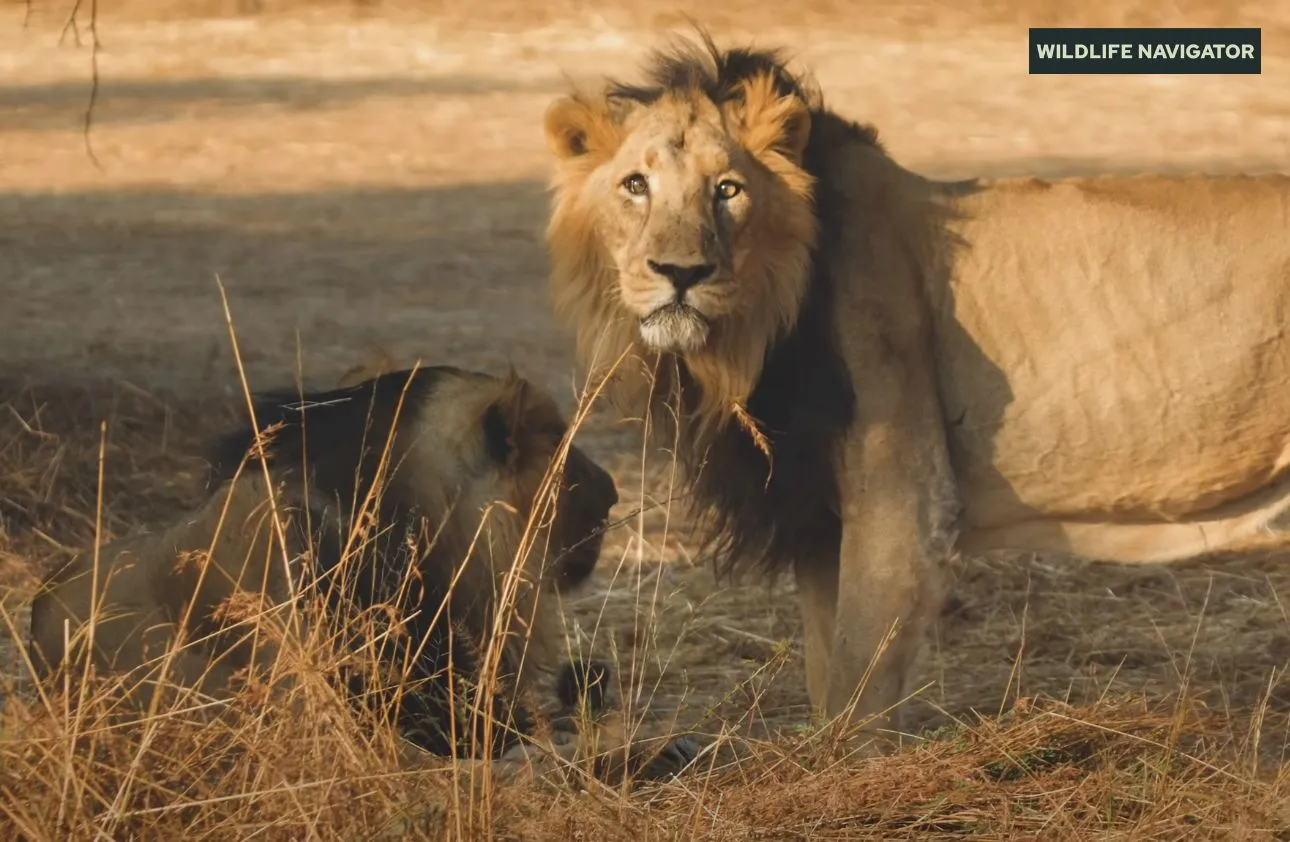
The Asiatic Lion (Panthera leo persica), also known as the Indian Lion or Persian Lion, is one of the most majestic and endangered big cats on Earth. Once roaming freely across Asia, the Middle East, and even parts of Europe, today this subspecies survives only in the Gir Forest of Gujarat, India. This makes the Asiatic lion not just a symbol of India’s wildlife heritage but also a living reminder of what strong conservation efforts can achieve.
Unlike its African cousin, the Asiatic lion has a more modest appearance, with a shorter mane, a distinctive fold of skin along its belly, and a slightly smaller body. But what it lacks in size, it makes up for in history, culture, and resilience. Revered since ancient times as a symbol of power and courage, lions appear in Indian mythology, coins of ancient rulers, and even the national emblem of India – the Lion Capital of Ashoka.
Today, around 600–700 Asiatic lions live in the wild, restricted entirely to Gujarat. Their survival story is one of the most inspiring chapters in modern conservation, as they were once reduced to fewer than 20 individuals in the early 20th century. Thanks to strict protection, community awareness, and government initiatives, the Asiatic lion has staged a remarkable comeback.
For travellers, the opportunity to witness the last wild lions outside Africa is a once-in-a-lifetime experience. Whether it’s the deep roar echoing through Gir’s teak forests at night or the sight of a pride basking under the Indian sun, encountering the Asiatic lion is nothing short of magical.
History & Evolution of Asiatic Lions
The Asiatic Lion (Panthera leo persica) is a subspecies of the lion, belonging to the Felidae family. Its close relatives include the African Lion (Panthera leo leo) and other extinct subspecies that once roamed across Europe and Asia. Lions, in general, are believed to have originated in Africa around 2 million years ago, before spreading to Asia and Europe during the Pleistocene epoch.
Taxonomy & Classification
- Kingdom: Animalia
- Phylum: Chordata
- Class: Mammalia
- Order: Carnivora
- Family: Felidae
- Genus: Panthera
- Species: Panthera leo
- Subspecies: Panthera leo persica (Asiatic Lion)
The Asiatic lion shares the same species (Panthera leo) as the African lion, but is recognised as a distinct subspecies due to morphological differences, genetic studies, and geographical isolation.
Evolutionary History
In ancient times, lions were the most widespread large carnivores on Earth, ranging across Africa, Europe, the Middle East, and Asia. Fossil evidence suggests that lions were once present as far west as Spain and as far east as India. Over time, climate changes, human expansion, and hunting led to the fragmentation of populations.
The Asiatic lion’s ancestors once roamed across Greece, Iran, Iraq, Afghanistan, Pakistan, and India. Historical records, including Persian art, Mughal miniatures, and even Biblical references, mention lions across Asia. In India, lions were widespread across the northern, central, and western regions until the 19th century, when hunting by Mughal emperors, colonial rulers, and local kings drastically reduced their numbers.
Near Extinction & Survival
By the late 1800s, the Asiatic lion was already facing near extinction. Trophy hunting by royalty had decimated populations, and lions were seen as prestigious kills. The turning point came when Nawab Rasulkhanji of Junagadh, a princely ruler in Gujarat, recognised the alarming decline and declared Gir Forest a protected sanctuary in the early 20th century.
At that time, fewer than 20 lions remained. Conservation efforts since then have slowly revived the species, with the current wild population now crossing 600 individuals. This makes the Asiatic lion not only a conservation success story but also one of the most carefully monitored big cats in the world.
Cultural & Historical Significance
- In Indian mythology, lions are linked with Goddess Durga, who rides a lion as a symbol of power.
- The Lion Capital of Ashoka (four lions seated back-to-back) was adopted as India’s national emblem in 1950.
- Ancient empires such as the Mauryas, Guptas, and Mughals celebrated lions in their architecture, coins, and art, signifying royal strength.
The Asiatic lion is more than just a species—it’s a living heritage of India’s history, connecting the past with the present through culture, mythology, and conservation.
Physical Characteristics of the Asiatic Lion
The Asiatic Lion (Panthera leo persica) may share a common ancestor with its African cousin, but it has several unique features that set it apart. Slightly smaller, less flamboyant in appearance, yet equally majestic, the Asiatic lion is perfectly adapted to the dry forests and scrublands of western India.
General Appearance
- Body Size: Male Asiatic lions typically weigh between 160–190 kg, while females weigh around 110–120 kg. This makes them a little smaller than African lions, which can exceed 200 kg.
- Length: Adult males measure 2.75–2.95 meters from head to tail, while females measure slightly less.
- Height: They stand around 110–120 cm at the shoulder.
Distinctive Features
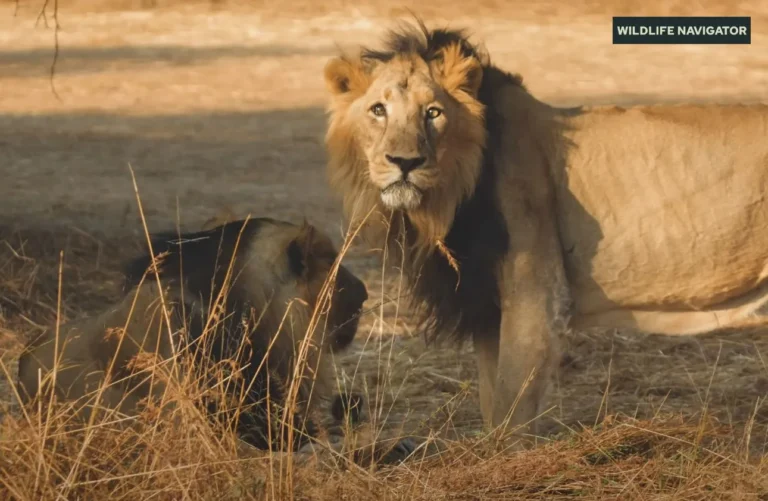
- Mane: Male Asiatic lions have a shorter and thinner mane compared to African lions, leaving their ears often visible. This gives them a less imposing, but more rugged look.
- Belly Fold: A distinctive long fold of skin along the belly is a hallmark of Asiatic lions, absent in African lions.
- Tufted Tail: Like all lions, they have a tuft of dark fur at the tail tip, which hides a small spine-like structure.
- Face & Skull: Asiatic lions have a narrower face and slightly smaller skull compared to African lions.
- Roar: Their roar can travel up to 8 km, used to mark territory and communicate with the pride.
Coat & Color
- Their coat is pale buff to sandy brown, which camouflages well in Gir’s dry deciduous forest and scrubland.
- Cubs are born with spots, which fade as they grow.
Lifespan
- In the wild: 14–16 years
- In captivity: Up to 20 years
Asiatic Lion vs. African Lion: A Comparison
| Feature | Asiatic Lion (Panthera leo persica) | African Lion (Panthera leo leo) |
|---|---|---|
| Size | Males: 160–190 kg Females: 110–120 kg | Males: 180–230 kg Females: 120–150 kg |
| Mane | Short, sparse, ears visible | Large, bushy, often covers ears |
| Belly Fold | Prominent skin fold present | Absent |
| Distribution | Only in Gir Forest, Gujarat, India | Widely across sub-Saharan Africa |
| Face Shape | Narrower face, smaller skull | Broader face, larger skull |
| Population | ~600–700 (endangered) | ~20,000 (vulnerable) |
| Roar | Travels up to 8 km | Travels up to 10 km |
| Social Groups | Smaller prides (2–5 females) | Larger prides (5–12 females) |
The Asiatic lion may be less flamboyant than its African counterpart, but its rarity, resilience, and cultural significance make it one of the most remarkable big cats on Earth.
Habitat & Distribution of the Asiatic Lion
Historical Range
The Asiatic Lion (Panthera leo persica) once had one of the widest distributions of any land mammal. Thousands of years ago, they roamed from:
- Greece and the Balkans in Europe,
- Across the Middle East (Turkey, Iran, Iraq, Israel, and Syria),
- Through Afghanistan and Pakistan,
- All the way to India and Bangladesh.
They were depicted in ancient Persian and Mesopotamian art, celebrated in Indian mythology, and even mentioned in Greek writings by Herodotus and Aristotle. However, over centuries, habitat loss, expansion of agriculture, and uncontrolled hunting caused their range to shrink drastically.
By the late 19th century, the Asiatic lion was wiped out from everywhere except India.
Present-Day Distribution
Today, the only surviving population of Asiatic lions exists in and around the Gir Forest National Park and Wildlife Sanctuary in Gujarat, India.
- Core Area: Gir National Park (about 258 sq km)
- Greater Gir Protected Area: ~1,400 sq km including Gir Sanctuary, Girnar Sanctuary, Pania Sanctuary, and Mitiyala Sanctuary.
- Outside Protected Areas: Some lions also roam beyond Gir, spreading into nearby villages, coastal belts, and agricultural fields of Amreli, Bhavnagar, and Junagadh districts.
This makes the Asiatic lion one of the most restricted-range large carnivores in the world — a whole subspecies surviving in just one corner of the Earth.
Habitat Type
Gir’s ecosystem is a tropical dry deciduous forest mixed with savannah grasslands and thorny scrub. It is perfectly suited for lions because of:
- Vegetation: Teak, acacia, jamun, dhak, and flame-of-the-forest trees provide cover.
- Water Sources: Seasonal rivers, dams, and man-made waterholes sustain wildlife through dry months.
- Prey Base: Abundant herbivores such as chital (spotted deer), sambar deer, nilgai (blue bull), chinkara, wild boar, and domestic cattle.
Interestingly, unlike African lions that depend mainly on wild prey, Asiatic lions also occasionally prey on livestock. This often leads to human-lion conflict, but compensation schemes by the Gujarat government help reduce hostility.
Population Distribution
According to the 2020 census by the Gujarat Forest Department:
- 674 Asiatic lions live in the wild.
- Out of these, around 400 are inside Gir Forest, while 250+ roam outside in surrounding areas.
This expansion outside protected areas shows healthy population growth, but also increases risks of vehicle collisions, open well accidents, and human conflict.
Why Is Their Distribution Important?
- Being confined to a single location makes the species highly vulnerable to disease outbreaks or natural disasters (like floods, fires, or epidemics).
- Scientists have recommended creating a second home for Asiatic lions in Kuno National Park, Madhya Pradesh, but the project has faced delays.
- Conservationists stress the need for genetic diversity and dispersal, as inbreeding could weaken the population over generations.
The story of the Asiatic lion’s distribution is both a triumph and a warning — while their survival in Gir is a remarkable conservation success, their confinement to one pocket of India poses serious long-term challenges.
Behaviour & Social Structure of the Asiatic Lion
The Asiatic Lion (Panthera leo persica) may share its ancestry with African lions, but its lifestyle and behaviour show some fascinating differences. Living in the relatively smaller forests of Gujarat, rather than the vast savannahs of Africa, the Asiatic lion has adapted its social structure, hunting techniques, and territorial behaviour to suit its environment.
Pride System
- Unlike African lions, which form large prides (10–15 members), Asiatic lions usually live in smaller groups of 2–5 females with their cubs.
- Males often form coalitions of 2–3 brothers, who collectively defend a territory.
- Male and female groups are more loosely associated compared to African lions — they usually come together only for mating or sharing kills.
This difference is largely due to the scarcity of prey in Gir Forest compared to Africa’s open grasslands, which makes it harder to sustain large groups.
Territorial Behavior
- A male coalition typically controls a territory of 100–150 sq km, which may overlap with several female ranges.
- Territories are marked with urine spraying, roaring, and scratch marks on trees.
- Males are extremely protective — intruding males often fight fiercely for dominance, with roaring contests and physical clashes.
Hunting Techniques & Diet
- Asiatic lions are nocturnal hunters, most active during dusk and dawn.
- They hunt cooperatively, with lionesses doing most of the hunting while males patrol and defend territory.
- Prey mainly includes:
- Chital (spotted deer)
- Sambar deer
- Nilgai (blue bull)
- Wild boar
- Occasionally, domestic cattle
Because Gir Forest has denser vegetation than African savannahs, Asiatic lions rely more on ambush techniques, stalking prey through cover rather than open chase.
Male vs. Female Roles
- Females: Hunt for food, raise cubs, and maintain smaller pride units.
- Males: Defend territory, protect cubs from rival males, and feed after females secure a kill.
- Cubs are dependent on their mothers for the first 18–24 months, after which young males often leave to form new coalitions.
Communication
Asiatic lions use a variety of vocal and physical signals:
- Roaring: Can be heard up to 8 km, used to declare territory and communicate with pride members.
- Chuffing & Grunting: Softer sounds for communication between individuals.
- Scent Marking & Scratching: Reinforce territorial boundaries.
Daily Habits
Like most big cats, Asiatic lions are lethargic during the day, spending up to 20 hours resting. They prefer to lounge under shady trees, riverbeds, or rocky outcrops, conserving energy for night hunts.
Social Adaptations
The smaller group size of Asiatic lions makes them:
- More flexible in adapting to Gir’s patchy habitats.
- Less dependent on group hunting, compared to African lions that often hunt in large teams.
- Better survivors in fragmented landscapes, but also more vulnerable to threats, since fewer lions are around to defend cubs from rivals or other predators.
The social elegance of the Asiatic lion lies in this delicate balance — tight family bonds among females, strong territorial instincts among males, and a hunting style perfectly tuned to the forests of Gujarat.
Conservation Efforts & Success Stories
The survival of the Asiatic Lion (Panthera leo persica) is one of the greatest wildlife conservation success stories in the world. Once on the brink of extinction, reduced to fewer than 20 individuals in the early 20th century, the lion has made a remarkable comeback thanks to a century of protection, community involvement, and government initiatives.
The Turning Point – Nawab of Junagadh
In the late 1800s, the Asiatic lion was almost hunted to extinction. Royal hunts, or shikar, were popular among Indian kings and British officers. Lions were prized trophies, and hunting was carried out on a massive scale.
The situation became so dire that by 1890–1900, only a handful of lions remained in the Gir Forest of Gujarat. At this critical moment, Nawab Rasulkhanji of Junagadh, a local ruler, recognised the urgent need for protection. He banned lion hunting in his princely state and declared Gir Forest a protected area.
This visionary decision saved the Asiatic lion from vanishing forever.
Independent India & Lion Protection
After independence in 1947, the Government of India continued conservation efforts. Gir was officially declared a Wildlife Sanctuary in 1965, and later, Gir National Park in 1975. Strict anti-poaching laws, habitat protection, and compensation for cattle kills helped reduce human-lion conflict.
The Gujarat Forest Department introduced:
- Round-the-clock patrolling to prevent poaching.
- Waterholes and artificial feeding programs during droughts.
- Rescue centers for injured or displaced lions.
Thanks to these efforts, the lion population began to recover steadily.
Project Lion – India’s Commitment
In August 2020, the Prime Minister of India announced Project Lion, modeled after the success of Project Tiger. The project focuses on:
- Habitat expansion: Protecting and restoring lion habitats beyond Gir.
- Disease control: Preventing epidemics like Canine Distemper Virus (CDV), which once killed lions in Serengeti.
- Relocation: Preparing new safe zones (such as Kuno National Park, Madhya Pradesh) to establish a second population.
- Community involvement: Engaging local Maldhari pastoral communities in coexistence strategies.
Success in Numbers
- 1900: < 20 lions left in Gir.
- 2010: ~ 400 lions.
- 2020 Census: 674 lions (spread across Gir, Girnar, Amreli, Bhavnagar, and Junagadh).
- 2025 (estimates): Numbers continue to rise, with lions even seen wandering into coastal areas and villages.
This growth is proof that long-term protection and community participation can reverse the fate of even critically endangered species.
Recognition & Global Significance
- The Asiatic lion is listed as Endangered on the IUCN Red List.
- It is protected under Schedule I of the Wildlife Protection Act, 1972 in India.
- Conservationists worldwide see it as a model example of how strong laws and local support can bring a species back from the edge of extinction.
Community Involvement – The Maldharis
The Maldharis, a pastoral community living inside Gir, share a unique bond with lions. For generations, they have coexisted with these big cats, grazing livestock in the same forests where lions roam. While livestock predation does occur, the Gujarat government provides compensation schemes to ensure harmony. Many Maldharis now work as guides, trackers, and protectors of lions, making them crucial allies in conservation.
Conservation Beyond Gir
While Gir remains the stronghold of Asiatic lions, their increasing numbers have pushed them into new areas — agricultural fields, villages, and even coastal belts. This expansion shows success, but also highlights the urgent need for a second population in case of disease outbreaks or natural disasters.
The Asiatic lion’s recovery is nothing short of extraordinary — from the shadows of extinction to a thriving symbol of Indian wildlife pride. Yet, its story also reminds us that conservation is a continuous effort, and the journey is far from over.
Threats & Challenges
While the Asiatic Lion (Panthera leo persica) is often hailed as a conservation success story, its survival remains fragile. With a single isolated population in and around Gir Forest, the lions face several serious threats that could undo a century of conservation if not addressed carefully.
1. Habitat Fragmentation & Human Expansion
- Gir and its surrounding sanctuaries are home to the entire global population of Asiatic lions, but expanding human settlements, roads, railways, and farms are eating into their natural range.
- Lions are increasingly seen wandering into villages, highways, and coastal regions, raising the risk of vehicle collisions, electrocution from power lines, and accidental falls into open wells.
- As agriculture expands, core forest areas shrink, forcing lions into human-dominated landscapes.
2. Human-Lion Conflict
- Asiatic lions often prey on livestock, as cattle and buffalo graze in and around Gir. This leads to economic losses for local herders.
- Though the Gujarat government provides compensation schemes, resentment can still build among communities.
- Occasionally, lions enter villages, leading to panic, injuries, or rare human fatalities. Such encounters can cause retaliation against lions.
3. Risk of Epidemics & Small Gene Pool
- One of the biggest dangers to Asiatic lions is their limited genetic diversity. With fewer than 20 ancestors surviving in 1900, today’s population is highly inbred.
- This lack of genetic variation makes them vulnerable to disease outbreaks.
- A stark reminder comes from Africa: in the 1990s, over 1,000 lions in Serengeti were killed by Canine Distemper Virus (CDV). If such a disease spreads in Gir, it could wipe out the entire population.
4. Natural Disasters
- Since all lions live in one region, a flood, forest fire, prolonged drought, or cyclone could cause catastrophic losses.
- Gujarat’s proximity to the coast makes lions particularly vulnerable to cyclones, which are becoming more frequent due to climate change.
5. Poaching & Illegal Trade
- Though poaching has drastically reduced, it still poses a potential threat. Lions are targeted for their bones, skin, and body parts, which feed illegal wildlife trade networks in Asia.
- With increasing demand in black markets, continued vigilance and enforcement are crucial.
6. Political & Legal Delays in Relocation
- For decades, wildlife experts have pushed for establishing a second wild population of Asiatic lions outside Gujarat.
- Kuno National Park in Madhya Pradesh has been prepared for lion relocation since the 1990s, but political disputes between states have stalled the project.
- Until this happens, the entire species remains dependent on one habitat, a dangerous gamble for long-term survival.
7. Climate Change Pressures
- Rising temperatures and changing rainfall patterns affect prey availability and water resources in Gir.
- As herbivore populations fluctuate, lions may face food shortages, pushing them further into human areas.
The Conservation Dilemma
The Asiatic lion’s recovery is remarkable, but its concentration in a single location is its greatest weakness. Without habitat expansion, disease management, and relocation to new regions, the species could face another crisis in the future.
In the words of many conservationists:
“We have saved the Asiatic lion once. Now we must secure its future.”
Asiatic Lion vs. African Lion
While the Asiatic Lion (Panthera leo persica) and the African Lion (Panthera leo leo) share a common species, centuries of separation and adaptation to different environments have given them unique traits.
Physical Differences
- Size: African lions are larger and bulkier; Asiatic lions are slightly smaller and lighter.
- Mane: African males boast large, bushy manes; Asiatic males have shorter, sparser manes, with ears often visible.
- Belly Fold: A distinct skin fold along the belly is unique to Asiatic lions.
- Face: Asiatic lions have a narrower face and less developed mane hair around the head.
Social Structure
- Asiatic Lions: Smaller prides (2–5 females), less cohesion between males and females.
- African Lions: Larger prides (10–15 members), stronger group bonds.
Habitat & Range
- Asiatic: Dry deciduous forests, scrublands, and grasslands of western India; confined to Gir Forest and nearby regions.
- African: Open savannahs, grasslands, and some woodlands across sub-Saharan Africa.
Hunting & Diet
- Asiatic: Rely on ambush hunting in dense forests; prey includes deer, antelopes, wild boar, and livestock.
- African: Use cooperative hunts in open plains; prey includes zebras, wildebeest, buffalo, and giraffes.
Population & Status
- Asiatic: ~674 individuals (endangered).
- African: ~20,000 individuals (vulnerable but more widespread).
Behavior
- Asiatic lions are slightly more reclusive due to denser habitats and a smaller prey base.
- African lions are more visible and social, often spotted in larger groups in open landscapes.
In short, while African lions represent strength in numbers and vast wilderness, the Asiatic lion symbolises resilience and survival in isolation.
9. Best Places to See Asiatic Lions in India
If you dream of witnessing the last wild lions outside Africa, Gujarat is the only place in the world to do so.
1. Gir National Park & Wildlife Sanctuary
- Gir National Park is the heartland of the Asiatic lion, covering 1,412 sq km of core and buffer zones.
- Offers Jeep Safari Tours with trained guides for early morning and evening sightings.
- Best time to visit: December to March (pleasant weather, high chance of sightings).
2. Devaliya Safari Park (Gir Interpretation Zone)
- A fenced-off area near Gir that provides a controlled safari experience.
- Perfect for tourists with limited time who want a guaranteed lion sighting.
3. Girnar Wildlife Sanctuary
- Located near Junagadh, it is part of the greater Gir landscape.
- Lesser-known, but lions frequently roam here.
4. Coastal Belts of Gujarat
- Lions have recently expanded into coastal forests near Pipavav and Bhavnagar.
- Unique chance to see lions against the backdrop of beaches and fishing villages.
Safari Tips for Travellers
- Book safaris well in advance through the official Gujarat Forest Department portal.
- Choose early morning safaris for the best chance to spot lions on the move.
- Carry binoculars, a good camera, and light cotton clothes for comfort.
- Respect wildlife — never get out of vehicles or provoke lions for photos.
A lion safari in Gir is not just about spotting a predator — it’s about experiencing the thrill of India’s last lion kingdom.
Future of the Asiatic Lion
The Asiatic lion’s story is both a symbol of hope and a warning. From near extinction to recovery, its future now depends on wise conservation strategies.
Relocation Plans – The Kuno Debate
- For decades, experts have pushed for moving a second lion population to Kuno National Park, Madhya Pradesh.
- This would safeguard against epidemics and disasters.
- However, political resistance from Gujarat has stalled the project, leaving all lions concentrated in one state.
Genetic Health & Breeding Programs
- Conservationists stress the need to increase genetic diversity.
- Breeding programs in zoos (both in India and abroad) play a role in ensuring a healthy backup population.
Role of Communities & Eco-Tourism
- Locals, especially Maldharis, will remain key partners in protecting lions.
- Responsible eco-tourism brings income to communities, making lions valuable beyond their symbolic power.
Climate Change Preparedness
- Rising temperatures, droughts, and cyclones pose new threats.
- Long-term plans must include habitat corridors, water conservation, and forest restoration.
Global Importance
The Asiatic lion is the only surviving lion outside Africa. Protecting it is not just an Indian responsibility but a global conservation priority. Its survival proves that endangered species can recover with consistent protection.
Conclusion: The Eternal King of Gir
The Asiatic Lion is more than just a big cat — it is a living legend of India, a reminder of our cultural heritage, and a symbol of resilience. From the brink of extinction to a thriving population, its journey inspires conservationists worldwide.
Yet, its future hangs in a delicate balance. With all lions confined to a single region, the species remains vulnerable to nature’s unpredictability. The challenge now is to ensure that this last population of wild Asiatic lions not only survives but thrives for generations to come.
For travellers, a visit to Gir is not just a safari; it’s an opportunity to witness history, culture, and conservation come alive in the roar of the last surviving lions of Asia.